After listening to the businesspeople, Prime Minister Shah had also asked for suggestions regarding possible solutions to the problems.
We use Google Cloud Translation Services. Google requires we provide the following disclaimer relating to use of this service:
This service may contain translations powered by Google. Google disclaims all warranties related to the translations, expressed or implied, including any warranties of accuracy, reliability, and any implied warranties of merchantability, fitness for a particular purpose, and noninfringement.
Prime Minister Balendra Shah met with construction entrepreneurs on Thursday. Prime Minister Shah is committed to addressing practical problems and implementing policy reforms to ensure projects are completed on time. During the meeting, construction entrepreneurs raised policy and practical issues. After listening to the entrepreneurs, Prime Minister Shah also sought suggestions on possible solutions to the problems.
After one hundred days of leading the government, Prime Minister Shah has begun meeting with some diplomats and representatives from the private sector. The meeting was attended by President of the Federation of Contractors’ Associations of Nepal, Nikolas Pandey; Senior Vice President Mukesh Pant; General Secretary Shivahari Ghimire; Vice President of the Federation Bagmati, Bal Krishna Thapa; and former President and advisor Jayaram Lamichhane.
There was a discussion on issues in the construction sector, promotion of construction business, and physical infrastructure development, among other topics. Prime Minister Shah stated that the construction sector is a vital foundation for the country’s economic development, job creation, and infrastructure building, and emphasized that the government is positive about resolving the practical problems seen in this sector. He said that to make the construction business dignified, transparent, responsible, and result-oriented, and to complete development works on time, active and effective cooperation from all sides is essential.
President Pandey stated that the discussion with the Prime Minister covered challenges faced by the construction sector, such as payments, deadline extensions, contract management, timely project implementation, price adjustments, and banking and investment-related issues. Pandey said he emphasized the need to make cooperation between the government and the private sector even more effective to keep the construction industry dynamic.
He clarified that the meeting with the Prime Minister did not raise the issue of some ministers’ statements that contractors who do not work should be forced to work by any means necessary. “We did not raise that issue because it had already been discussed with the concerned ministers, and they have already clarified their positions. The Prime Minister has placed great emphasis on maintaining good governance,” he said. “For this, we have suggested that the payment system be made online.”
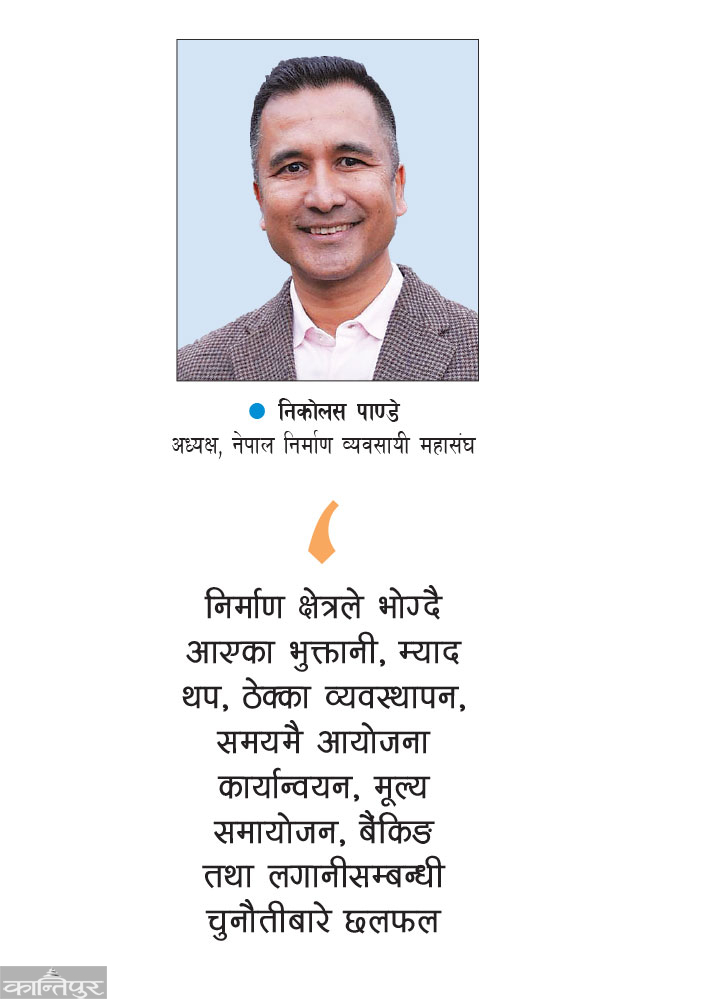 Of the budget allocated by the government, the construction industry, as an industry, accounts for nearly 80 percent of capital expenditure. There has been an unexpected and excessive increase in the prices of construction materials such as fuel and bitumen. Due to disruptions in the supply chain, the construction industry has collapsed, adversely affecting the overall national economy, Pandey said. “Although the government committed in the budget statement to ‘appropriately address the difficulties faced by construction entrepreneurs due to price increases,’ this problem has not been resolved so far,” he said. “In the current difficult situation, without providing relief to construction entrepreneurs, the impractical and irrelevant directives being issued one after another by government agencies have left construction entrepreneurs both financially and mentally distressed.” The Federation has provided an eight-point suggestion to solve the current problems in the infrastructure sector.
Due to the ongoing war in the Middle East, there have been repeated and excessive, unexpected price increases in fuel materials such as diesel and bitumen used in the construction industry, and shortages of construction materials have created an uncontrollable situation, resulting in automatic halts to construction work and making it impossible to complete projects on time. Therefore, the Federation has stated that deadline extensions should be granted as needed.
In the past, projects were selected without study, research, or resource assurance, so the state has no financial resources assured to complete the projects. The Federation argues that such sick and dilapidated contracts, which cannot be completed even after deadline extensions, should be immediately terminated and re-tendered based on contract convenience.
Payments that have been pending because they were not included under budget headings in previous fiscal years, as well as amounts claimed through arbitration, should also be paid. “If a system is established to make monthly payments transparently using the highest level of technology, including timeline payments, construction workers will receive payments on time, and the government will receive about 30 percent revenue, so instructions should be issued accordingly,” President Pandey said. “For construction businesses, essential river-based and mine-based materials should be made easily available by designating extraction areas and providing such materials from local levels after paying the required revenue, the double taxation system should be removed, and the crusher industry should also be regulated.”

