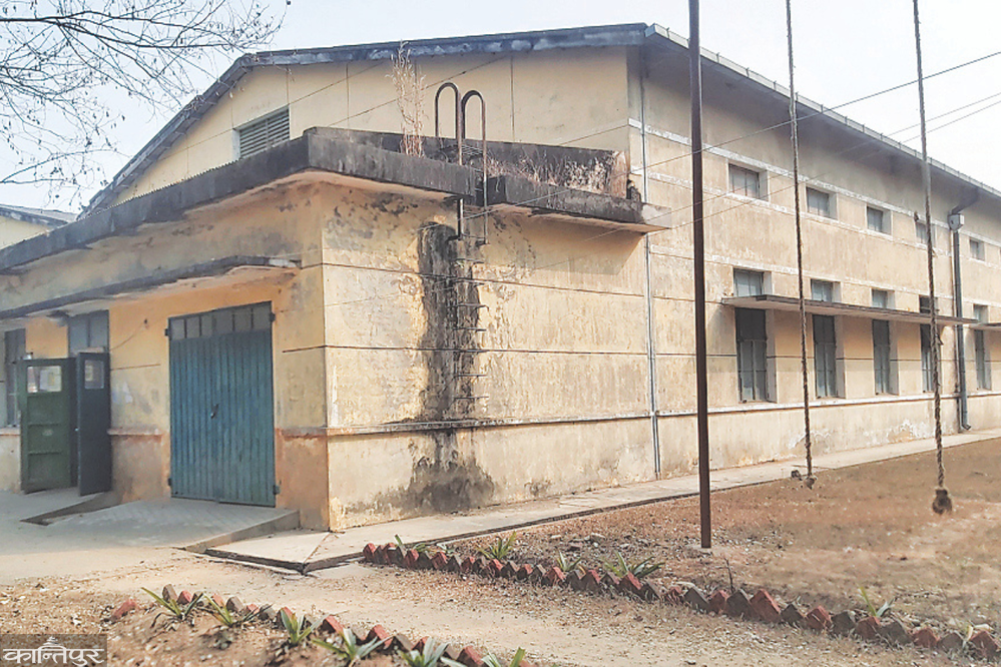
The industry currently owns 166 ropani of land. Businesspeople associated with the Nepal Ready-Made Garment Industry have responded positively to the government's efforts to resume operations of the old industry.
We use Google Cloud Translation Services. Google requires we provide the following disclaimer relating to use of this service:
This service may contain translations powered by Google. Google disclaims all warranties related to the translations, expressed or implied, including any warranties of accuracy, reliability, and any implied warranties of merchantability, fitness for a particular purpose, and noninfringement.
Nearly three decades later, the government has begun preparations to resume operations at the Hetauda Textile Industry. For this purpose, the responsibility for conducting a feasibility study and making preparations has been assigned to the Nepal Army.
The Ministry of Industry, Commerce, and Supplies has stated that preparations are underway to expedite the process of restarting the industry. The government has included the preparation of a study report and ongoing cleaning and maintenance work for the industry in its 100-day progress plan.
Joint Secretary and Spokesperson of the Ministry of Industry, Commerce, and Supplies, Netra Prasad Subedi, said that the budget has already been released as the Nepal Army requested funds for cleaning the industry, inspecting the condition of the machines, and conducting trial production. “Currently, a budget of 3.3 million rupees has been provided for preparations,” he said. “We are moving forward with operating the industry after the Nepal Army, with its resources, studies and assesses the condition of the machines and prepares a report.” At present, preliminary work is being carried out to resume operations at the industry.
“If the old machines work, we will conduct trial production,” he said. “If this is successful, there is a long-term plan to produce uniforms for the three security agencies: the Nepal Army, Armed Police Force, and Nepal Police.” He said that much will be learned once trial production begins. “After trial production, new machines can be brought in and work can be done differently; in the long term, there is also a plan to operate the Butwal Yarn Industry and run the textile industry by cultivating cotton,” he said. “Once uniforms for the three security agencies are produced, we will also begin producing fabric for other possible public agencies.”
In 2008 (2065 BS), during the tenure of then-Finance Minister Baburam Bhattarai, a plan was made to resume operations at the industry. At that time, a plan was put forward to produce the necessary fabric for the army, police, and civil servants domestically. Later, in 2015 (2072 BS), the Nepal Army proposed to the government that it could operate the industry. The subsequent study concluded that with the installation of modern machinery, a guaranteed market, and professional management, it would be possible to resume operations at the industry.
The Hetauda Textile Industry is a government enterprise established in the early phase of Nepal’s industrialization. Established on 16 Saun 2032 BS (late July 1975) with financial and technical assistance from the Chinese government, the industry began commercial production on 10 Mangsir 2035 BS (late November 1978). Later, the industry was completely shut down from 1 Falgun 2056 BS (mid-February 2000).
According to military spokesperson and Assistant Brigadier General Rajaram Basnet, as per the government’s decision, work is underway to conduct a feasibility study and inspect the machines in the industry to determine if they can be operated. “Currently, Nepal Army technicians are preparing a study report on the machines, and the fabric production capacity of the machines is also being assessed,” he said. “We will prepare the report as quickly as possible and submit it to the government.” The industry is often included in the budget, but the work of resuming operations has not gained momentum.
If the old machines work, we will conduct trial production. If this is successful, there is a long-term plan to produce uniforms for the three security agencies: the Nepal Army, Armed Police Force, and Nepal Police. - Netra Prasad Subedi, Joint Secretary and Spokesperson, Ministry of Industry, Commerce, and SuppliesThe industry currently owns 166 ropani of land. Entrepreneurs involved with Nepal Ready-Made Garments Industry have taken the government’s efforts to resume the old industry positively. However, they say that cooperation with the private sector is necessary for long-term success.
President of Garment Association Nepal, Pashupati Dev Pandey, said that the government’s decision to resume the industry is welcome. “It is a good thing to revive ailing industries; it will create jobs and increase industrial activity,” Pandey said. “But to make the industry successful in the long term, it is necessary to make the private sector a partner as well.” He emphasized the need to focus on the production of raw materials along with operating the textile industry. “Plans to produce raw materials such as cotton and animal-based fibers domestically should also move forward simultaneously. Modern technologies that consume less electricity are now available. If such technologies are used, production costs can also be reduced,” he said.
Pandey suggested that, along with raw materials, attention should be paid to market management to replace imports from external markets. “If the goal is to produce tens of millions of meters of fabric annually, it must be ensured where that output will be consumed. Along with government agencies like the army and police, the civilian market should also be expanded,” he said.
At the initial stage of operation, the industry had an annual yarn production capacity of about 2,300 tons. When operated in three shifts, the industry could produce 11 million meters of fabric annually. At that time, the industry made the country self-sufficient in cotton fabric by using domestically produced cotton. When fully operational, the industry provided employment to 1,200 workers.
According to the preliminary study report prepared by the Nepal Army in 2080 BS (2023/24), it is mentioned that machines should be purchased to operate two shifts daily to produce an estimated 2.6 million meters of fabric annually for all security agencies. The preliminary study estimates that a machinery plant costing about 700 million rupees will be required to produce 2.6 million meters of fabric annually. The report states that the industry can produce ready-made uniforms, shirts, pants, bed sheets, quilt covers, aprons, daura-suruwal, and other garments for security agencies.
The report estimates about 250 million rupees will be needed for building repairs, perimeter wall post construction, and maintenance; 50 million for plumbing and industrial pipelines; and 350 million for other works. The preliminary estimate for annual operating expenses, manpower, and other production costs is 780 million rupees. Altogether, the total cost is estimated to be 1.93 billion rupees.
“Currently, we are only conducting a technical study to assess the condition of the industry and its operating costs,” said military spokesperson Basnet. “The army is not operating the industry at this time, only conducting a technical study.”
Why was the industry shut down?
After initial success, the industry gradually fell into trouble. Political influence began to outweigh professional management in its operation. More employees were hired than necessary, production costs could not be controlled, and the technology was not modernized over time.
While cheap and quality fabrics were being produced in the global market with new technology, the Hetauda Textile Industry remained dependent on old machines. Problems with electricity supply, increased maintenance costs, and lack of new investment weakened the industry’s competitiveness.
As cheap fabric from India, China, and other countries began entering Nepal, the production of the government industry became expensive. As administrative costs exceeded production, the industry continued to incur losses. Even though the government tried to operate it with subsidies, improvements could not be achieved. Thus, after operating for about two decades, the industry was completely shut down from 1 Falgun 2056 BS (mid-February 2000).