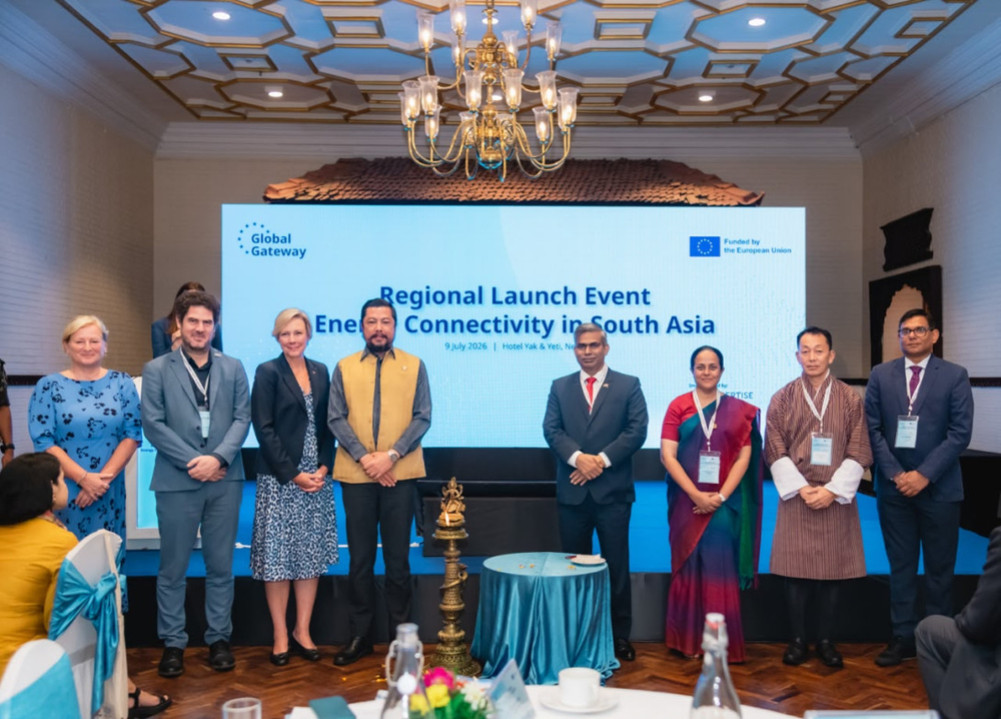
At the 'Energy Connectivity in South Asia' event organized on the occasion of the project's inauguration, Minister for Energy, Water Resources and Irrigation Biraj Bhakta Shrestha stated that cross-border energy connectivity is a matter of high priority for Nepal.
We use Google Cloud Translation Services. Google requires we provide the following disclaimer relating to use of this service:
This service may contain translations powered by Google. Google disclaims all warranties related to the translations, expressed or implied, including any warranties of accuracy, reliability, and any implied warranties of merchantability, fitness for a particular purpose, and noninfringement.
A regional project worth 5 million euros has been launched with financial support from the European Union (EU) to expand cross-border electricity trade in South Asia. The four-year ‘Energy Connectivity in South Asia (ECSA)’ project, to be implemented by Expertise France, includes Nepal, India, Bangladesh, Bhutan, and Sri Lanka as participants.
At the ‘Energy Connectivity in South Asia’ event organized to mark the launch of the project, Minister for Energy, Water Resources and Irrigation Biraj Bhakta Shrestha stated that cross-border energy connectivity is a high priority for Nepal. Noting that Nepal is exporting electricity to Bangladesh using India’s transmission system, he said that regional cooperation would promote renewable energy and expand energy trade.
He said that Nepal has set a target to develop 28,500 megawatts of hydropower generation capacity by 2035, and preparations are underway to export the electricity produced to neighboring countries. He added that with the construction of 400 kV double circuit transmission lines in border areas connected to India and China moving forward, the scope of cross-border electricity trade would further expand once these projects are completed.
The main objectives of the project are to expand cross-border electricity trade among participating countries, strengthen energy security, reduce greenhouse gas emissions, and increase the use of renewable energy. It is expected that this will contribute to the integration of the energy market in South Asia, enhance the reliability of electricity supply, and support sustainable economic development.
Under the project, support will be provided for energy policy and regulatory reforms, technical studies, capacity building, investment roadmap development, regional workshops, and the development of joint renewable energy and cross-border transmission infrastructure. It has also been stated that experiences related to European energy market management and electricity transmission system operation will be shared with South Asian countries.
EU Resident Ambassador to Nepal, Veronique Lorenzo, said that since the practice of cross-border energy connectivity has been successful in Europe, that experience could also be useful for South Asia. She stated that promoting clean energy is essential to face the challenges of climate change.
Secretary of the Ministry of Irrigation, Sarita Dawadi, said that regional cooperation is necessary to make cross-border electricity trade more organized and convenient. Alberto Pototsrigl, Executive Deputy Director of the Florence School of Regulation, said that the expansion of cross-border electricity trade would create an environment for the exchange of electricity at concessional rates among participating countries. Nicolas Chenet, Director of the Sustainable Development Department of France, said that energy security has now become a global priority and emphasized the need for regional cooperation in building clean and sustainable energy systems.
South Asia is still considered one of the least integrated energy markets in the world. It has been stated that a Steering Committee will be formed for the strategic direction and monitoring of the project, and an Implementation Committee will be formed for implementation and technical coordination.