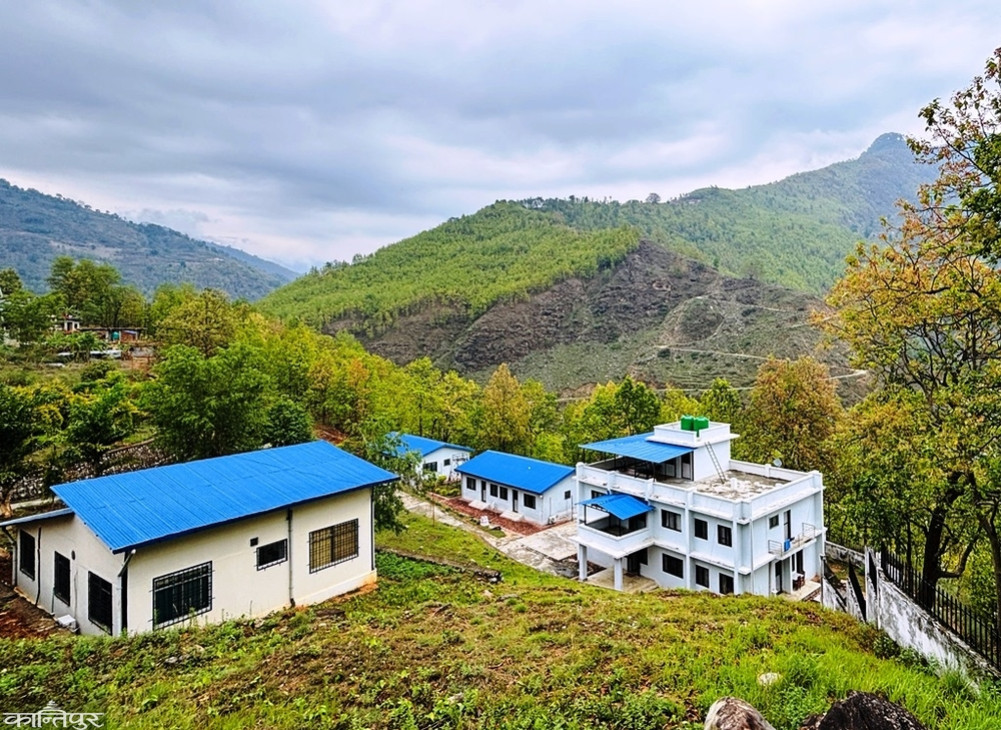
After signing a contract agreement with Chinese and Nepali companies, construction work has proceeded with the goal of completing the 20-megawatt capacity project within 42 months.
We use Google Cloud Translation Services. Google requires we provide the following disclaimer relating to use of this service:
This service may contain translations powered by Google. Google disclaims all warranties related to the translations, expressed or implied, including any warranties of accuracy, reliability, and any implied warranties of merchantability, fitness for a particular purpose, and noninfringement.
After the contract process was canceled three times, leaving the 20-megawatt Budhiganga Hydropower Project in uncertainty for years, activity has increased in the Safebagar area as the construction process has now begun. On Bhadra 29, 2082 (September 15, 2025), following the contract agreement under the EPC (Engineering, Procurement, and Construction) model between the Chinese company Super Power Engineering Construction and the Nepali company Baniya Nirman Sewa Pvt. Ltd. (Makwanpur), preparatory physical construction and administrative work at the project site have accelerated.
With the goal of completing the project within 42 months, the construction company has deployed the necessary technical and other personnel in the field. After a long wait, initial work has begun in the dam construction area (headworks), which is part of the main structure, to ensure the project is completed within the stipulated time.
The process of approving the project's detailed engineering design is also progressing simultaneously. Budhiganga Hydropower Project Chief Surendra Ghimire said that once the design is approved, the main construction work can proceed at full capacity. According to him, the design for the overall layout of the project has already been finalized. "Separate approvals are required for the tunnel route, powerhouse, and bridge designs, and the necessary work for these is currently progressing rapidly," said Project Chief Ghimire. "The final technical design prepared by the construction company will be finalized based on the recommendations of the project's consultants." He also stated that the construction of the laboratory building required for technical testing at the construction site is in its final stage.
According to the project office, temporary accommodation and camps for engineers, consultants, and workers of the construction company are being built. Project Chief Ghimire said that all these camps will be completed within a month, after which all technical teams will work permanently at the project site.
Project Chief Ghimire also stated that the procurement process for explosives required for tunnel construction and other rock cutting has already begun. According to him, a Nepali Army camp has been kept on standby at the project site for the security and supervision of explosive materials. The project office has stated that internal preparations are underway to import explosives from neighboring countries India and China through the Government of Nepal and the Army. "It has been agreed that the Army will immediately provide 20 percent of the required blasting materials from its own stock," said Project Chief Ghimire. "If the Army provides 20 percent of the blasting materials immediately, work on the tunnel and mountain cutting will begin quickly."
Project Chief Ghimire said that after the remaining 80 percent of the materials are imported from abroad, blasting work will proceed under the Army's supervision. According to him, installation of the crusher plant and batching plant is also ongoing in the field to expedite construction work. He said that since the technical team has already conducted two detailed site visits, it has become easier for the construction company to understand the availability of construction materials, the terrain, and the geographical conditions of the work area.
According to Chief Ghimire, technicians from the Division Forest Office are marking trees within the project area for felling. Tree cutting will begin immediately after the marking is completed. Similarly, a team from the Survey Office has also been deployed in the field for land compensation, demarcation, and other technical work.
Project Chief Ghimire said that the project has also prioritized coordination with local residents. "Under social responsibility, priority has also been given to community development work. Currently, work such as constructing boundary walls and access roads is underway in three local projects in the affected area," he said.
From a financial management perspective, this is a 100 percent government hydropower project. Of the total investment, 20 percent will be provided by the Government of Nepal, while the remaining 80 percent will be taken as loans from international donors. According to the project office, 610 million rupees have already been disbursed in the current fiscal year to carry out initial work on the dam, tunnel, and powerhouse under Lot-1 civil works.
In the initial phase, full priority has been given to Lot-1 work. "According to the technical schedule, only after the main civil structures under Lot-1 progress will the installation of mechanical and electrical equipment begin," said Ghimire. "Only from the next fiscal year will the installation and testing of equipment such as turbines, generators, control panels, and transformers under Lot-2 begin."
According to the 1997 feasibility study, the estimated cost of this project is about 10 billion Nepali rupees. For the project, a loan agreement of 6 billion rupees was signed with the Saudi Fund for Arab Development on June 18, 2014. The Saudi Fund has extended the loan period until 2027. Similarly, on July 4, 2012, a loan agreement of 5 million Kuwaiti Dinars (about 1.8 billion Nepali rupees) was signed with the Kuwait Fund for Arab Economic Development.
In the past, due to reasons such as lack of competition, excessively high cost proposals, and disagreement from the main lender, the Saudi Fund, the contract was canceled three times, pushing the project back by decades. It took nearly five years just to prepare the detailed project report (DPR), which was supposed to start in 2013, by Australian company SMEC International and Nepal's Uday Consultancy. This cost 199.1 million rupees. Now, since the fourth contract is under the EPC model, the contractor company has taken full responsibility from design to construction.