The survey has shown that the recruitment fees, agent expenses, and other costs that workers going for foreign employment have to pay are placing a financial burden on them.
We use Google Cloud Translation Services. Google requires we provide the following disclaimer relating to use of this service:
This service may contain translations powered by Google. Google disclaims all warranties related to the translations, expressed or implied, including any warranties of accuracy, reliability, and any implied warranties of merchantability, fitness for a particular purpose, and noninfringement.
A survey has revealed that Nepali workers going for foreign employment have to bear a heavy financial burden to complete the recruitment process.
According to the “Labour Migrant Recruitment Cost Survey 2023” conducted by the National Statistics Office with technical support from the International Labour Organization (ILO), Nepali workers spend an average of NPR 176,000 as recruitment costs to go abroad. For women, the cost is even higher, at NPR 219,000.
The survey shows that the recruitment fees, agent expenses, and other costs that workers must pay for foreign employment impose a financial burden on them. On average, workers have to spend 3.3 months’ income to recover these costs. For women, it takes an average of 4.5 months of work to recoup the expenses. This indicates that women are forced to bear even greater financial risks and costs compared to men when going for foreign employment.
According to the National Statistics Office, this was prepared to measure the recruitment cost indicator under Sustainable Development Goal 10.7.1. The survey covered 3,742 households across the country.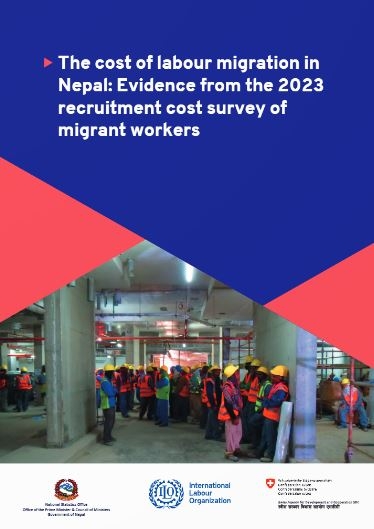
According to the report, 34.7 percent of Nepali workers said they did not have to pay any fees or additional costs for foreign employment. However, this means that more than two-thirds of workers have borne recruitment costs directly or indirectly.
Among female workers, 54.2 percent reported not paying any costs. By employment sector, the proportion of those not paying fees is 37.2 percent in the service sector, 32.8 percent in the industrial sector, and 29.5 percent in the agricultural sector.
Comparing by destination country, the Gulf countries and Malaysia are found to be the destinations with the highest recruitment costs for Nepali workers. The median recruitment cost for these destinations is NPR 200,000.
The lowest recruitment cost is found in India, where the median recruitment cost is only NPR 15,000, according to the report.
Recruitment costs are also linked to occupation and skill level. Workers going into the service sector and highly skilled professions have to pay comparatively higher recruitment costs. In the agricultural sector, recruitment costs are found to be lower.
Comparing by channel of employment, the recruitment cost indicator is highest for workers going abroad through unregistered agents. Such workers have to work an average of 5.6 months to recover the recruitment costs.
For workers going through registered agents, the average recruitment cost indicator is 3.6 months.
Highest earnings in Malaysia
The report shows that, by destination country, Malaysia has the highest average income at NPR 57,696. Next are Qatar and the United Arab Emirates, where workers earn NPR 55,000. The lowest is in India, at NPR 26,083.
The report recommends reducing recruitment costs, controlling the role of illegal agents, and developing a worker-friendly recruitment system. The situation where workers have to spend at least 3 to 4 months’ earnings to recover recruitment costs raises questions about the effectiveness of the “zero recruitment fee” policy. Since 2015, the government has been working through a task force to revise the “free visa, free ticket, and NPR 10,000 service fee” policy.
The report recommends that the government strictly enforce the principle that, according to international labour standards, recruitment fees and related costs should be borne by employers, not workers.
The report also states that Nepal’s bilateral labour agreements and memoranda of understanding with destination countries should be based on international labour standards and fair recruitment principles.
The report further suggests expanding digital systems to control opacity and informal payments in the recruitment process. It recommends increasing digital literacy among workers and their families, making recruitment and service delivery easier through digital means, and making grievance redressal and compensation systems more effective to create an environment where workers can file complaints against recruitment fees, fraud, and other abuses.