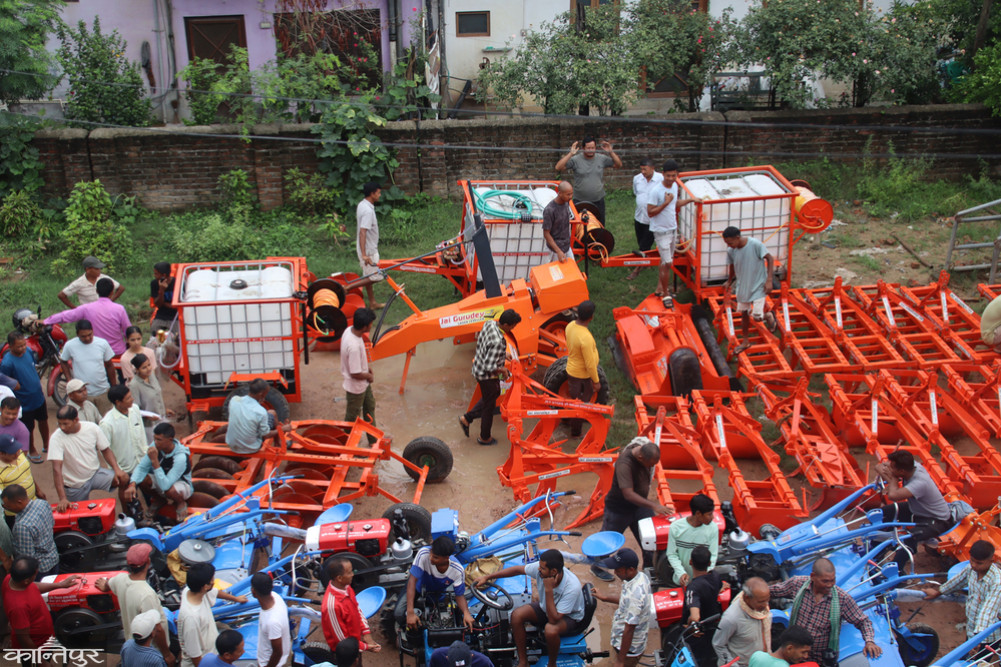
More than 10 million rupees invested by local and federal governments in Belauri, overcoming labor shortages and making strides in agricultural mechanization.
We use Google Cloud Translation Services. Google requires we provide the following disclaimer relating to use of this service:
This service may contain translations powered by Google. Google disclaims all warranties related to the translations, expressed or implied, including any warranties of accuracy, reliability, and any implied warranties of merchantability, fitness for a particular purpose, and noninfringement.
From plowing the fields to planting rice, every season farmers in Belauri had the same worry: where to find laborers? The workforce available for farm work in the village kept decreasing, and the wages of the remaining laborers kept rising.
As the cost of farming increased, some farmers began leaving arable land fallow, while others reduced the area they cultivated. But this time, the scene in the fields of Belauri in southern Kanchanpur has started to look a bit different. Modern machines have begun to replace the plow and hoe. With technology reaching farmers’ hands, not only has their confidence in farming returned, but hope for the future has also begun to blossom again.
To accelerate this change, Belauri Municipality, under the approved program for fiscal year 2082/083, has distributed 176 modern agricultural tools worth 8.4 million rupees to farmers, farmer groups, and agricultural firms at a 50 percent subsidy. The equipment, purchased with 4.2 million rupees from the municipality and an equal partnership from beneficiary farmers, is expected to shift farming from a labor-based traditional system to a technology-friendly system.
Along with this, the National Agricultural Modernization Program Implementation Unit, Kanchanpur, under the paddy block development program operated in Belauri Municipality–2, Teduwa, has distributed modern agricultural machinery, irrigation materials, and production materials worth about 1.7 million rupees.
Through this program, run in collaboration with Samjhauta Multipurpose Cooperative Limited, the goal is to produce quality paddy seeds on 15 hectares of land. With the local government’s mechanization campaign and the federal government’s seed production program coming together, agricultural modernization in Belauri has gained new momentum.
The materials distributed by the municipality include 176 pieces of equipment such as motors, pump sets, mini tillers, power tillers, rotavators, cultivators, four-wheel power tillers, reapers, combine mills, laser land levelers, power sprayers, and trenchers. Meanwhile, under the National Agricultural Modernization Program, power tillers, mini tillers, paddy threshers, rotavators, levelers, three borings, six electric motors, and delivery pipes have been distributed. These tools will help complete tasks from field preparation to irrigation, planting, weeding, and harvesting more quickly, easily, and at lower cost, says Prem Bahadur Chaudhary, a farmer from Belauri Municipality–5.
According to Sumanraj Joshi, head of the Agricultural Development Section of Belauri Municipality, in recent years, the shortage of laborers has become the biggest challenge in agriculture. “At planting time, laborers are not available, and even if they are, you have to pay extremely high wages. In such a situation, modern agricultural equipment can become the main support for farmers. Using equipment allows farming to be completed on time, reduces production costs, and greatly helps make agriculture commercial,” he said.
Govindaraj Joshi, head of the National Agricultural Modernization Program Implementation Unit, Kanchanpur, described the block farming system as an effective means of producing quality seeds. “When farming is scattered, it is difficult to control quality. When the same variety of rice is produced scientifically in the same area, it is easier to use modern equipment, costs decrease, and quality seeds can be produced. That’s why we have given special priority to the block farming program,” he said.
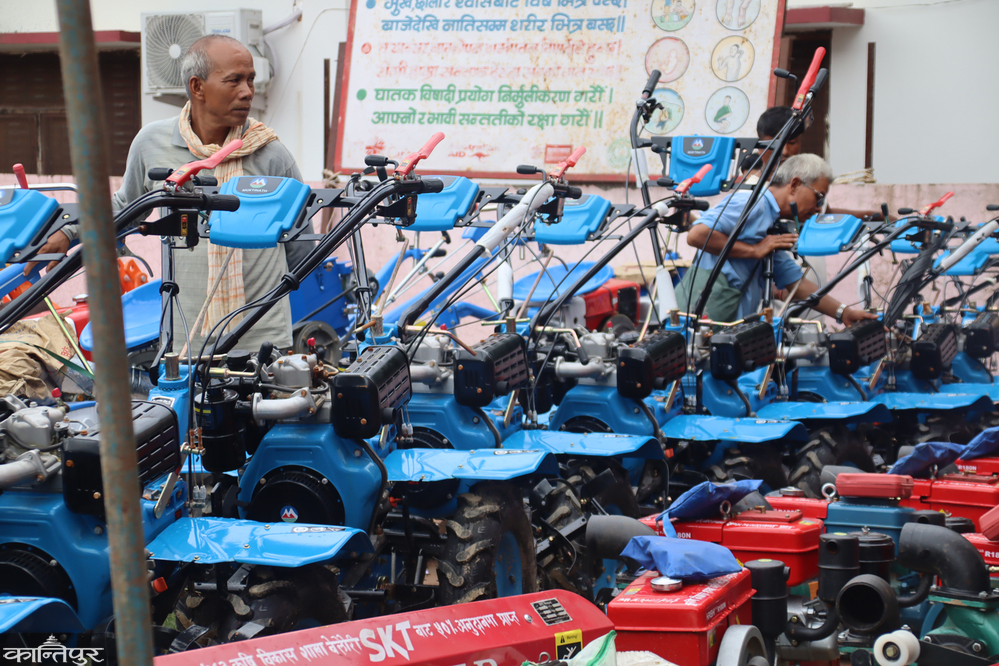
Belauri Municipality Mayor Potilal Chaudhary said the municipality has been continuously increasing investment in agriculture, considering it the backbone of the local economy. “If we can connect farmers’ hard work with technology, both production and income will increase. Modern agriculture is no longer an option, but a necessity. Therefore, the municipality will continue to prioritize agricultural mechanization in the coming years as well,” he said.
Sun Kumari Chaudhary, a farmer from Belauri Municipality–2, Teduwa, who directly benefited from the program, said her confidence in farming has increased after receiving modern equipment. “Previously, I had to go around looking for laborers during planting season. It used to cost a lot of money. Now, with machines, both time and expenses are saved. Women can also farm easily now. I am even more encouraged to farm,” she said.
Shankar Chaudhary, coordinator of the seed production group in Belauri Municipality–2, Teduwa, recalled that until a few years ago, farmers used to farm in their own ways, but now the block farming system has changed the style of farming altogether. “Previously, a lot of laborers were needed for plowing, planting, and weeding. Now, using modern equipment, a lot of work can be done in a short time. Costs have decreased, and the quality of work has improved. We are confident that when all farmers farm under the same management, production will also be better,” he said.
After receiving modern agricultural materials on subsidy, changes have also begun to appear in farmers’ daily lives. Kalawati Jaisi, a farmer from Belauri Municipality–4, said that modern equipment has changed her entire perspective on farming. “Previously, it felt like expenses just kept increasing with farming. Now, with machines doing much of the work, I believe both time will be saved and production will increase. Such programs have provided great relief to farmers,” she said.
Ramita Rana, a farmer from Belauri Municipality–8, said that technology has made it easier for women to move toward commercial farming. “Previously, we had to depend on others for many tasks. Now, because of modern equipment, women can do much of the work themselves. This has increased our confidence in farming,” she said.
Surendra Prasad Bhatt, a farmer from Belauri Municipality–9, said that at a time of increasing labor shortages in agriculture, modern equipment has become the greatest relief for farmers. “When laborers were not available on time, farming was delayed. This also affected crop production. Now, after getting equipment, it seems that problem has been solved to a large extent,” he said.
Prem Bahadur Chaudhary, a farmer from Belauri Municipality–5, said that agricultural mechanization programs should not be limited to a one-time subsidy but should be run continuously. “It’s not enough to distribute equipment for just one year. Such programs should be held every year to make farmers commercial. If that happens, even young people can be attracted to farming,” he said.
According to Asreram Wadayak, a leading farmer from Belauri Municipality–6, known locally as an “agricultural scientist,” the biggest challenges in agriculture now are labor shortages, rising production costs, and declining interest in farming. “Now, agricultural mechanization is not an option, but a necessity. Only if all tasks from field preparation to planting, weeding, and harvesting can be done on time can farmers make a profit. If local, provincial, and federal governments can continue such programs, not only Belauri but the entire agricultural sector could see major changes,” he said.