There are concerns that a bigger blow could come in the coming days, with falling export earnings, potential job losses and New Delhi hinting at further import restrictions.
We use Google Cloud Translation Services. Google requires we provide the following disclaimer relating to use of this service:
This service may contain translations powered by Google. Google disclaims all warranties related to the translations, expressed or implied, including any warranties of accuracy, reliability, and any implied warranties of merchantability, fitness for a particular purpose, and noninfringement.
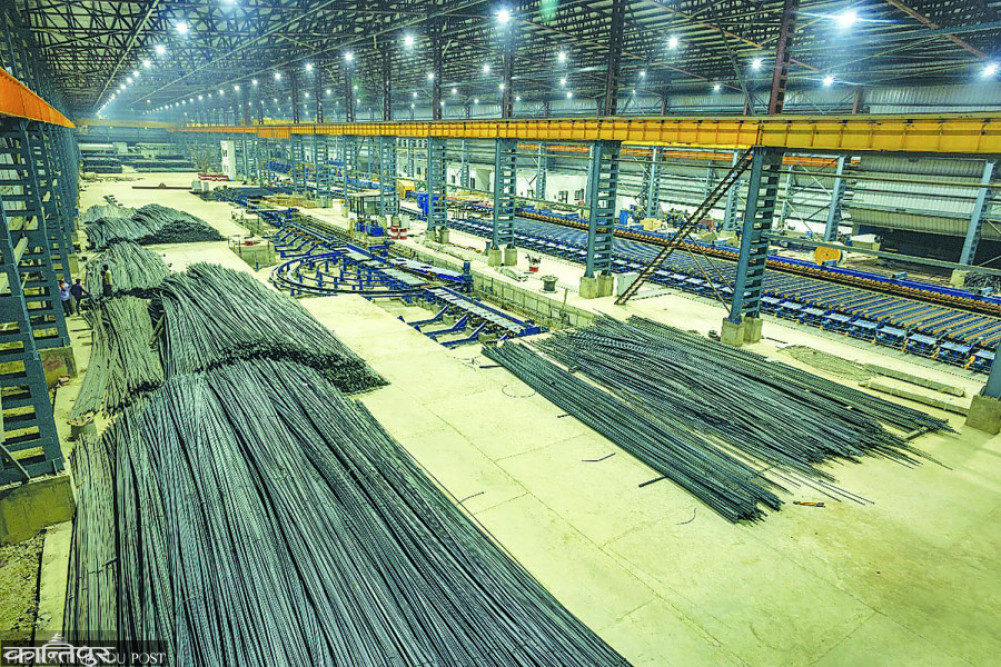
Nepal's iron and steel exports to India have declined after India imposed safeguard duties. This has raised concerns about a drop in export earnings, potential job losses and a bigger blow in the coming days, as New Delhi signals further import restrictions.
Nepal exported Rs 15.42 billion worth of iron and steel to India in the first 11 months of the last fiscal year. In the same period of the current fiscal year, exports have fallen by 68.67 percent to Rs 4.83 billion.
Nepal has lost Rs 10.59 billion in exports in less than a year due to India's new trade policy. This sharp decline has also added to concerns about a drop in government revenue and job losses in the sector.
Industry experts say that the risk of Nepal's iron and steel exports facing another blow is still not averted as India is preparing to take further steps to curb imports of steel, especially those produced using Chinese raw materials.
Last December, India imposed a three-year safeguard duty of 11 to 12 percent on steel products designated to prevent cheap imports. The tax will be 12 percent in the first year, 11.5 percent in the second year and 11 percent in the third year. The arrangement has been applied to imports from China, Vietnam and Nepal. ‘Specialty steel’ products, including stainless steel, are exempted from this.
According to Reuters, India, the world’s second-largest crude steel producer, approved the three-year safeguard duty after the ‘Directorate General of Trade Remedies’ under the federal commerce ministry recommended in its final conclusion. Before imposing the safeguard duty in December, India had imposed a temporary duty of 12 percent for 200 days in April.
Nepali industrialists argue that imposing a safeguard duty on its products is not justified as Nepal is still a least developed country (LDC) with high economic and environmental risks. They say that this tariff has caused a major disruption in production and exports.
Traditionally, galvanized sheet has accounted for a large share of Nepal's steel exports, and its main market is India. According to the UNDP report titled 'Assessment of Brick, Cement and Steel Sector in Nepal', the annual demand for iron and steel in Nepal is about 1.2 million tons and domestic industries are currently able to meet that demand.
According to industry experts, the demand for iron and steel is increasing by about 20 percent annually. The annual demand for rebar alone is about 500,000 tons, of which domestic producers are meeting about 80 percent of the demand. There are about 83 iron and steel industries registered in Nepal, including 54 thermo-mechanically treated (TMT) bar production plants.
Nepal exported 145,932 tons of iron and steel and related products worth Rs 16.35 billion to India last fiscal year, according to the customs department data.
According to industry sources, the main exports are flat-rolled iron and non-alloy steel products with a width of more than 600 mm and a thickness of 1 mm to 3 mm. These cold-reduced steel coils are used in automobile panels, electrical appliances, furniture and general construction (fabrication).
Nepal also exports rolled iron and steel products with aluminum-zinc alloy coatings, plastic-coated iron and steel sheets and stainless steel utensils and kitchenware. As Reuters recently reported, India will review steel imports in August before deciding whether to take further steps to curb shipments, especially from China. The Indian government has not yet decided whether to impose anti-dumping duties or take other trade measures.
The possibility of more stringent restrictions has Nepali industry concerned. “India is preparing to conduct an annual review of the safeguard duty imposed on iron and steel products. The review will be held in October or November. This is the right time for the Nepali government to request the Indian government to remove this duty imposed on Nepali iron and steel products,” said Sunil Manot, chief financial officer (CFO) of Hulas Steel Industries, one of Nepal’s largest steel producers. “We are preparing to write a letter to the industries ministry suggesting possible solutions to this problem.”
According to Manot, India has also stopped issuing Bureau of Indian Standards (BIS) certificates to Nepali industrialists. “We had applied for renewal of our BIS certificate, but were informed that our application was on hold,” he said.
Hulas Steel exports galvalume (GL) and pre-painted galvalume (PPGL) products to India. The company produces about 10,000 tonnes of GL and PPGL per month. It also says it has the capacity to export up to 20 per cent of its production. Galvalume is a steel sheet coated with a mixture of aluminium-zinc-silicon.
Devendra Sahu, general manager of Panchakanya Group, another large industry that manufactures stainless steel water tanks and other items, said the company resumed exports only three months ago after a nine-month suspension.
“India’s Steel Import Monitoring System (SIMS) had made BIS certification mandatory for both raw materials and finished goods. We were unable to obtain BIS certification, due to which our exports were stopped,” Sahu said. He added that India does not have any BIS standard for stainless steel water tanks. The company imports steel from Taiwan to make the tanks.
According to Sahu, exports resumed after SIMS introduced the ‘Simple SIMS’ system, which allows Indian importers to import stainless steel water tanks in consignments of 20 to 25 tonnes. “Each of our water tanks weighs less than one tonne, which makes exports possible under the new system,” he said.
According to Sahu, apart from India’s 6 per cent Goods and Services Tax (GST), the company does not levy any additional duties on water tanks exported by the company. Panchakanya Group produces around 25,000 stainless steel water tanks annually, of which 10 to 12 per cent is exported to India. The company operates manufacturing plants in Bhairahawa, Rupandehi and Thankot, Kathmandu, with most of the output from the Bhairahawa plant going to the Indian market. Trade experts say the Ministry of Industry has failed to remove trade barriers faced by domestic industrialists and exporters.
The government should actively coordinate with India when such trade disputes arise, said former Commerce Joint Secretary and trade expert Ravi Shankar Sainju. “Trade-related issues are inevitable. They should be resolved through government-to-government (G2G) dialogue,” Sainju said. “Our weakness is that we cannot negotiate strongly with India. Be it tea exports or the issue of BIS certification, Nepal has repeatedly missed opportunities to raise these concerns during high-level visits to India. As a result, such trade issues keep recurring.”