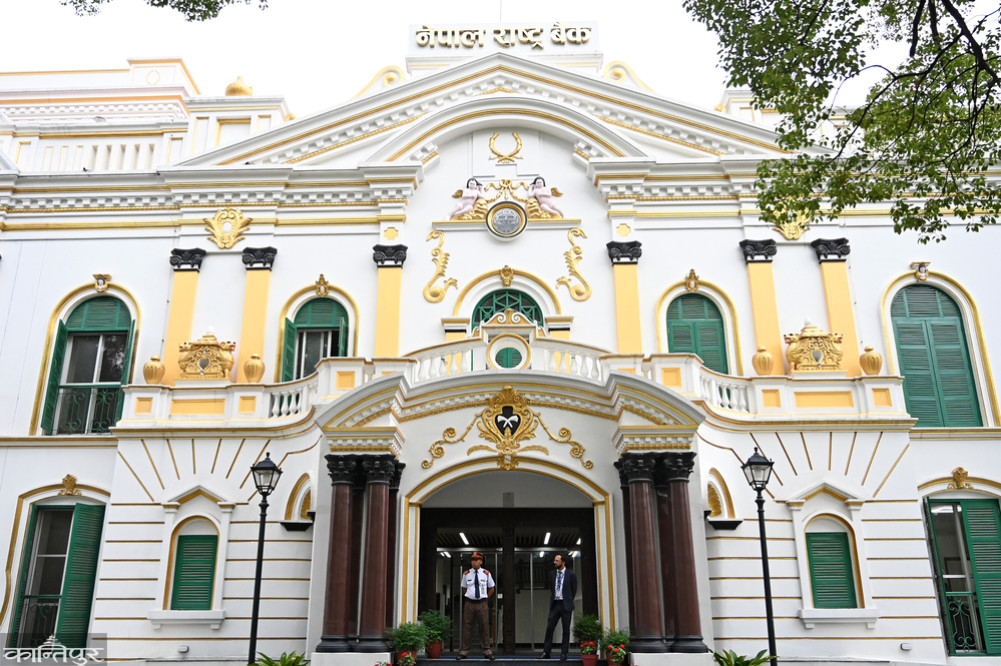
The annual review report of the Nepal Rastra Bank states that the expected increase in credit flow has not been seen due to confusion in foreign trade, construction and PPA agreements.
We use Google Cloud Translation Services. Google requires we provide the following disclaimer relating to use of this service:
This service may contain translations powered by Google. Google disclaims all warranties related to the translations, expressed or implied, including any warranties of accuracy, reliability, and any implied warranties of merchantability, fitness for a particular purpose, and noninfringement.
Nepal Rastra Bank has stated that the credit flow from the financial system has not increased as expected due to the decrease in foreign trade, slowness in public and private construction, real estate division and power purchase agreements (PPA) and other issues.
The Rastra Bank, while releasing the annual review report of the monetary policy for the fiscal year 2082/83, has shown the reasons mentioned for the failure to increase the credit flow. The Rastra Bank has stated that the amount inflowing from remittances continues to be added to the financial system, but due to the lack of expected growth in credit flow and investment, the situation of excess liquidity continues to persist, and monetary management is under pressure.
The growth rate of broad money supply for the fiscal year 2082/83 is projected to be 13.0 percent and the growth rate of credit to the private sector to be 12.0 percent, but in 2083 Baisakh, the growth rate of broad money supply on a point basis was 15.2 percent and the growth rate of credit to the private sector was 6.5 percent.
The bank has also stated that the interest rates on deposits and loans are decreasing further due to low short-term interest rates and the prevailing situation of excess liquidity. The average interest rates on deposits of commercial banks, development banks and finance companies in 2083 Baisakh are 3.35 percent, 3.70 percent and 4.59 percent, respectively.
The weighted average interest rate on loans from commercial banks, development banks and finance companies is 6.73 percent, 7.87 percent and 9.14 percent respectively, according to the review report of the Nepal Rastra Bank.