The expected improvement in the economy has not been seen due to slow expansion of the agricultural sector, low government spending, and a decline in the import of tools and equipment.
We use Google Cloud Translation Services. Google requires we provide the following disclaimer relating to use of this service:
This service may contain translations powered by Google. Google disclaims all warranties related to the translations, expressed or implied, including any warranties of accuracy, reliability, and any implied warranties of merchantability, fitness for a particular purpose, and noninfringement.
Despite expectations of improvement in economic activity in recent months, data has shown that the economy has not slowed down. The growth rate of 7 sectors in the third quarter was negative compared to the second quarter of the current fiscal year, and government data has confirmed that the economy has not slowed down.
According to a report released by the National Statistics Office on Monday, the growth rate of seven sectors of the economy, including agriculture, manufacturing, housing and food, information and communication, finance and insurance, education and others, was negative in the third quarter (Magh, Falgun and Chaitra) compared to the second quarter (Kartik, Mangsir and Poush). Compared to the second quarter, the economic growth rate in the third quarter of this year is 0.58 percent. Such a growth rate was 0.92 percent in the third quarter of last year.
The statistics office has projected that the country's economic growth rate in the current fiscal year will be 3.51 percent compared to the third quarter of the last fiscal year. The office has stated that the economic growth rate during the period is expected to be 3.5 percent due to the increase in electricity generation and distribution, deposit collection and credit flow, non-life insurance premium collection, and trade services. This growth rate is lower than the third quarter of last year.
The economic growth rate in the third quarter of last year was 4.05 percent. Statisticians generally compare data annually. They say that even if the quarterly comparison does not show the real situation, it gives an indication of where the economy is heading. The statistics officer said that the accounting data for the third quarter did not show the expected improvement in various sectors of the economy.
The agriculture sector did not grow as expected, low government spending, and imports of machinery and equipment did not increase, said Dhundiraj Lamichhane, Deputy Chief Statistics Officer and Spokesperson of the National Statistics Office.
‘Compared to the third quarter of last year, the growth rate of two sectors in the same period of this year and the second quarter of this year, the negative growth rate of seven sectors, and the growth rate of other positive sectors, are also normal, indicating that economic activity has not improved,’ he said. ‘Generally, annual comparison data is considered real. Quarterly comparison data is not a direct but an indirect indication. Now, even in annual and quarterly comparisons, the negative growth rate in some sectors and the decline in growth rate in positive sectors confirm that the economy has not improved.’
 Lamichhane said that the lack of government spending will have an impact on many sectors, including construction and industry. ‘On the one hand, government spending has not increased and on the other hand, the import of construction materials has also decreased significantly, so the construction sector has also become negative,’ he added. ‘The aforementioned data shows no signs of improvement in the economy. While the financial sector, transportation and other sectors have shown some positive results, the growth rate of many has decreased. This also shows that there has not been the expected improvement in economic activity.’ The growth rate of other sectors, including household chores, is also low. He said that the expected improvement in the economy is not visible.
The growth rate of 16 out of the 18 industrial classifications presented in the report in the third quarter is positive. The growth rate of the public administration and defense and industrial production sectors is negative during this period. The report has shown that the growth rate of this quarter is normal due to the decline in the import of construction materials, production of rice crops and domestic production of some goods in the same period of the current fiscal year compared to the third quarter of the last fiscal year.
The highest growth rate of 24.88 percent in electricity and gas related activities in the third quarter of this year compared to the last year. The office has preliminary estimates that financial and insurance activities, transport and storage and wholesale and retail trade will grow by 10.27, 7.83 and 5.25 percent respectively during the same period.
Despite the decrease in rice crop production, the report has shown that the modest increase in the production of livestock, vegetable crops and fruits and forest products has had a positive impact on the total value added of this sector. The growth rate of the wholesale and retail trade sector, which accounts for the second largest share of the economy, is estimated at 5.25 percent.
The growth of this sector seems to be due to the increase in domestic production and imports of trade goods. On the other hand, the office estimates that the growth rate of the public administration and defense sector will be negative by 1.59 percent and industrial production by 0.54 percent. The initial estimate is that the growth of other industrial classifications is normal.
Ram Prasad Gyawali, Head of the Central Department of Economics at Tribhuvan University, said that there has been no improvement in the country's economic activity not only compared to the second quarter of this year but also compared to a year ago. 'Low capital expenditure and failure to improve the productive sector have been fundamental structural problems for Nepal. There has been no improvement in that situation even now,' he said. 'The lower economic growth rate this year compared to last year also confirms that there has been no improvement in the economy.' He argues that the new government needs to do a lot to improve the economy and move forward by correcting the problems that have been brewing for a long time.
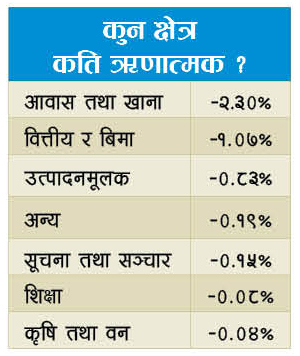
The office has stated that the economic growth in the third quarter of this fiscal year will be only 0.58 percent compared to the second quarter of the fiscal year 2082/83. The growth rate of only 11 out of 18 industrial classifications of the economy is positive, while the office projects that seven sectors will be negative.
‘During this period, the agriculture, forestry and fisheries sector, which has the largest share in the economy, has seen a negative growth of 0.04 percent. Wholesale and retail trade, which has the second largest share in the economy, has seen a growth of 2.02 percent,’ the report says. ‘Among the 16 industrial classifications with a positive growth rate, the highest growth rate is electricity and gas at 6.87, followed by mining and quarrying at 2.23 and wholesale and retail trade at 2.02 percent.’
On the other hand, the growth rate of housing and food has been negative at 2.30 percent, banking and insurance at 1.07 percent, and industrial production at 0.83 percent. The growth rate of the remaining industrial classifications appears normal.
Economist Kalpana Khanal said that the expected improvement in the economy has not been achieved due to the interim government after the Gen-G movement, low capital expenditure and political uncertainty. ‘The interim government had cut the budget by more than 1 trillion. Capital expenditure was also low during that period,’ she said. ‘The work of the Rashtriya Swayamsevak Party government, which got a close to two-thirds majority in the elections held under the auspices of the Gen-G movement, remains to be seen. The economy has not improved because investor confidence has not increased during this period.’
Even though the government has set a target of 6 percent economic growth for the current fiscal year, it is unlikely to achieve it. The projection made by the National Statistics Office in Baisakh indicates an initial estimate of 3.65 percent economic growth in basic prices and 3.85 percent in consumer prices this year.