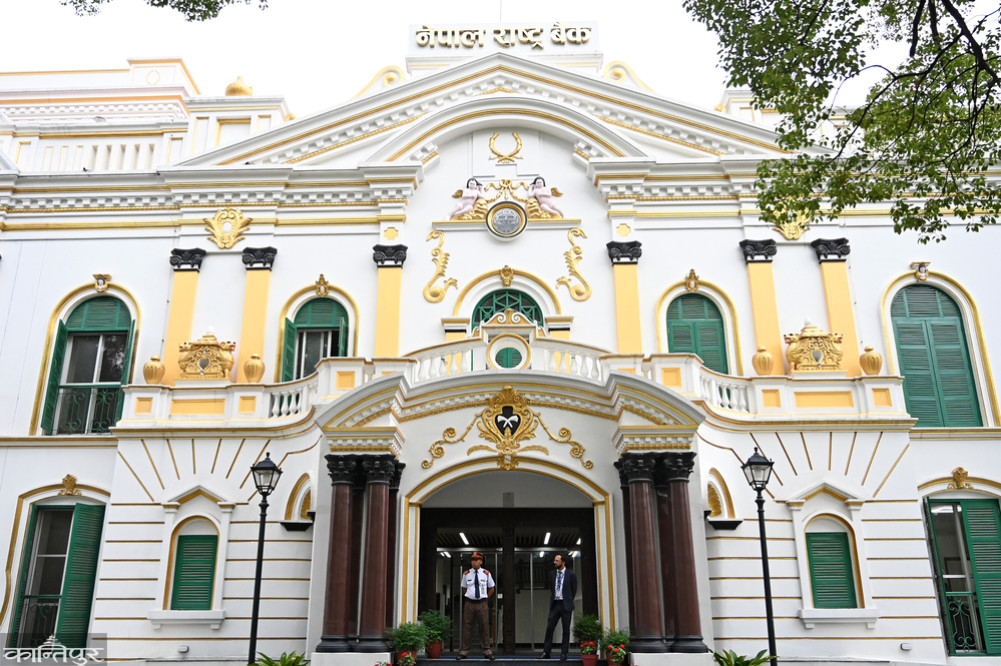
The Rastra Bank has stated that the credit flow from the financial system has not increased as expected due to the decrease in foreign trade, slowness in public and private construction, and uncertainties over issues such as real estate division and power purchase agreements.
We use Google Cloud Translation Services. Google requires we provide the following disclaimer relating to use of this service:
This service may contain translations powered by Google. Google disclaims all warranties related to the translations, expressed or implied, including any warranties of accuracy, reliability, and any implied warranties of merchantability, fitness for a particular purpose, and noninfringement.
As in previous years, the National Bank has pointed out that in the current year too, banks and financial institutions have been under pressure to manage excess liquidity.
Reviewing the monetary policy for the fiscal year 2082/83, the National Bank has acknowledged that the non-performing loan ratio has increased due to the lack of expected expansion in economic activity and the quality of loans flowed in the past, which has led to a decline in the investment capacity of banks.
‘The amount inflowing from remittances continues to be added to the financial system, but due to the lack of expected growth in credit flow and investment, the situation of excess liquidity has continued to persist, and monetary management has remained under pressure,’ the review said.
During the implementation of the monetary policy for the fiscal year 2082/83, the economy had to face various national and international challenges. The Rastra Bank has stated that there is continued uncertainty due to the impact of trade tariffs caused by global geopolitics, damage to petroleum infrastructure due to the war between Israel-US and Iran, disruptions in the supply chain due to the closure of the Strait of Hormuz, and pressure on global inflation due to rising fuel prices.
Similarly, the late arrival of monsoon in Nepal and the decrease in agricultural production due to excessive rainfall in the month of Asoj, the uncomfortable situation arising after the protests of Bhadra 23 and 24, 2082, and the weakening of the morale of the private sector, which has prevented businesses from expanding, are putting pressure on aggregate demand.
The Rastra Bank has stated that the decrease in foreign trade, the slowdown in public and private construction, the uncertainty seen in issues such as real estate division and power purchase agreements, etc. have also failed to increase the expected credit flow from the financial system.