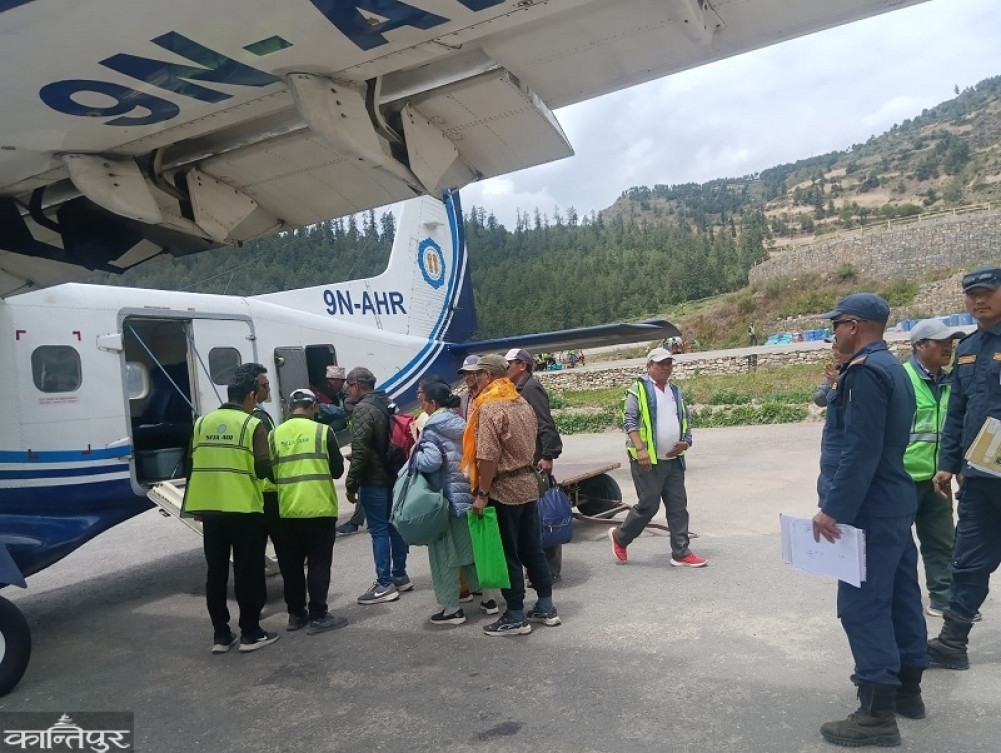
In one and a half months, 5,000 Indian tourists visited Kailash-Mansarovar.
We use Google Cloud Translation Services. Google requires we provide the following disclaimer relating to use of this service:
This service may contain translations powered by Google. Google disclaims all warranties related to the translations, expressed or implied, including any warranties of accuracy, reliability, and any implied warranties of merchantability, fitness for a particular purpose, and noninfringement.
Vijay Lama, the owner of Hotel Vijay in Simkot, the headquarters of Humla, and half a dozen employees are currently busy. Their daily management of 40 to 60 Indian tourists going for Kailash-Mansarovar Darshan has increased their busyness. ‘It has been a month since the pilgrims started coming, and the season continues for another 3 months,’ he said. ‘It is difficult to find a moment of leisure while arranging food and accommodation for tourists.’
It is also difficult to find accommodation at Hotel Potala in Simkot for anyone other than Indian pilgrims. ‘Bookings have been received until September,’ said hotel owner Min Bahadur Tamang. ‘We are trying to satisfy as many guests as possible, and we are managing the accommodation of up to 40 tourists daily, including food and drinks.’ He informed that they have served nearly 800 tourists since the first week of Jestha alone. He informed that this time, the pilgrims did not have to be accommodated in tents as the tourism entrepreneurs sent pilgrims according to the capacity of the hotels. According to him, before the Corona pandemic, when there were not enough rooms in the hotels, the pilgrims had to be accommodated in tents.
Currently, 8 large-investment hotels, including these two, are full in Simkot. Mim Lama, the president of the Hotel Entrepreneurs Association, said that the tourist hotels are full of Indian tourists and the small hotels are full of airline employees, tourism entrepreneurs, tourist guides, etc. According to him, 10 million to 50 million rupees have been invested in hotels in Simkot, including Kailash, Mansarovar, Karnali, Humla, Alice, targeting Indian tourists. A dozen hotels with tourist facilities have also been opened in Hilsa, located on the China border. Those hotels have prepared a package of 3,500 rupees for one day's stay and food.
It is difficult for other travelers to find accommodation in hotels in Nepalgunj. Two four- and five-star hotels are operating in Nepalgunj and Kohalpur targeting Indian tourists. The remaining half-dozen three-star hotels are also seeing an increase in the number of Indian pilgrims. Keshav Neupane, Regional Executive Director of Siddhartha Business Group of Hospitality, said that 80 to 100 Indian tourists are staying in his hotel every day. According to him, hotels have already been booked until the end of Shrawan. According to him, hotels in Nepalgunj, including Siddhartha, Soaltee Westend Premier, Hotel Starlight, Diamond Palace, Batika, Sneha, City Palace, Signet Inn Krishna, Kalpataru and Center Plaza in Kohalpur, are full.
Indian tourists have started using the Hilsa border crossing in Humla after the 2072 BS earthquake. The Tatopani border crossing in Humla, which was closed after the earthquake, has not yet reopened. Mansarovar can also be reached by road via Rasuwagadhi in Rasuwa to Kerung, while some pilgrims also travel to Mansarovar by air via Lhasa in China. According to tourism professionals, it takes at least 10 days to make the Mansarovar pilgrimage from other parts of Nepal, while the journey can be completed in 7 days via Humla.
According to the Kailash Yatra Operators Association (ACTON), Indian pilgrims go to Humla via Lankanau via Nepalgunj. "The nearest Indian airport from Nepal is Lucknow. From there, Nepalgunj is 190 km away, which can be traveled in 3 hours," said Acton President Bimal Naharki. "From Nepalgunj, one can go to Simkot by plane and then reach Hilsa on the Chinese border by helicopter. From there, the distance of 105 km to Mansarovar can be covered in 4 hours." According to him, tourists who stay in Nepalgunj for the first day stay in Simkot, the headquarters of Humla, on the second day, and from there, they reach Hilsa on the Chinese border by helicopter and stay at Darchen Base Camp on the banks of Mansarovar on the third day. On the fourth day, they visit Mount Kailash, which is about 60 km away, and return after visiting it, he informed.
‘Those who can walk reach Kailash and circumambulate the 52 km distance, while the disabled visit Darchen Base Camp and return,’ said tourism entrepreneur Vijay Singh, ‘After returning from there, they stay in Simkot the next day and return to Nepalgunj the next day. This route can be completed in 7 days at the earliest.’
According to Acton, nearly 20,000 Indian tourists have ‘booked’ the pilgrimage this year. This year, travel arrangements have been made through 35 tours and travels for Kailash-Mansarovar darshan and ‘booking’ is still ongoing, Naharki informed. According to him, the attraction of many tourists to Mansarovar is seen through the Hilsa checkpoint in terms of weather, geography, distance and cost.
Due to the pressure of tourists, 3 Summit Airlines, 2 Sita Airlines and one Tara plane have been kept in Nepalgunj. This season, up to 29 flights have been made from Nepalgunj to Simkot daily, and at least 10 flights are currently being made daily, said Mahendra Singh, head of the Civil Aviation Office, Simkot. According to him, six helicopters of Simrik, Fishtail, Mountain, Prabhu and Kailash Air have been stationed at Humla Airport to ferry tourists from Simkot to Hilsa on the China border. ‘Flights are being made from 7 am to 5 pm,’ he said, ‘air traffic jams occur almost every day due to the pressure of aircraft.’
The District Police Office has stated that so far, 5,014 tourists have visited Kailash-Mansarovar via Humla. According to the office, 2,487 women and 2,527 men have visited Mansarovar. Police have stated that about 400 more tourists are waiting in Simkot to go to Mansarovar. Indian tourists have started coming on the Kailash-Mansarovar pilgrimage since the first week of Jestha this year. Tourism entrepreneur Ranjit Lama said that 80 to 300 tourists go on the Mansarovar pilgrimage via the Hilsa checkpoint in Humla every day.
Tourism entrepreneur Mim Lama said that the influx of Indian tourists has made porters, tour guides, and even flight and helicopter staff busy. According to him, flight companies have given employment to about 25 people to load and unload luggage due to the influx of Indian pilgrims, while up to 50 porters are getting work at Simkot airport every day.
Pilgrims stay in hotels in Simkot for two days, one day when they come to Humla and one day when they return, and stay in hotels in Hilsa for one day on the way, and the remaining 3 to 4 days are spent in China. Tourism entrepreneurs say that a tourist can earn at least Rs 10,500 by staying in Simkot in Humla for two days and Hilsa for one day. Based on that, he informed that hotels alone have generated an estimated business of at least Rs 52.6 million so far.
Hotels have prepared menus of local dishes such as Marsi rice, Phapar, and Kodo, and local vegetables are used. Lama, the president of the Hoteliers Association, said that farmers have also benefited from the increased consumption of local agricultural products. According to him, a hotel now consumes up to 50 kg of fresh vegetables daily. He informed that local vegetables are being sold for Rs 100 to 200 per kg.
‘When tourists return, they take produce such as walnuts, beans, phapar, chino, kaguno, marsi rice and others for Koseli,’ he said. ‘We hope that they will also find a price and market after the apple season starts.’ Currently, walnuts are sold at Rs 10 per kernel in the local market, while other agricultural products are bought by tourists for Rs 150 to Rs 200 per kilogram.’
Another tourism entrepreneur, Tshering Lama, said that this pilgrimage has also created employment at the local level. Porters who carry loads from Simkot Airport to hotels earn up to Rs 3,000 daily. ‘Porters charge between Rs 100 and Rs 300 for carrying a bag,’ he said. ‘Even if they carry the loads of 10 tourists, one person is earning at least Rs 3,000.’
Simkot and Namkha rural municipalities have collected fees from foreign tourists who have reached Humla. Simkot rural municipality chairman Vijay Bhandari said that a revenue of Rs 1,100 per person has been collected from pilgrims as a cleaning fee. According to him, a revenue of Rs 5.5 million has been collected so far.
According to tourism entrepreneur Tenzin Norbu, the most tourists come from South India, Gujarat, Maharashtra, and North India for Mansarovar Darshan. He informed that the majority of those who come on the pilgrimage are over 50 years old. ‘People who have retired from various services and businessmen come on the pilgrimage more often. Indians believe that they should visit Kailash once in their lives,’ he said. ‘Retirees also have money and 10 to 15 days of time, so many people in this age group come on the pilgrimage more often.’
Pilgrims also say that they were able to visit Mansarovar after a long time. Nitish Kumar Verma, 67, from Kanpur Dehat in Uttar Pradesh, India, expressed his happiness at being able to visit Kailash after a long time. He visited Mansarovar last Monday and reached Nepalgunj via Humla. ‘It was a long-standing desire, but the Corona epidemic prevented him from coming to visit,’ he said. ‘After visiting Kailash, I experienced the direct sight of Shankarji. I believe that visiting Kailash has brought salvation.’ Manoj Patel, 66, from Agra in Uttar Pradesh, who was part of his travel team, said that visiting Kailash has given him the greatest happiness in his life. ‘I hope that Bholenath will fulfill our wishes, visiting Kailash has brought us a sense of golden bliss.’
According to Norbu, it is mentioned in various religious texts that Lord Shiva resides on Mount Kailash. ‘The Mansarovar-Kailash Yatra is given importance as a symbol of self-purification, liberation from karma and salvation,’ he said, ‘That is why Indians believe that one must visit Kailash at least once in their lives.’ Various state governments have arranged grants of Rs 25,000 to Rs 100,000 for pilgrims coming on the Kailash-Mansarovar Yatra. Due to which, he said, the attraction of Indians to Kailash-Mansarovar has increased. According to him, Telangana state has been providing grants of Rs 25,000, Karnataka Rs 50,000 and Uttar Pradesh Rs 100,000.’ Acton has stated that a package of Rs 250,000 to Rs 300,000 has been prepared for Indians for this pilgrimage. According to the organization, Nepalis are being offered packages ranging from Rs 150,000 to Rs 100,000 from Kathmandu, said tourism entrepreneur Sange Lama. According to him, tourists from Hilsa on the Chinese border reach Taklakot (Purang), about 30 kilometers away, and from Purang, they are taken to Mansarovar, about 80 kilometers away. From Mansarovar, they are taken to Kailash Base Camp (Dharchen), about 50 kilometers away, and pilgrims circumambulate Kailash, which is 6,714 meters above sea level. Mount Kailash, on the border of China, India, and Nepal, is triangular (pyramid) in the north-west.
It takes at least one to three days to circumambulate the 53-kilometer base of Mount Kailash. The Lama informed that arrangements will be made on horseback for those who want to go around in one day. According to him, the circumambulation that starts from Darchen passes through Yamadwar-Dirapuk-Juthulpuk-Dolmala and ends at Darchen. Four major Asian rivers, the Indus, Sutlej, Brahmaputra and Karnali, flow from Mount Kailash, located near Lake Mansarovar and Lake Rakshasa. He said that it is claimed that no one has climbed the mountain so far.
Kailash Darshan is considered important for all religions within the Omkar Parivar, said religious activist Khimanand Sharma. According to him, Buddhists worship Thank Rimpoche, Jains worship him as the deity of the mountain, and Bon worship him as 'Pribuddhist'. 'Buddhists, including Hindus, Bon and other religions circumambulate in a clockwise direction,' he said, 'Jains circumambulate counterclockwise.' Being a high mountainous region, Mount Kailash receives heavy snowfall for three months in winter, and there are storms during Chaitra-Baishakh. The time from June to September (from Jeth to Asoj) is considered suitable for darshan.
Humla Chief District Officer Tek Kumar Regmi said that the Mansarovar Yatra is also an exercise in self-discipline, restraint and dedication as the tour involves experiencing different Himalayan settlements, weather and different biodiversity. According to him, amidst the altitude, cold, fatigue and difficulties, pilgrims try to balance their body and soul through mantras, meditation and yoga. 'Kailash Mansarovar Yatra is also an adventure as it involves a journey to the high Himalayan region,' he said. 'It is important to be vigilant at all times as adverse weather conditions can cause fatigue and various health problems during this journey.' He said that the lack of seasonal food and suitable accommodation, telephone, internet, drinking water, toilets and other inconveniences have caused problems for tourists. Last year, 6,500 Indian pilgrims visited Kailash-Mansarovar via Humla.