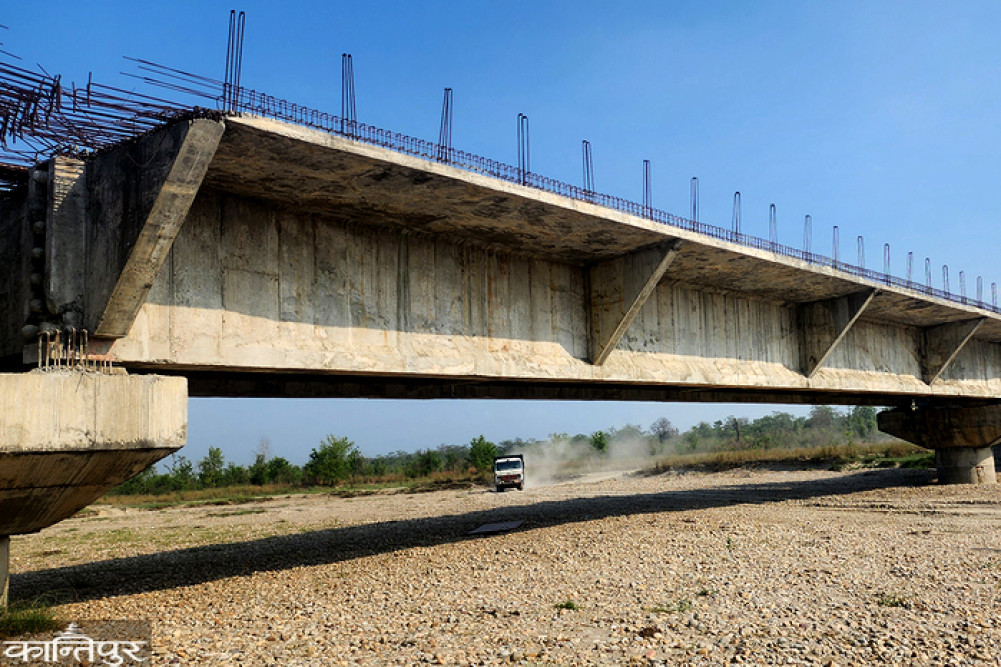
The study team has made recommendations on whether to continue or not, after evaluating the feasibility and feasibility of projects with broken contracts, unprofitable investments, and projects that have not been completed for a long time.
We use Google Cloud Translation Services. Google requires we provide the following disclaimer relating to use of this service:
This service may contain translations powered by Google. Google disclaims all warranties related to the translations, expressed or implied, including any warranties of accuracy, reliability, and any implied warranties of merchantability, fitness for a particular purpose, and noninfringement.
The government has concluded that 250 projects in the road infrastructure sector are in a sick state. According to the study team's report, 122 projects are stalled, while construction has been delayed in 153 projects.
The team has evaluated the justification and feasibility of abandoned projects, unprofitable investments, and projects that have not been completed for a long time and recommended whether to continue them or not.
The report was prepared by forming a study team to solve the problems of abandoned projects, abandoned projects, and unprofitable investments as per the 100-day agenda of the Balenandra Shah-led government. The agenda mentioned evaluating the justification and feasibility of the projects and recommending whether to continue them or not.
Accordingly, the team formed under the coordination of Secretary of the Ministry of Infrastructure Development, Gopal Prasad Sigdel, prepared a report on 5th Jestha and submitted it to the Office of the Prime Minister and Council of Ministers. According to the study team, 15 contracts have been terminated and 38 have been identified as 'other situations'. The study team included the involvement of concerned ministries and agencies.
After a detailed study of 578 contracts, the team has also suggested measures to find immediate solutions in terms of law and implementation and to prevent such situations from recurring in the future.
Sushil Babu Dhakal, Head of the Development Assistance Coordination and Quality Division of the Ministry of Infrastructure Development, who is a member of the study team, said that projects older than 5 to 10 years have not yet been completed. 'The presence of businessmen at the construction site has only been symbolic, there is no work. There is another contract, it has not been terminated, there has been no activity there,' he said, 'The contract has been signed, but it seems that the work has been delayed abnormally.' It has been found that the work has not been completed even though the deadline of some contracts has passed.
Most of the sick contracts are for roads and bridges.
The ministry says that it has been instructed to proceed with the immediate action process according to the Public Procurement Act, considering whether it is appropriate to keep it in a stagnant state. The study team suggests that such contracts should not be extended, saying that there is now an opportunity to manage problematic contracts. ‘The party that has not borne its risk should be regulated and action should be taken,’ said another member of the committee. ‘The party that has weaknesses should be made responsible for its work, the party that is suffering should be looked at, and if there is a problem, a solution should be sought.’
In the past, the Public Procurement Regulations were amended repeatedly to extend the deadline for projects. Construction entrepreneurs who did not work used to request the amendment of the regulations and take the facility of extension. ‘Earlier, the procurement law was amended and the deadline was extended, which set a wrong precedent,’ said a ministry source. ‘That will not happen now.’
In a contract agreement, the risks between the government and the construction entrepreneur are shared. ‘It is mentioned that the public body has to bear the risk and the ups and downs that it has to take,’ said a source from the ministry, ‘the same should be responsible for the risk given to the construction entrepreneur.’
The Ministry of Infrastructure Development has included this in the list of works done in 100 days. Similarly, the ministry has issued a circular to the concerned bodies stating that the payment of bills submitted after the work is technically acceptable, completed according to the prescribed standards and quality standards should be made within a maximum of 3 days from the date of approval by the authorized officer.
Earlier, construction entrepreneurs did not receive payment for bills that had been worked on for months. Some did not complete the process, while others were forced to visit the project office or department even after completing the process. The ministry is unaware of whether it has been implemented or not. Ramhari Pokharel, Joint Secretary and Spokesperson of the Ministry of Infrastructure Development, said that the work of paying those who have completed all the processes within 3 days has been taken forward.
The ministry has stated that it will continue contracts that have not been obstructed by public bodies but have been extended by more than 50 percent of the initial contract period, have less than 90 percent of overall progress, and have not had a contractor present at the construction site for more than a month.
The ministry says that it has been instructed to proceed with the immediate action process as per Section 59 of the Public Procurement Act, 2063, considering whether it is appropriate to keep them in a stagnant state. 'If work is done in such contracts, they will be done, otherwise the process of termination will be initiated,' said Spokesperson Pokharel. The ministry has stated that 105 contracts have been terminated in the current fiscal year so far.
Similarly, the provision related to infrastructure construction companies has been included in the Public Procurement Act, 2063, which is in the process of being amended, to provide for the direct implementation of projects that have not been awarded contracts more than twice or whose contract process has failed, to be implemented directly through a government infrastructure construction company.