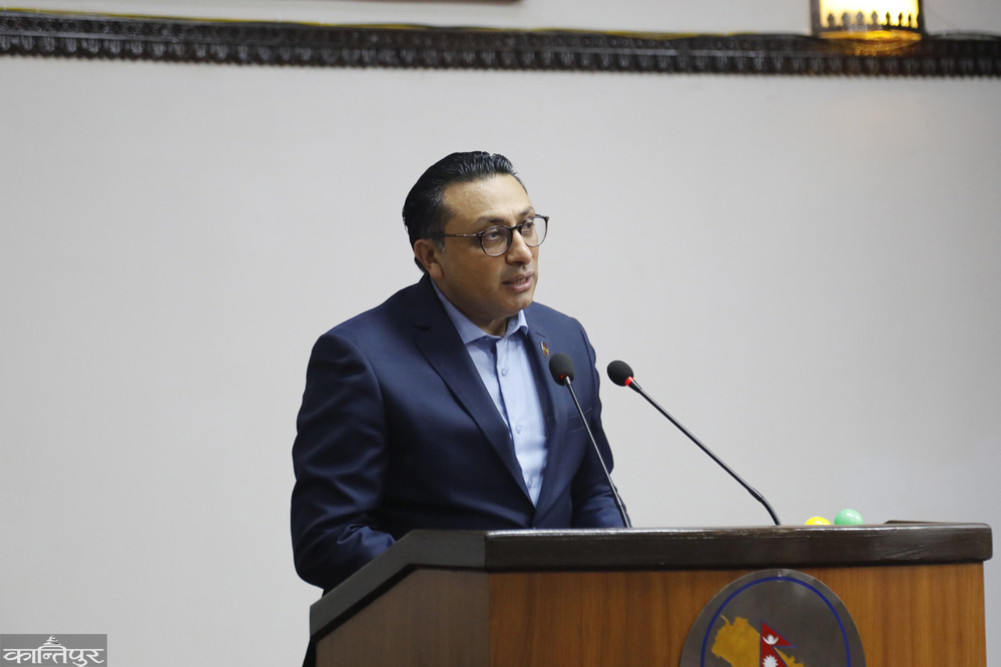
Finance Minister Swarnim Wagle has claimed to have achieved achievements ranging from policy, legal, and administrative reforms to digital transformation within 100 days of assuming office.
We use Google Cloud Translation Services. Google requires we provide the following disclaimer relating to use of this service:
This service may contain translations powered by Google. Google disclaims all warranties related to the translations, expressed or implied, including any warranties of accuracy, reliability, and any implied warranties of merchantability, fitness for a particular purpose, and noninfringement.
A list of the works completed by Finance Minister Swarnim Wagle in the first 100 days after assuming charge of the Ministry of Finance has been made public by the ministry and its subordinate bodies. The list made public by Finance Minister Wagle's secretariat on Sunday includes policy and legal reforms, bills submitted to Parliament and their status, governance reforms, institutional reforms, public service delivery, administrative simplification, digital transformation, and other issues.
According to which, Nepal's current economic status report has been made public in legal and policy reforms, the principles and priorities of the Appropriation Bill for the fiscal year 2083/84 and the budget statement have been prepared and submitted to the federal parliament. It has been stated that a draft roadmap for comprehensive economic and legal reforms has been prepared, setting the priorities for new bills or amendments to existing laws, including private enterprise and business protection and promotion and facilitation of large development projects.
‘The Financial Procedures and Financial Responsibility Regulations, 2077 have been amended to delegate authority to the Secretary (Accounting Officer) of the concerned ministry to transfer capital funds.’ The list includes, ‘As per the suggestions of the High-Level Economic Reforms Suggestion Commission, it has been decided to repeal 15 laws and their implementation has been taken forward. The Revenue Investigation Department has been abolished and its management has been taken forward.’
Similarly, Finance Minister Wagle has also considered the approval and implementation of the 5-Year Strategic Plan, 2082 of the Office of the Comptroller and Auditor General as an achievement. ‘The budget and program for the upcoming fiscal year 2083/84 have been prepared with a transformative policy to build the foundation for greater economic reform, bills including the Financial Bill and Appropriation Bill have been presented in Parliament, and amendments have been made to related acts including the Customs Act and Income Tax Act,’ said a statement issued by the Ministry of Finance.
Under the legal reforms, the Alternative Development Finance Mobilization Act, the Nepal Rastra Bank Act, 2058 BS, and the Ordinance to amend the Money Laundering Prevention Act, 2064 BS have been passed by the Parliament. The Bills, Payment and Final Settlement (First Amendment) Bill, submitted to the Council of Ministers of the Government of Nepal have been submitted for opinion. Similarly, about a dozen regulations and procedures have also been amended and implemented.
The Finance Minister claims that this has eliminated legal duplication, facilitated development, capital market and financial sector development, and laid the foundation for economic reform.
Similarly, arrangements have been made to provide taxpayer services with permanent account numbers from 120 local levels and the office of the company registrar, and in the context of disruptions in the supply of petroleum products (diesel, petrol, kerosene) and price increases in the world market due to the ongoing tension in West Asia, a 50 percent discount has been given on customs duties and infrastructure development fees on imports to reduce the burden on the public.
Finance Minister Wagle has also started the development of an e-pension verification system so that pension verification can be done from any place or home.
Similarly, the government has also taken the public as a great achievement in the budget for the upcoming fiscal year 2083/84. In which, income tax exemption has been increased to one million, the health insurance program has been restructured, a detailed blueprint for the development of the education sector has been prepared, and farmers have been ensured easy, convenient and timely access to fertilizers, seeds and other materials.
‘The development of positive perception of the general public towards simple, easy and less cumbersome public services has made the life of the general public easier,’ Finance Minister Wagle has claimed.
The Finance Minister has also stated that a lot of work has been done in governance reform, institutional reform, public service delivery, administrative simplification, and digital transformation.
Accordingly, the organization and management survey of the ministry and subordinate departments has been completed and restructured, the largest financial crime in history (a scam worth more than Rs 110 billion in the insurance and securities sector) has been successfully investigated and a case has been filed in court for money laundering, and further investigation has been intensified, according to the Finance Minister.
Similarly, the Revenue Investigation Department has been abolished and the organization has been restructured so that the work performed by it can be performed by other departments, and officers of 47 offices including large taxpayer offices, medium-level taxpayer offices, and the related treasury and accounts controller offices have been designated as excise officers with responsibilities and jurisdictions as per Sections 5 and 6 of the Excise Act, 2058 BS.
Similarly, the federal ministry has started providing salaries to civil servants on a semi-monthly basis from 16 Baisakh 2083, while the Operational Guidelines, 2081 have been amended to reduce the benefits of officials and employees receiving fuel facilities.
The Ministry of Finance has also considered the selection process of competent leadership through open competition in government banks, capital markets and regulatory bodies in the insurance sector, and the appointment of the Chairman of the Nepal Securities Board as achievements.
Similarly, all work including public service delivery, administrative simplification and digitalization, submission of tax returns from the Internal Revenue Office, tax payment, etc. is provided through an online system, and the Ministry has also launched an online customs valuation system to make customs valuation scientific.
A new system has been implemented to facilitate tourists and other visitors to Nepal. The Ministry of Finance claims that the aforementioned work has improved service delivery, facilitated international trade, reduced the number of complaints, and improved revenue collection.
Bilateral or multilateral agreements have been signed by the Government of Nepal. This has mobilized foreign aid to build the country's socio-economic development infrastructure, and facilitated trade by making international trade more systematic and transparent, the Ministry of Finance claims.
Similarly, the Ministry of Finance has stated that various works have been done in economic and social infrastructure, investment, job creation, innovation, and development management.
Similarly, the implementation process of the report received from the committee regarding the restructuring of Nepal Stock Exchange Limited has been taken forward. Various works have been done in the reform and management of public corporations in the last 100 days.