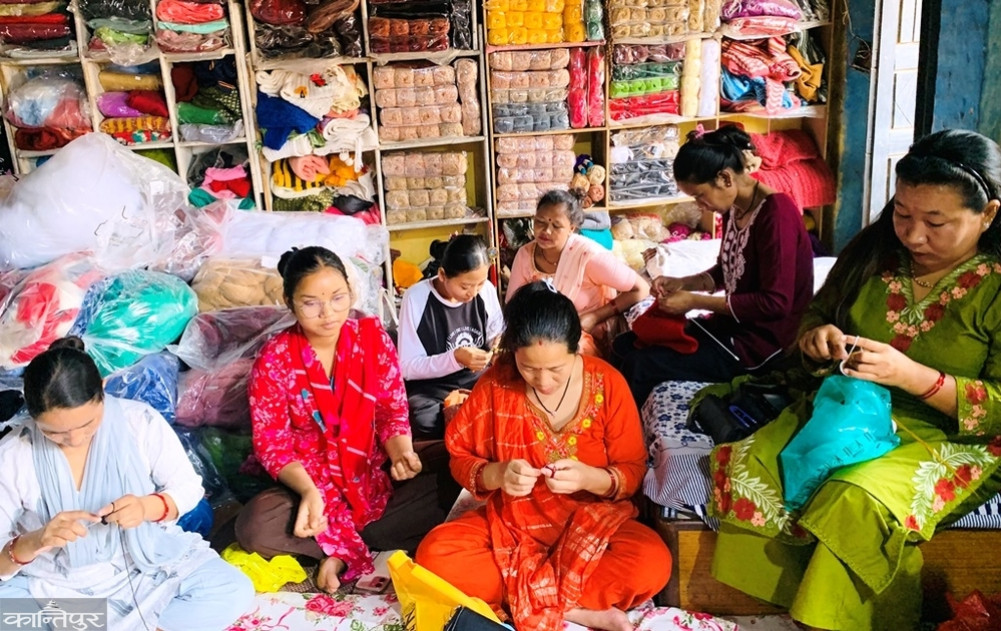
Violence-affected and single women have been contributing to employment and economic empowerment by producing educational materials and other handicrafts ranging from wool to silk.
We use Google Cloud Translation Services. Google requires we provide the following disclaimer relating to use of this service:
This service may contain translations powered by Google. Google disclaims all warranties related to the translations, expressed or implied, including any warranties of accuracy, reliability, and any implied warranties of merchantability, fitness for a particular purpose, and noninfringement.
Children are shown pictures from books to learn from A for Apple to J for Zebra. In some schools, plastic items are shown. With the aim of making things child-friendly and easy to learn, women from Ghorahi have made items from A to Z from wool.
Single women affected by gender-based violence are coming together to make various items at the Swapna Hosiery Industry and Training Center in Ghorahi-15. Currently, 15 women are working in the hosiery industry. They are producing more than 55 items including baby frocks, hats, socks, gloves, hair vents, baby sets, sweaters, kurta sets, gloves, etc.
The operator, Rachana Subedi, said that she started the hosiery industry to connect women affected by violence with income. She said that human feelings and love are mixed in hand-woven items. ‘Because they are handmade, love is mixed in these items. There is a psychological feeling attached,’ she said, ‘I feel like it hurts when I sew a doll, I feel like it will be difficult for her to put it in a drawer after making it.’ She said that an attempt was also made to reduce stress by making women victims of violence forget about work.’
Some people make items at home. Subedi said that since it is woven by hand and does not require a machine, this work can be done anywhere. She said that items made from wool can be used repeatedly, can be washed and kept clean, do not hurt children and are also entertaining. According to Subedi, it takes a few hours to a day to make one letter item.
Wool items are being sold in different parts of the country as well as abroad. Subedi said that most of the items are sold in Montessori schools, Koseli houses, local markets and museums. She said that the industry, which is operated with an investment of about 1 million, has an annual turnover of 20 to 25 million.
She said that since the handmade goods are sold as examples of handicrafts from the country to abroad, they are being sold. 'Handicrafts are an important art that preserves our culture, increases employment and helps in economic development,' she said. 'Understanding this importance, the demand for goods has increased. Women have found employment.'
Subedi said that more than 1,200 women from Lumbini Province have been trained and most of them are doing similar jobs. The women who have learned start working in the industry. Champa Chaudhary of Ghorahi-13 has been making woolen goods in the industry for three years. This has made her a living. Samjhana Pun of Banglachuli Rural Municipality has been working for four years.
She said that she has joined employment after learning the skill and it has given her self-satisfaction. ‘I feel happy when I get to make children’s toys,’ she said, ‘I feel like children learn something from the things we make.’
Yami Pun of Mandavi Rural Municipality-2, Pyuthan, has also been working for four years. She said that after learning to make things from wool, she created self-employment. ‘Spending free time causes unnecessary stress,’ she said, ‘Once you start working, you forget your sorrows and earn money.’
Thami Bantha Magar of Pyuthan is recently learning skills in the industry. Like other sisters, she has also come to the industry with a plan to earn income. Since it is an industry and training center, women who come to learn regularly and work after learning can sit together and learn from each other, share their joys and sorrows.