The scope of areas where banks and financial institutions are required to extend mandatory credit has also been revised due to the high number of bad loans in the specified areas and the failure to achieve the desired results.
We use Google Cloud Translation Services. Google requires we provide the following disclaimer relating to use of this service:
This service may contain translations powered by Google. Google disclaims all warranties related to the translations, expressed or implied, including any warranties of accuracy, reliability, and any implied warranties of merchantability, fitness for a particular purpose, and noninfringement.
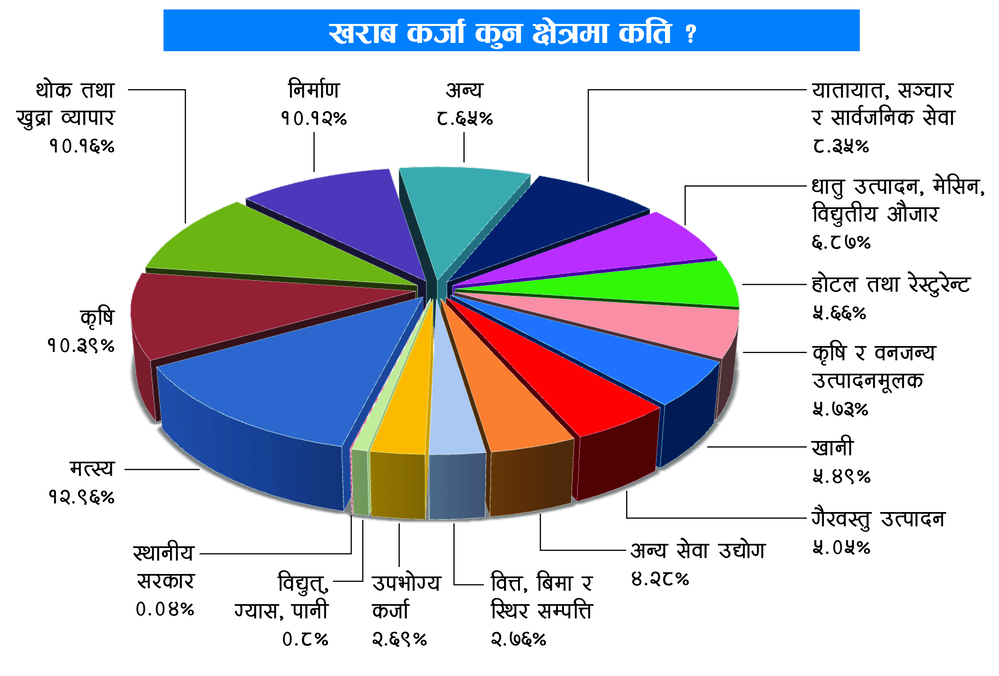
The problem of loans flowing in the sectors where the Nepal Rastra Bank has instructed banks and financial institutions to provide loans at a fixed percentage has started to arise. Of the total bad loans as of last Chaitra, agriculture and fisheries accounted for about 23.5 percent. The construction sector, including hydropower projects, accounted for about 10.5 percent. Wholesale and retail trade accounted for about 10 percent of the bad loans.
Experts say that this is due to the fact that if loans are not provided in the specified sectors, regulatory bodies will take action, banks and financial institutions will also turn a blind eye to the quality of loans, and that micro, small and medium enterprises, along with agriculture, will be the fastest affected when the economy is not in motion.
Due to the high number of bad loans in the specified sectors and the failure to deliver results as intended, the Rastra Bank revised the scope of areas where banks and financial institutions must extend mandatory loans in last Chaitra. Previously, only agriculture, energy, and micro, household, small and medium enterprises/businesses were included in the specified sectors, but now tourism, information and communication technology-based industries, and export industries based on domestic raw materials have also been added.
According to the new system, banks and financial institutions must provide 10 percent to agriculture. At least 20 percent of the total credit will have to be expanded to tourism, micro, household, small and medium enterprises/businesses, energy, information technology and export industries based on indigenous raw technology. However, the system of providing at least 5 percent credit to the disadvantaged group remains unchanged.
In this way, banks must still provide at least 35 percent of credit to the specified sector. Of this, problems have started to be seen in the recovery of loans to the disadvantaged group, agriculture and small and medium enterprises.
Even officials of the Nepal Rastra Bank admit that relatively more bad loans are seen in the agriculture, energy, micro, small and medium enterprise sectors (priority sectors). The problems in the overall economy have affected economic activity and its direct impact has been on the agriculture, micro, small and medium enterprise sectors, said Nepal Rastra Bank spokesperson Guru Prasad Poudel.
‘Small entrepreneurs neither have alternative sources nor can they diversify their businesses. Therefore, the capital base of small entrepreneurs has been shaken by the slowdown in economic activity, and has not yet recovered,' he said. 'They seem to be in trouble because the credit policy to protect small entrepreneurs and the inclusive insurance policy are not sufficient.' Poudel suggested that the state should take a policy to effectively protect and encourage them, as they have less chance of taking loans and diversifying their businesses compared to large borrowers.
Poor class loans Poor class loans are loans provided without collateral to low-income and especially socially backward women, tribals, Dalits, differently abled people, marginalized communities, and small farmers, artisans, laborers, and landless families.
The National Bank has directed banks to disburse at least 5 percent of their total loans to this sector to operate self-employment-oriented micro-enterprises operated for the economic and social upliftment of the poor class. Commercial banks do not invest in the loans disbursed to the poor class themselves. They provide wholesale loans to microfinance institutions and banks can count those loans as poor class loans.
The significant increase in bad loans of microfinance financial institutions in Chaitu compared to last Ashar confirms that many loans flowing to the poor have not been recovered.
The average bad loans of microfinance financial institutions have reached 11.32 percent as of last Chaitu. This ratio was 7 percent in last Ashar. Since then, the bad loans of microfinance financial institutions have increased by 4.32 percentage points to 11.32 percent. The report of the Nepal Rastra Bank has shown that the non-performing loans of microfinance financial institutions have increased significantly as of last Chaitu, but the growth rate of total loans and borrowings has been normal.
The average bad loans of microfinance financial institutions in last Ashar was 7 percent. There are 52 microfinance financial institutions in Nepal. Of these, only 2 are allowed to collect deposits from the general public, the rest are not. Their source is the wholesale loans taken from banks and financial institutions. Because the wholesale loans given to microfinance are counted by banks as loans to the poor. Therefore, the increase in bad loans of microfinance indirectly means that the bad loans of banks and financial institutions also increase.
As of Chaitra 2082, the bad loans of microfinance financial institutions are 54.08 billion (i.e. 11.32 percent). Compared to last Ashar, the bad loans of microfinance financial institutions have increased by 74.35 percent in amount in Chaitra. As of last Ashar, the bad loans of microfinance were 31.02 billion rupees. Compared to the same period of the last fiscal year, the bad loans have increased by about 71.5 percent in amount this year.
As the direct impact of the problem in the economy has been on the economic activities of rural areas, small loans are not in a position to repay the loans even if they want to, said Ram Bahadur Yadav, Chairman of the Microfinance Bankers Association. ‘Currently, microfinance financial institutions have disbursed about 5 trillion loans. About 85 percent of them have been disbursed without collateral,’ he said, ‘There was a problem in the economy. After the economic activities were directly affected, small loans could not sustain the business. The impact of this has been felt by small borrowers, who have not been able to repay their loans.’
Yadav says that industries that used to work 5/6 days a week in the past have now started working only 2/3 days a week, and as the market demand has decreased, their businesses have gone into losses, so they are not in a position to repay their loans even if they want to. Yadav said that the policy of the regulatory body is also a factor in the increase in bad loans in microfinance.
‘The National Bank has also provided restructuring and rescheduling facilities for borrowers of microfinance financial institutions. But after providing that facility, the restructured and rescheduled loans should be classified as bad loans,’ he said, ‘That is why the bad loans of microfinance have increased.’
According to bank data, the average bad loans of banks and financial institutions are 5.60 percent as of the third quarter of the current fiscal year. Sectorally, the highest bad loans are seen in agriculture, construction, wholesale and retail trade, transportation, communication, and public services. Accordingly, as of last Chaitra, there is more than 23 percent bad loans in agriculture and fisheries alone. During the same period, the financial statements published by the banks mention that there were 10.12 percent bad loans in construction, 10.16 percent in wholesale and retail trade, 8.5 percent in transport, communication and public services, about 7 percent in metals, manufacturing, machinery and electrical equipment, and about 6 percent in hotels and restaurants.
‘Credit had to be provided in the specified sector no matter what. That is why banks could not pay enough attention to the quality of loans,’ said former banker and chartered accountant Analraj Bhattarai. ‘The objective of the Rastra Bank’s directive to expand a certain percentage of loans in the primary sector is good. However, we should have also developed entrepreneurship at the same time. Otherwise, if we only give loans, they are not used in the right places and even if they are used, the expected results are not achieved.’
Bhattarai said that bad loans have increased in this sector due to the mandatory provision for direct investment in the poor class and MSMEs. ‘In the past, when the total loans of banks and financial institutions were about 7 trillion, the regulatory body had made a provision to provide at least 5 percent of the total loans to the poor class. Even though the total loan has now reached more than 5.9 trillion, the same system is still in place,' he said, 'After being forced to give loans due to the directives of the regulatory body, banks and financial institutions have also compromised on the quality of assets. The impact of this is now visible.'
Bhattarai says that the fact that the MSME sector is not under the scope of regulation is also the reason for the increase in bad loans. 'Without regulation, MSMEs were not accountable to anyone. They were free to make their own decisions. Problems started to appear in recent years when the economy started facing problems.' Bhattarai suggests that the mandatory system for banks and financial institutions to directly extend loans to this sector should be removed to improve this problem.
Government data also shows that bad loans of banks and financial institutions have started increasing. The average bad loan ratio, which was 3.33 percent in Asad 2072 and 3.02 percent in Asad 2080, has reached 5.42 percent by Magh 2082. ‘The non-performing loan ratio of development banks and finance companies is higher than that of commercial banks,’ Finance Minister Swarnim Wagle said in the economic status report presented in Jestha. ‘Although the average non-performing loan ratio of banks and financial institutions is currently at an acceptable level, its increasing pace is likely to be a challenge for financial stability in the coming days if corrective measures are not taken immediately.’
The bad loans of banks have increased in the third quarter of the current fiscal year compared to the previous year. In the third quarter of the previous fiscal year, the average bad loans of commercial banks were 4.98 percent, but it has increased to 5.25 percent in the same period this year.
Out of the 20 commercial banks in operation, five banks have bad loans above 7 percent. Generally, there is a provision to keep the bad loans of banks and financial institutions within 5 percent. However, even if it goes above that, the Rastra Bank does not take action. Because the action taken by the Rastra Bank when the bad loans exceed the prescribed limit is only to not keep deposits in those banks. Currently, the Rastra Bank has made arrangements to keep deposits in banks with bad loans of at least 8 percent.
‘Even when the economy is sluggish due to the Gen-G movement, the interim government and parliamentary elections, small entrepreneurs seem to be more affected,’ said Santosh Koirala, President of the Nepal Bankers Association. ‘There were problems with many loans flowing to the agriculture, poor class and small and medium enterprises sectors.’
While some of the loans flowing to the agriculture, small entrepreneurs, poor class and other sectors were used for other purposes, many borrowers who used them for the right purpose were unable to repay the loans due to problems in the economy, Koirala said.
Many loans were kept ‘alive’ during the restructuring facilities provided during the Covid pandemic. After that period, the real quality of those loans has started to come out. Real estate, loans secured by the stock market, and small and medium enterprise loans are particularly affected.
Sujit Shakya, Chief Executive Officer of NIC Bank, said that a large share of the bad loans of banks and financial institutions belong to micro, small and medium enterprises (MSMEs). “At that time, due to the directive of the National Bank to provide a certain percentage of total loans to MSMEs and especially after the Covid pandemic, banks and financial institutions also aggressively provided small investments, a large share of bad loans is now seen to be from MSMEs,” he said. “If the specified loans were not provided to the MSME sector, the regulatory body would have to take action. That is why banks had increased direct investment in that sector.” Until last Chaitra, there was a regulatory provision that banks had to provide 15 percent of total loans to small and medium enterprises.
When the economy was not moving, when problems arose in one sector for large borrowers, another sector would take over, Shakya argues, but this was not the case for small borrowers, which is why bad loans have increased.
Banks and financial institutions have adopted various measures to prevent corporate and large borrowers from having bad loans, but since small borrowers were not provided with that facility, many small loans have been in trouble, says Sarojkaji Tuladhar, former president of the Nepal Finance Company Association. ‘ठूलो ऋण नउठेपछि खराब कर्जा पनि धेरै हुने भएकाले बैंक तथा वित्तीय संस्थाले ठूला ऋणी जोगाउन जसोतसो गरेर मिलाइरहेका हुन्छन्,’ उनले भने, ‘तर साना ऋण/उद्यमीलाई बेवास्ता गरिन्छ ।’
सहकारी र लघुवित्त क्षेत्रमा समस्या आउँदा त्यसको प्रत्यक्ष असरले साना उद्यमीको नगद चक्र नै भत्किएकाले उनीहरू ऋण तिर्न सक्ने अवस्थामा नरहेको तुलाधरको टिप्पणी छ । ‘विगतमा एउटै व्यक्तिले पनि धेरै लघुवित्तबाट एकभन्दा बढी सहकारीबाट कर्जा लिइरहेका हुन्थे, उनीहरूको नगद चक्र (नगद व्यवस्थापन) नियमित थियो,’ उनले भने, ‘जब एकै पटक सहकारी र लघुवित्तबाट ऋण लिन अप्ठ्यारो हुन थालेपछि साना उद्यमीको नगद चक्र भत्किएकाले ऋण तिर्ने क्षमता हराएको हो ।’
बैंकिङ क्षेत्र अहिले गम्भीर दबाबमा रहेको बैंक तथा वित्तीय संस्था परिसंघ, नेपाल (सिबिफिन) का अध्यक्ष प्रचण्डबहादुर श्रेष्ठले जनाए । श्रेष्ठका अनुसार कागजमा बैंकिङ प्रणालीमा पर्याप्त तरलता देखिए पनि वास्तविक अर्थतन्त्रमा कर्जाको माग घटेको र व्यावसायिक आत्मविश्वास कमजोर बनेको छ ।
विभिन्न आर्थिक क्षेत्रमा नगद प्रवाह (क्यास फ्लो) सुकेकाले बलिया र सक्षम व्यवसायको समेत ऋण भुक्तानी गर्ने क्षमता प्रभावित बनेको श्रेष्ठको भनाइ छ । ‘खराब कर्जा बढेको प्रत्यक्ष असर बैंकहरूको सम्पत्ति व्यवस्थापनमा परेकाले ६० अर्ब रुपैयाँभन्दा बढीको गैरबैंकिङ सम्पत्ति (ननबैंकिङ एसेट) थुप्रिएको छ । धेरै ऋणीले ऋण तिर्न नसक्दा बैंकहरूले धितो सम्पत्ति स्वीकार गर्नुपरेको र ठूलो परिमाणमा बैंकहरूको पुँजी अनुत्पादक सम्पत्तिमा फसेको छ,’ उनले भने, ‘यसले बैंकहरूको अर्थतन्त्रमा थप लगानी गर्ने क्षमता खुम्चिएको छ ।’
सरकारको कार्यक्रमअन्तर्गत बैंक तथा वित्तीय संस्थाले प्रवाह गरेको ब्याज अनुदानको सहुलियत कर्जामध्ये करिब १८ प्रतिशत दुरुपयोग (सही ठाउँमा प्रयोग नभएको) भएको एक स्वतन्त्र मूल्यांकनले देखाएको छ । राष्ट्र बैंकको निर्देशनमा २०८१ मा सहुलियतपूर्ण कर्जाको प्रभावकारिता तथा उचित उपयोगको निर्क्योल गर्न परामर्शदाताको जिम्मेवारी पाएको जोशी एन्ड भण्डारी चार्टर्ड एकाउन्टेन्ट्सले गरेको मूल्यांकन प्रतिवेदनले यस्तो देखाएको थियो ।
मूल्यांकन गरिएका कर्जा फाइलमध्ये सदुपयोग नभएको कर्जा ७, लक्षित वर्ग पहिचान नभएको १२, दोहोरो उपयोग गरेको ६ र दुरुपयोगको आंशका गरिएको कर्जा ११ प्रतिशत रहेको प्रतिवेदनमा उल्लेख छ । लक्षित वर्ग पहिचान नहुनु, दोहोरो उपभोग हुनु र दुरुपयोगको आशंका हुनु पनि कर्जाको दुरुपयोग नै हो ।
सदुपयोग नभएको ७ र दुरुपयोगको आशंका गरिएको ११ गरी करिब १८ प्रतिशत सहुलियत कर्जा दुरुपयोग भएको निष्कर्ष निकालिएको हो । यो तथ्यांकभित्र लक्षित वर्ग पहिचान नभएका र दोहोरो उपयोग भएका कर्जा पनि पर्ने राष्ट्र बैंकले प्रस्ट्याएको छ ।
चालु आर्थिक वर्षको पहिलो ६ महिना (साउनदेखि पुस) सम्म साना, मझौला र ठूला गरी मुलुकभर थप ४ सय ६१ उद्योग दर्ता भएका छन् । गत वर्षको सोही अवधिको तुलनामा यस वर्ष नयाँ दर्ता भएका उद्योगको संख्या १ सय २० ले कम हो ।
गत आर्थिक वर्षको पहिलो ६ महिनामा मुलुकभर थप ५ सय ८१ उद्योग दर्ता भएका थिए । गत आर्थिक वर्षको तुलनामा यस वर्ष उद्योग दर्ता संख्यामा कमी हुनुलाई मुलुकको सुध्रिन नसकेको लगानीमैत्री वातावरणसँग जोडेर हेरिएको छ । उद्योग राज्यको प्राथमिकतामा नपरेको, उद्योगमा जग्गा, वन, कर्मचारीलगायत लामो समयदेखि जकडिएका समस्या समाधान नभएको लगायत कारण उद्योगमा आकर्षण घट्दै गएको उद्योगी बताउँछन् ।