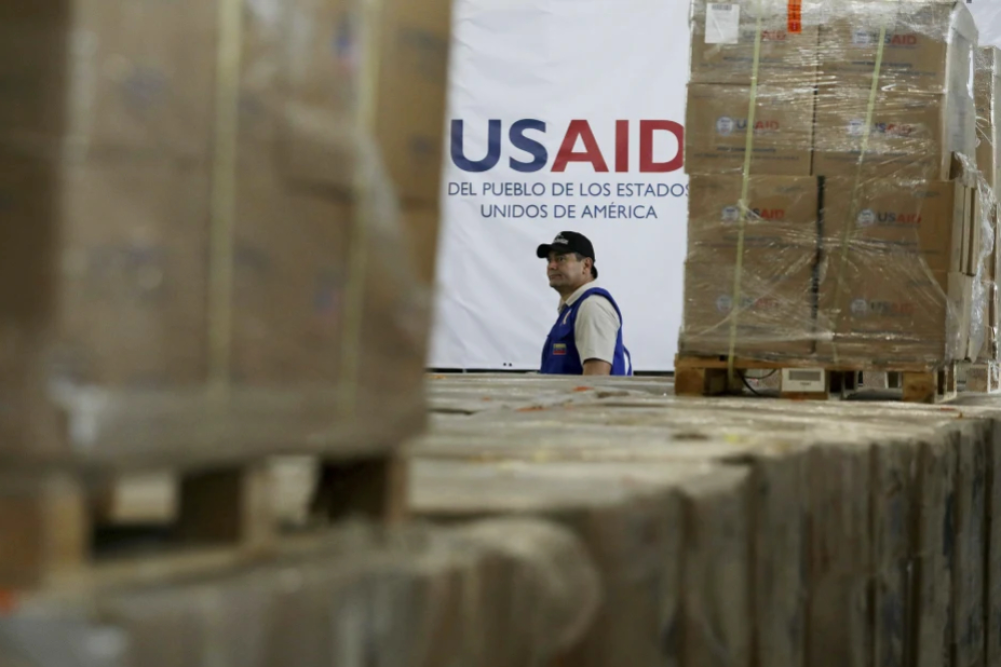
Before the aid cuts, USAID had committed to providing $72 million over five years for targeted nutrition programs for about 9 million people in 48 districts of Nepal.
We use Google Cloud Translation Services. Google requires we provide the following disclaimer relating to use of this service:
This service may contain translations powered by Google. Google disclaims all warranties related to the translations, expressed or implied, including any warranties of accuracy, reliability, and any implied warranties of merchantability, fitness for a particular purpose, and noninfringement.
A new study published in The Lancet has sparked a global debate, warning that cuts to aid provided by the United States Agency for International Development (USAID) could lead to more than 14 million additional deaths by 2030.
Since the report was published, many users on social media, especially on X, have criticized billionaire Elon Musk, who has been campaigning to dismantle USAID through the Department of Government Efficiency (DoD), and called the study “complete nonsense.” Musk has responded by posting a series of aggressive tweets on X, calling the study “complete nonsense.” He has also claimed that “the reality is that no one has died” and that USAID has “caused a lot of the deaths.”
Musk has also said that he rejects the study’s modeling, claiming that the death rate in Africa has not increased after aid cuts. Since the study was made public, it has received widespread international attention. The potential impact of USAID aid cuts has been rekindled a year after the agency closed. The study, led by researchers at the Barcelona Institute for Global Health and published in The Lancet, analyzed data from 133 low- and middle-income countries between 2001 and 2021. The study found that USAID programs saved an estimated 91 million lives over two decades, including 30 million children under the age of five. The researchers projected that if current aid cuts continue through 2030, more than 14 million additional deaths could occur, including more than 4.5 million children under the age of five. The study found that USAID’s support is critical to reducing deaths related to HIV/AIDS, malaria, tuberculosis, diarrhea, and maternal health.
The sudden aid cutback could have a shock equivalent to a global pandemic or a major armed conflict for many developing countries, warned Dr. Davide Rasella, one of the study's authors. Last year, Musk said he would close USAID after taking over as the head of the agency. President Donald Trump announced the closure of the agency on his advice.
The findings of the recently published study have been taken seriously by global health experts. New York Times columnist Nicholas Kristof said that while Musk claims that no lives have been lost as a result of the aid cuts, reporting from affected countries shows a different picture. The BBC also quoted Rasella as saying that the cuts risk reversing two decades of gains in global health.
The impact is also seen as significant for countries like Nepal. Before the aid cut, USAID had pledged to provide $72 million over five years for targeted nutrition programs for about 9 million people in 48 districts of Nepal. In addition, it had been providing various assistance worth an average of $100 million annually over the past decade.
The agency, which has been continuously helping Nepal improve its public health sector for decades, has been suspended since 2025, and a recent public national survey has shown that the situation of child malnutrition is alarming. Health experts have also expressed concern that the gains made over decades will be lost if the funding shortage persists. Nepal is ranked 16th on the list of countries receiving US aid. USAID last signed a five-year strategic partnership agreement with the Nepalese government on May 15, 2022, providing $659 million in aid.