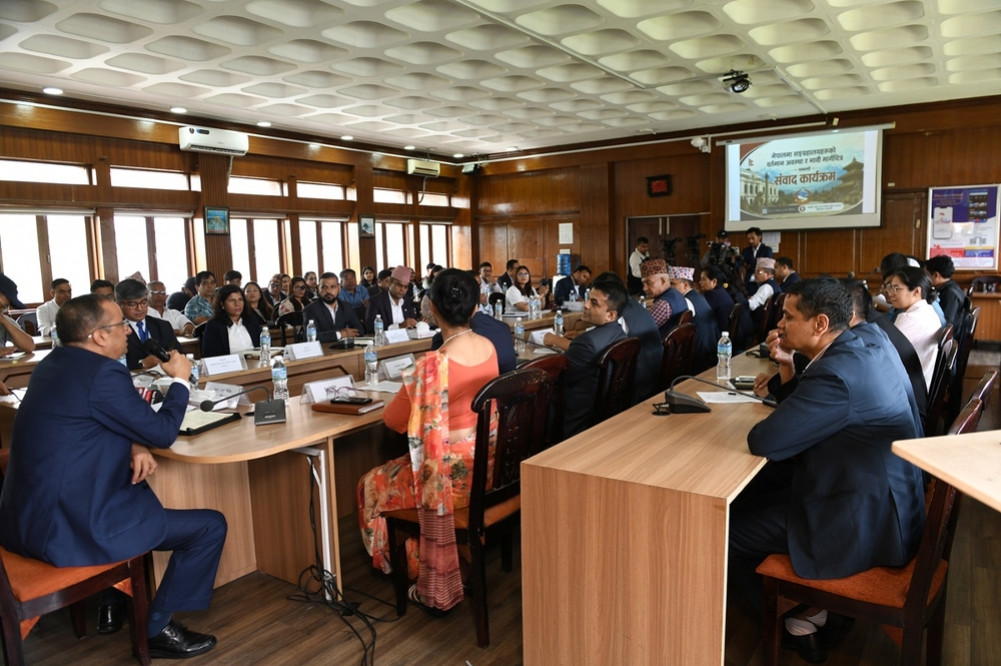
Participants in the discussion emphasized that museums should be developed not only as places to store objects but also as vibrant institutions that transmit history, culture, education, and national identity.
We use Google Cloud Translation Services. Google requires we provide the following disclaimer relating to use of this service:
This service may contain translations powered by Google. Google disclaims all warranties related to the translations, expressed or implied, including any warranties of accuracy, reliability, and any implied warranties of merchantability, fitness for a particular purpose, and noninfringement.
Experts and government officials have expressed concern that Nepal's museums are operating in the absence of clear national standards, unified legal framework, skilled manpower and effective regulation.
In a discussion on 'National Standards for Museums' organized by the Ministry of Culture, Tourism and Civil Aviation on Thursday, participants emphasized that museums should be developed not only as places to store objects but also as vibrant institutions that transmit history, culture, education and national identity.
At the program, Joint Secretary of the Ministry Suresh Suras Shrestha, Under-Secretary of the Ministry of Home Affairs Kumari, Under-Secretary of the Ministry of Federal Affairs and General Administration Deepak Dhakal, Chairman of BP Museum Parashuram Pokharel, Chief of the National Museum Camp Aruna Nakarmi and Secretary of the International Council of Museums Nepal Om Prakash Ghimire presented working papers and their views on Nepal's museums.
Most of the speakers in the discussion said that due to the lack of a separate and clear legal basis and national standards for operating museums in Nepal, even museums of the same nature are operating under different laws. Om Prakash Ghimire said that there is confusion not because there is no law in Nepal, but because there are many laws. According to him, museums are being registered under the District Administration Office, Companies Act, local level or various institutional laws. This has created problems in regulation, classification and quality assessment.
He suggested that Nepal should prepare national standards based on UNESCO's 2015 recommendation, ICOM's code of conduct and international human rights standards.
Joint Secretary at the Ministry of Tourism Suresh Suras Shrestha said that the main challenge is not the lack of laws for the operation of museums in Nepal, but the provisions scattered in various acts. According to him, government museums, museums under universities, museums of the Nepali Army and museums operated by NGOs are all operating on different legal bases. He informed that the ministry is now preparing to create a unified legal structure by incorporating these provisions. Shrestha also informed that the ministry has initiated the process of preparing a draft law related to museums and aims to take it to the government process within the next one year. He mentioned that another big problem is the lack of skilled manpower and said that the study of museum science in Nepal has been weakening recently. He said that there is a risk of shortage of skilled manpower in the future due to the closure of courses conducted at the university.
Undersecretary of the Ministry of Home Affairs, Kumari, admitted that museum security is still weak. According to her, although the Chief District Officer is currently responsible for protecting public property, there is no separate security system targeting museums. Although there is a tourism police, their responsibilities are extensive, so a mechanism focused on heritage and museum security is needed, she said. She admitted that regular museum monitoring by the District Administration Office is not possible, citing the lack of manpower as the main reason for this.
Undersecretary of the Ministry of Federal Affairs and General Administration, Deepak Dhakal, said that although the constitution has placed museum management as a common right of the federal, provincial and local levels, many museums being operated at the local level have been established without clear standards. According to her, some local levels have only operated collection centers in the name of museums. The necessary standards, conservation systems, archiving and management practices for actual museum operation have not yet been developed. He stressed the need to prepare national standards and model laws that can be implemented by the local level.
BP Museum Chairman Parashuram Pokharel criticized the tendency to understand museums only as buildings for storing old objects. He said that museums should be developed as living educational institutions as they tell the story of society's history, struggle, culture, lifestyle and generational transmission. 'Museums are not just collections of objects, they have life, history and a means of teaching the new generation,' he said. He emphasized that museums should be developed by linking them with education, tourism and national identity. In the discussion, speakers presented examples of countries like China, Japan, France and Egypt making museums a means of education, tourism, cultural diplomacy and 'soft power'. According to them, there is a need to develop museums in Nepal not only as centers for the preservation of archaeological objects but also as a means of education, research, digital archiving, tourism promotion and international image building.
The main problems raised during the discussion include the lack of a unified law on museums, the absence of a national standard and classification system, the lack of skilled manpower and museum experts, weak regular monitoring and regulation, the absence of a special mechanism for museum security, the absence of a single standard at the local level, weak digital archiving and research, and the lack of adequate linkage between museums and education and tourism. The participants in the discussion suggested that the government transform museums into modern, international-level, research-oriented and public-participation institutions along with the formulation of national standards. Joint Secretary of the Ministry, Jayanarayan Acharya, said that the national standards to be prepared by the government will be prepared by incorporating the suggestions of experts and adopted by the governments at the same levels.