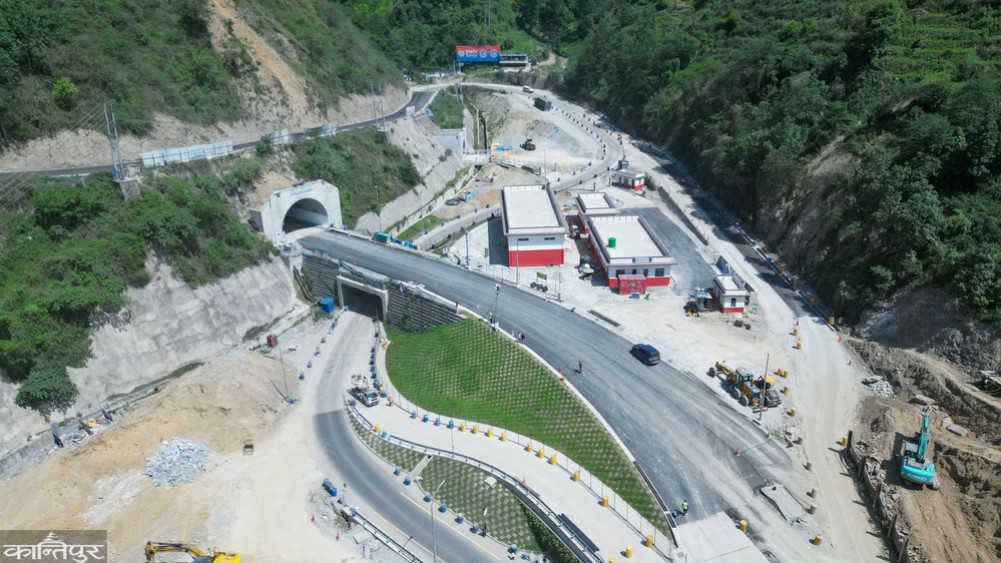
Preparations for the project to be operational by Shrawan, toll plazas also being constructed on both sides of Kathmandu and Dhading
We use Google Cloud Translation Services. Google requires we provide the following disclaimer relating to use of this service:
This service may contain translations powered by Google. Google disclaims all warranties related to the translations, expressed or implied, including any warranties of accuracy, reliability, and any implied warranties of merchantability, fitness for a particular purpose, and noninfringement.
The Nagdhunga-Sisnekhola tunnel has been completed in 79 months since its construction began. The Japanese company Hazma Endo Corporation, which took the contract, has handed over the tunnel to the Nagdhunga Tunnel Construction Project. Preparations are underway to bring the tunnel into operation by Shrawan.
The tunnel work was started on 4 Kartik 2076. As per the initial agreement, the work was to be completed within 42 months. However, it was delayed due to various reasons including Covid and local obstacles. The company handed over the project last Jestha.
As per the agreement, Hazma will have to repair and maintain the tunnel if there is any problem within a year. The project director, Saujanya Nepal, said that the software is being installed for the operation, from training the employees. ‘The construction company has completed the work, now we have taken over the tunnel,’ he said, ‘The period for correcting the errors for the said company is one year.’
The construction of toll plazas on both sides of Kathmandu and Dhading has also been completed. ‘The toll plaza work is complete and the software installation is underway,’ he said, ‘Work is underway to accustom the employees to operate the tunnel by Sharan.’ He said that the landslide management work on the Dhading side has also been completed.
The responsibility for operating the tunnel has been given to the USIN-ART JV. USIN is a Chinese and ART is a Nepalese company. There will be 150 employees on the tunnel route. The service provider company will have to manage and operate the tunnel for five years. The company that takes over the operation will have to maintain the tunnel, traffic management, emergency rescue, toll collection, and the entire tunnel and the 2.8-kilometer access road connecting Kathmandu and Dhading for five years. The service provider will have to operate and manage the tunnel round the clock.
Road Board Nepal Executive Director Ganesh Bahadur KC said that arrangements will be made for vehicles using the tunnel route to pay digitally. He said that N-tags and RFID (Radio Frequency Identification) gates will be arranged for payment. ‘If you have an account with the bank you are taking the N-tag from, the money will go to the card and be loaded. The gate will open as soon as you show that card at the gate, because the system has a provision to deduct the specified fee for using the tunnel by any vehicle.’ He said, ‘A maximum deposit of two thousand rupees is required for this, for which talks have been made with 13 different ‘A’ category banks, other banks can also join this.’ He said that it is mandatory for drivers to take the N-tag. Similarly, payment will be made by pasting a sticker on the front glass of the vehicle and scanning it with RFID, he said. For this, RFID gates will be arranged on both sides of Kathmandu and Dhading. Since RFID and N-tag are not available for those who use the tunnel only once or twice, QR codes and phone-pay will be arranged. This work will be done by the service provider company that will be responsible for operating the tunnel. The toll amount collected by it will have to be deposited in the account of Road Board Nepal every day.
A fee has been set for vehicles using the tunnel. According to which, cars and vans using the tunnel will have to pay a fee of Rs 65 when entering Kathmandu and Rs 60 when exiting. The Nagdhunga Tunnel Construction Project estimates that about 859 such vehicles will enter and 646 will exit daily. A fee of Rs 115 has been set for minibuses, trucks and tippers when entering Kathmandu and Rs 80 when exiting. It is estimated that 540 of these vehicles will enter the valley daily and 406 will exit daily. Buses and trucks will have to pay a fee of Rs 260 when entering Kathmandu through the tunnel and Rs 200 when exiting through the same route.
The project office estimates that 794 such vehicles will enter and 597 will exit daily. Large trucks and heavy vehicles (lorries) will have to pay a toll fee of Rs 600 when entering the valley through the tunnel and Rs 250 when exiting. It is estimated that 596 of these vehicles will enter and 448 will exit per day. According to the Nagdhunga-Sisnekhola Tunnel Transport Operation Directive, 2081, once the tunnel is operational, pedestrians, two-wheelers, three-wheelers and non-motorized vehicles will not be allowed to enter the tunnel. Vehicles carrying highly flammable and explosive substances including diesel, petrol, gas are also prohibited in the tunnel.
Such vehicles will be allowed to use the Nagdhunga-Sisnekhola road outside the tunnel. The main tunnel is 2,688 meters long and the emergency tunnel is 2,557 meters long. Overall, Japan has invested 21.5 billion rupees in the construction of the tunnel as a concessional loan and the Government of Nepal has invested 6 billion rupees.