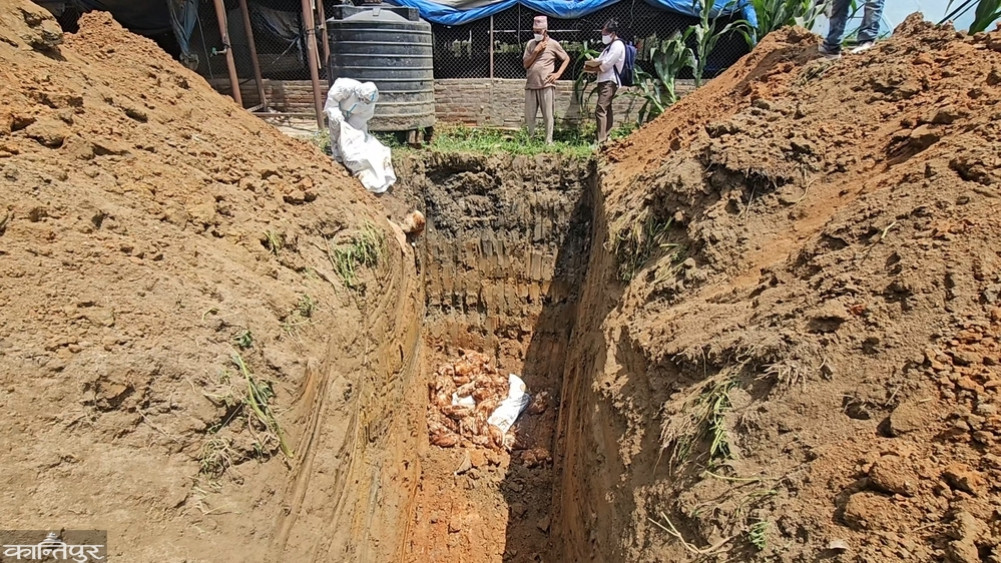
Farmers say, ”We helped destroy all the chickens by following the government's rules. Now the state should also assess the actual damage and provide relief. Relief may not cover all the losses, but it can provide a basis for recovery.”
We use Google Cloud Translation Services. Google requires we provide the following disclaimer relating to use of this service:
This service may contain translations powered by Google. Google disclaims all warranties related to the translations, expressed or implied, including any warranties of accuracy, reliability, and any implied warranties of merchantability, fitness for a particular purpose, and noninfringement.
‘One and a half years of hard work have come to an end in one fell swoop. Now I can’t sleep at night worrying about where and how to start again.’ This is the pain of Radheshyam Mahaju, a poultry farmer from the squatter village of Panauti Municipality-7.
Mahaju, who had been raising chickens for household purposes, started commercial poultry farming with a big dream a year and a half ago. He had invested up to Rs 1 million to raise about 750 chickens and ducks for eggs. He had dreamed of becoming self-reliant by expanding his business, but has now reached zero again after all the chickens died due to bird flu. He is confused whether to start the business again or not.
The business he started in 2082 Falgun was progressing well. The chickens had started laying eggs. He had hoped that the income from the business would increase. But a few days ago, when the chickens suddenly started dying, that hope gradually turned to despair. ‘Initially, only one or two died,’ he said, ‘Later the number increased, and the ducks also started dying without showing any symptoms.’ Initially, he sought local medicine. Despite trying treatment, the condition did not improve. Then he reached Kathmandu and showed the sample to the veterinarian. After initial tests, bird flu was suspected and he sent the sample for further testing. The report confirmed bird flu infection. 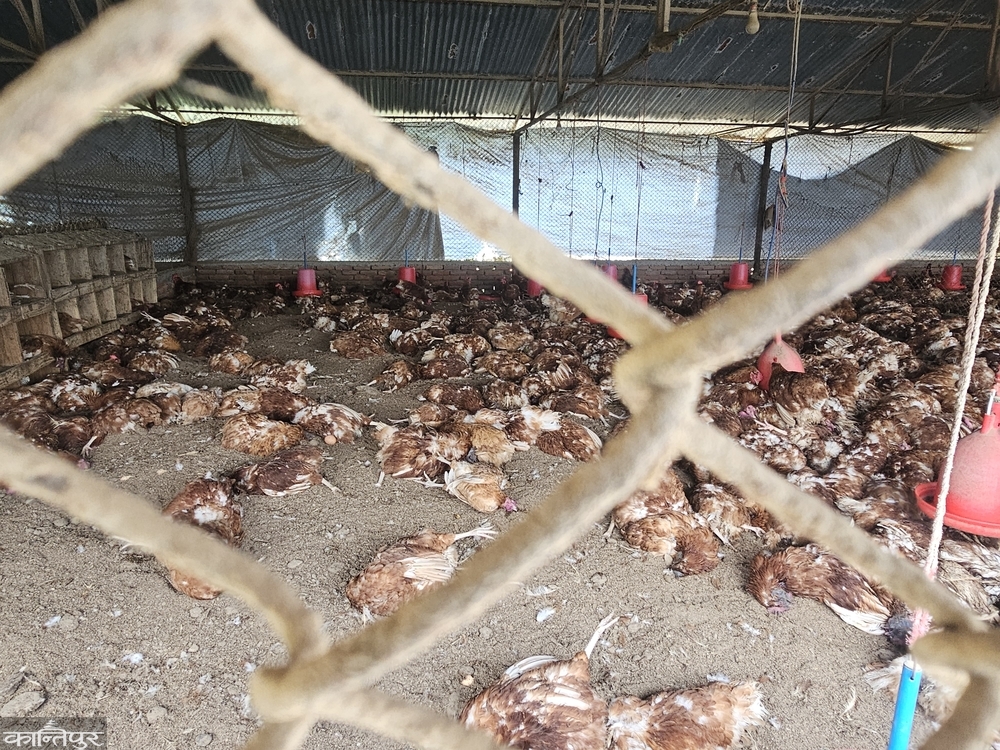 According to him, a government technical team reached the farm as soon as the report came. As per the instructions, all the chickens and ducks should be destroyed to prevent the spread of the infection, and the chickens and ducks were destroyed. ‘We have never experienced such a situation,’ he said, ‘When we were supposed to collect income, it was empty. It has been very difficult financially.’ According to him, this has caused a loss of about 4-5 lakh rupees. He, who had started a business by renting 5 ropanis of land and taking out loans, is now worried about how to start the business again.
000
The story of Madhav Prasad Sharma Tiwari of Panauti Municipality-5 is no different. He had taken a loan of Rs 8 lakh from a cooperative to start raising layer chickens commercially for the first time. He had invested about Rs 1.3 lakh in farm construction, chicks, feed, medicine, vaccinations and management and had raised 1,600 layer chickens.
After months of hard work, the chickens started laying eggs. Production had reached 70 percent. There was hope that the investment would be recovered. But at that time, he said, the chickens started dying due to bird flu infection.
According to him, initially 4 chickens died. They were treated at the local level, thinking it was normal. But the chickens kept dying. The sample sent for further testing confirmed bird flu. After the infection was confirmed, a government team reached the farm and destroyed all the chickens, he said. According to him, about 1,400 chickens have been destroyed.
‘There is nothing greater than the safety of the community,’ he said, ‘That is why we did not interfere, but it would be very sad to have to destroy the chickens raised with our own hard work.’ His financial crisis is not limited to this. Finance loans are still outstanding. About 400,000 rupees are yet to be paid to the feed supplier and about 250,000 rupees to the medicine and vaccine supplier.
‘We helped destroy all the chickens by following the government’s rules,’ he said. ‘Now the state should also provide relief after assessing the actual damage. Relief may not cover all the losses, but it can be a basis for recovery.’
000
From the first week of Ashad to Ashad 15, bird flu has been confirmed in the farms of Rabin BK, Bhaskar KC and Khadka of Panauti Municipality-9, Sahara Krishi Farm of Panauti-8, Maneshwori Agro Farm of Panauti-7, Vijay Thapa, Madhav Tiwari and Rita Khadka of Panauti-5, Itcha Agrotech Pvt. Ltd. located in Banepa Municipality-13 and Narayan Dahal of Banepa-6, according to the District Animal Service Office, Kavre. Chickens raised in these farms and even ducks in some places have been found infected. The office has stated that 27,527 chickens, 112 geese, 3,800 chicks, 3,550 kilograms of feed and 12,571 eggs have been destroyed so far in the course of infection control. 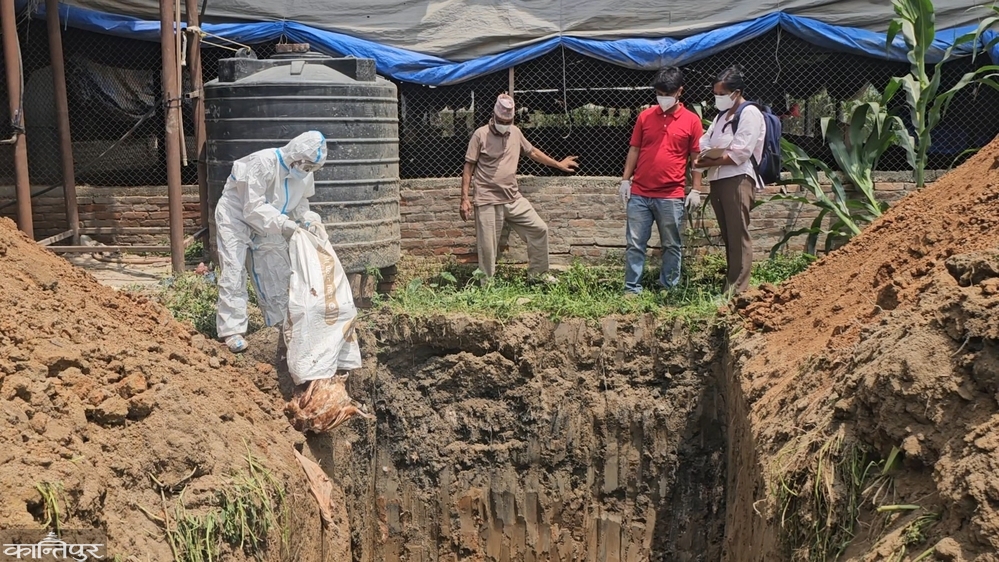
Government technicians are deployed from morning to midnight to prevent the spread of bird flu infection to the community level. They have been responsible for reaching the infected farm as soon as the phone rings, safely destroying the chickens, digging pits, applying lime and disinfectants, monitoring and coordinating with the farmers. But this work is not as easy as it seems from the outside.
According to Braj Kishore Thakur, head of the Animal Services Office, Kavre, the experienced manpower required for managing infected chickens is not readily available. Local workers are hesitant to do such work due to the risk. He said that there is also a situation where they leave work within a few hours and do not come to work due to concerns about personal safety. Therefore, he said that there is a compulsion to call in an experienced team from Kathmandu, who has been working on such campaigns since the past, to manage infected chickens.
The challenge for this work is not limited to manpower. He said that the dozer required to bury infected chickens is also not available on time. ‘Local-level dozers are busy with other work,’ he said, ‘some are in a broken condition, so dozers have to be brought from the private sector, sometimes it takes time for the dozer to arrive there.’ According to him, workers have to dig trenches manually in places where dozers cannot reach. He said that a similar situation has been seen in some areas of Panauti Municipality-5, 7 and 8. He said that since most farmers have provided their own fields, there has been no need to transport infected chickens far away.’ According to him, the Animal Services Office is also managing all expenses including dozer rental, laborer wages, food, lime, beryllium, phenol, etc. in the infection control campaign. He said that the necessary budget for such work has not been received yet. He informed that due to budget shortage, many materials have been borrowed to carry out the work.