As airline companies' costs rise and profits fall, governments and experts have raised mergers and structural reforms as possible solutions.
We use Google Cloud Translation Services. Google requires we provide the following disclaimer relating to use of this service:
This service may contain translations powered by Google. Google disclaims all warranties related to the translations, expressed or implied, including any warranties of accuracy, reliability, and any implied warranties of merchantability, fitness for a particular purpose, and noninfringement.
The need for mergers between airlines and helicopter companies operating in Nepal has been highlighted at a time when they are under financial pressure due to rising operating costs, a small market, unhealthy competition, and declining profits.
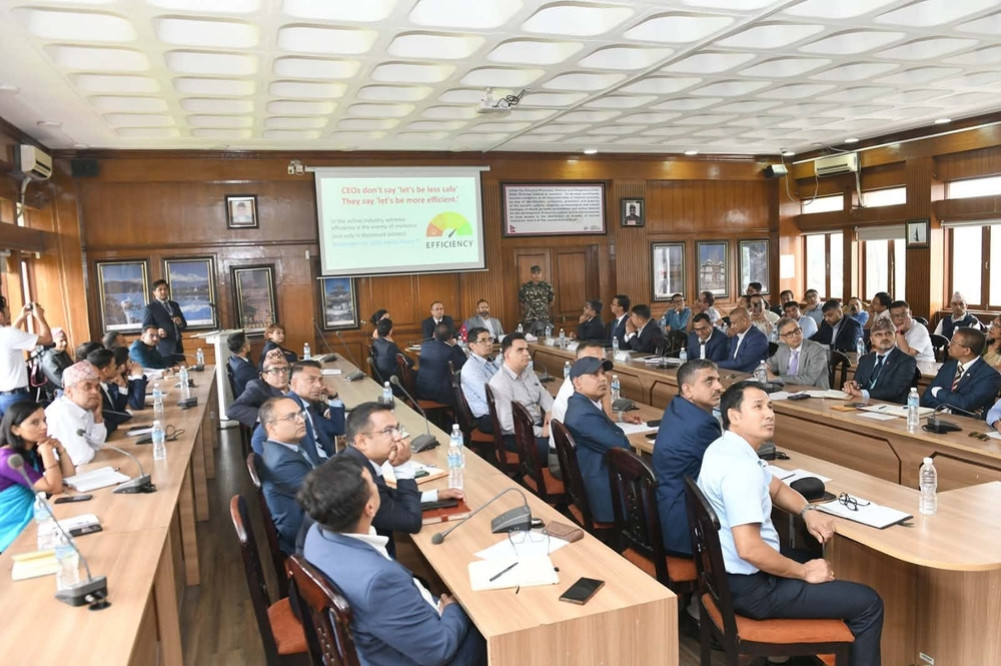
The Ministry of Tourism held a discussion on ‘Economic Stability and Security of the Nepali Aviation Industry’ at Singha Durbar on Monday with representatives of all airlines. In the discussion, Joint Secretary of the Ministry Indu Ghimire asked Airline Operators Association President Pratap Jung Pandey, Acting General Manager of Nepal Airlines Corporation Janak Raj Kalakheti, Director General of Civil Aviation Authority of Nepal Mukesh Dangol, and Aeronautical Engineer Ram Prasad Koirala, among others, ‘Is the current situation in Nepal such that helicopter or airline companies should merge?’
In the discussion, Airline Operators Association President Pratap Jung Pandey said that mergers could be a suitable option for airline companies operating at a loss in the current situation. According to him, if the government provides policy incentives like the banking and insurance sectors, the Nepali aviation industry can also be transformed into a large and sustainable structure. According to Pandey, the aviation industry is a very capital-intensive industry. But with many companies in the small market of Nepal, costs have increased and income has decreased. ‘It is not wrong to go into mergers and work with large capital,’ he said. ‘If the government provides tax and other concessions for a certain period like banks and insurance, the aviation industry can also go into mergers.’ Pandey said that the helicopter industry in particular has reached a serious crisis. He said that the lack of engineers, technicians and skilled manpower required to operate helicopter companies has further increased operating expenses. According to Pandey, the normal profit of airline companies is only about 5 percent, but recently, after the fuel price has increased by about 15 percent, there is a loss of about 10 percent on each flight.
He said that in recent years, the Civil Aviation Authority of Nepal has also increased the landing fees, parking fees and other regulatory fees significantly. He said that insurance premiums are twice as expensive as those in countries such as India due to the high risk in Nepal.
Pandey said that since helicopter companies in Nepal do not have their own hangars, they are forced to repair and store their aircraft under umbrellas in open areas of airports. He said that this has added to the challenge of maintenance and may also affect safety.
Other experts participating in the discussion also felt that it would be difficult for a financially weak company to maintain safety standards. Janakraj Kalakheti, Acting General Manager of Nepal Airlines Corporation, said that due to lack of financial stability, investment in necessary training, maintenance, equipment purchase and skilled manpower will decrease, which will ultimately directly affect flight safety.
Mukesh Dangol, Director General of the Civil Aviation Authority of Nepal, pointed out that although safety regulation has been given more emphasis in the aviation sector so far, there is now a need to make the financial health of companies a part of the regulation.
According to him, there is a need to institutionalize financial regulation under the new legal framework and regularly assess the financial condition, corporate governance, professional board and capital capacity of the company.
The speakers participating in the discussion said that in order to sustain the airline industry in the long term amidst rising costs, limited passengers and intense competition in the small market of Nepal, structural measures such as government policy facilitation, economic reforms and, if necessary, mergers should be adopted.