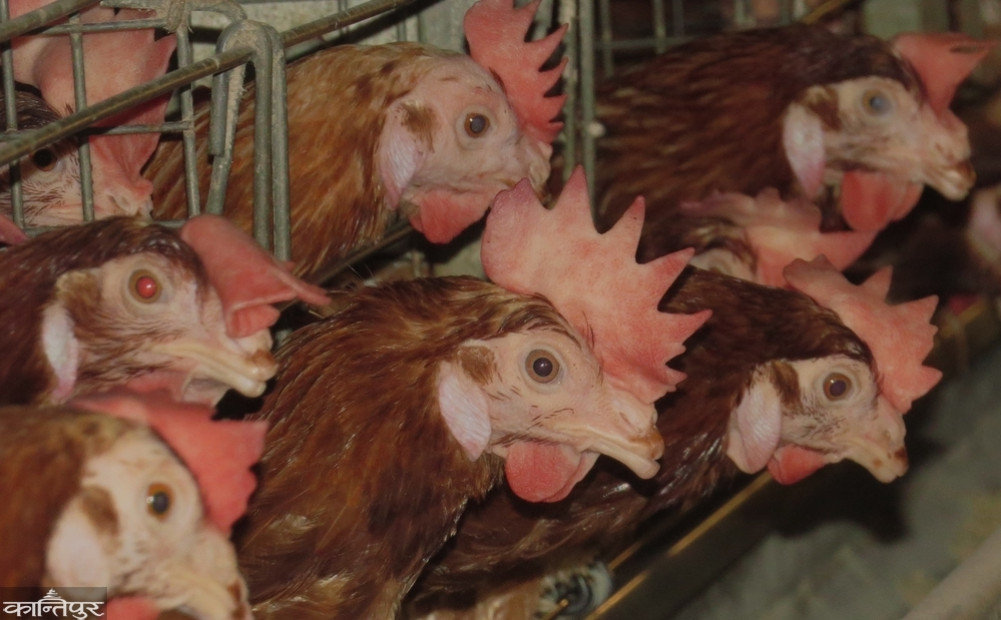
Businessmen have said that there could be a shortage of meat and eggs in the coming days as farmers are not raising chicks due to suspicions and uncertainty about bird flu.
We use Google Cloud Translation Services. Google requires we provide the following disclaimer relating to use of this service:
This service may contain translations powered by Google. Google disclaims all warranties related to the translations, expressed or implied, including any warranties of accuracy, reliability, and any implied warranties of merchantability, fitness for a particular purpose, and noninfringement.
There is a shortage of meat and eggs during this year's festival after chickens were found to have bird flu while they were being kept in a poultry farm and had to be sealed.
Farmers are not keeping chicks due to suspicion and confusion about bird flu, so there may be a shortage of meat and eggs during this year's festival, businessmen have said.
According to the information issued by the Animal Services Department, this time bird flu (H5N9) was confirmed in Morang on Chaitra 4. As of Asad 4, bird flu has spread to 11 districts across the country. Bird flu was confirmed in Bharatpur, Chitwan on Chaitra 2 and in Khairhani's Layers Chicken Farm on Jestha 23. Since then, bird flu has not been seen in Chitwan. Dr. Prabhat Neupane, head of the Animal Services Office of Bharatpur, said that bird flu is currently under control in Chitwan.
Bird flu focal person of the Animal Services Department Dr. Mukul Upadhyay said that although bird flu is currently active in 3 districts of the Kathmandu Valley and Kavre, it is under control in other districts. He said that bird flu has been confirmed in more than 100 places in 11 districts.
There is a rule to destroy chickens, eggs and feed in farms where bird flu is confirmed and seal the area for 45 days. Dr. Prabhat Neupane, head of the Animal Services Office, said that about 57,000 chickens from two farms in Chitwan have been destroyed. All of them are layer chickens raised for eggs. 569,858 birds have been destroyed in all the places where bird flu has been confirmed till Asad 9. Similarly, 989,000 eggs have also been destroyed, the department said.
After the appearance of bird flu, consumers are in a dilemma whether to eat meat or eggs. Deepak Pandey of Gaindakot, who has been selling chicken meat by opening a fresh house for 18 years, said that meat consumption has decreased in the last 20-22 days. Consumers who were not particularly worried when it appeared in one or two places are now suspicious when bird flu appears continuously.
Dr. Rewant Kumar Bhattarai, a professor at the Faculty of Veterinary Medicine of the University of Agriculture and Forestry and president of the Nepal Poultry Entrepreneurs Forum, says that there may be a shortage of meat in the coming days as the infection has been appearing in chickens for the past 3 months.
‘Until recently, the retail price of meat was Rs 430 per kilo.’ Now it has come down to Rs 400. My fresh house used to sell up to 4 quintals of meat a day, but now only two and a half quintals are sold,’ said Pandey. He himself used to raise 1,500-2,000 chickens for meat. He would remove them when the heat set in. He said that he was in a dilemma whether to keep chicks this time or not.
Nepal Poultry Entrepreneurs Forum Central President Dr. Rewant Kumar Bhattarai says that farmers are confused about whether to add chicks or not when bird flu appears.
Broiler chickens raised for meat are ready soon. Chicks can be sold within 45 days of being kept. But layers raised for eggs start laying eggs in 4 and a half months. This time, layer farms in Chitwan have been hit due to bird flu, says Dr. Bhattarai. Head of the Animal Services Office Dr. Neupane says that half of the poultry meat required for the country is produced in Chitwan.
Therefore, if Chitwan's production is affected, the entire country will be affected. The entrepreneur estimates that production will decrease during Dashain and Tihar, when chicken meat and eggs are in high demand.
If bird flu occurs, the farm will be sealed for 45 days. If everything remains normal, it may take another 45 days for other preparations, says Dr. Rewant Kumar Bhattarai, chairman of the Poultry Business Forum. He said that since bird flu has been seen in more than 100 places in 11 districts, everyone should be serious to ensure that production is not affected in the coming days. The government will compensate chickens and other products that have to be destroyed due to bird flu.
‘If those who directly suffered losses received compensation on time, it would have helped to add new chicks, even if it was something,’ Dr. Bhattarai said. There is a system of providing compensation up to 75 percent of the cost as per the price determined by the District Rate Committee. However, the process for compensation has not progressed in Chitwan as of now.
‘This is the time to add chicken chicks. If there is confusion now, production will be affected tomorrow. Consumers may be affected by higher prices. Illegal imports of meat and eggs will increase. Which is a big concern and challenge for the poultry sector,' said Dr. Bhattarai, President of the Nepal Poultry Entrepreneurs Forum. The poultry sector in Nepal has been declining since Corona.
According to the economic survey of 2082/083 released by the Finance Minister last month, the number of chickens in Nepal is 57.8 million. While in the fiscal year 077/78, it is mentioned that there were 66.8 million chickens. The survey shows that 1.12 billion eggs were produced in Nepal in the year. In the fiscal year 080/81, there is a report that 1.65 billion eggs were produced.
Dr. Bhattarai, Central President of the Nepal Poultry Entrepreneurs Forum, says that the number of hatcheries producing chicken chicks has decreased from 280 to around 100. There is a fear that the impact of bird flu will push the poultry farming industry, which has an investment of 60 billion rupees and provides direct employment to 400,000 people, further into crisis.