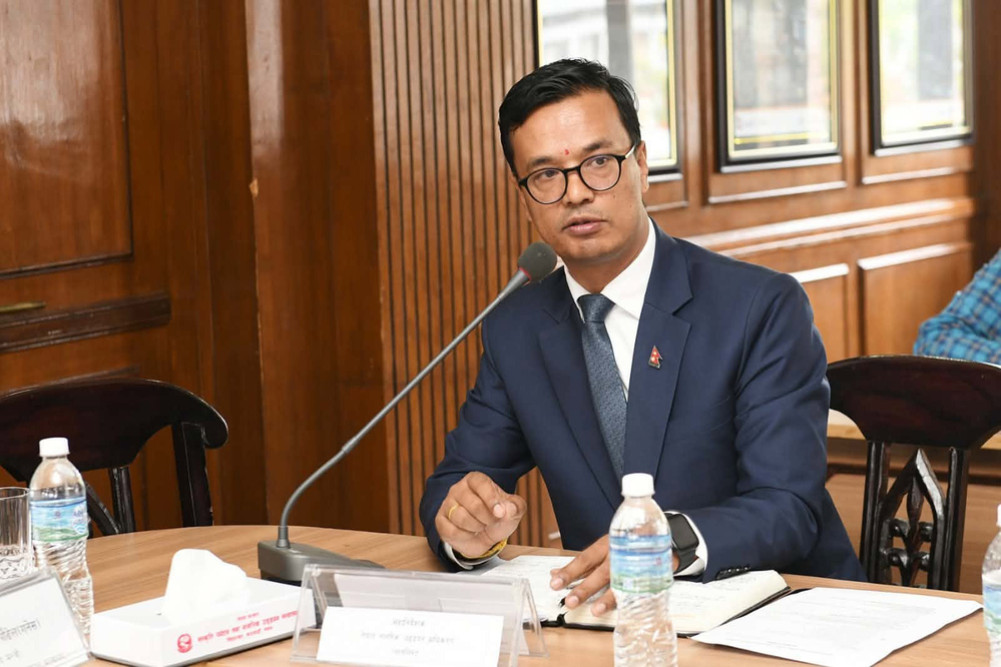
Mukesh Dangol, Director General of the Civil Aviation Authority of Nepal, says, “Since the aviation industry is very sensitive and operates under strict regulations, the weak financial condition of any organization directly affects aviation safety and the entire industry.”
We use Google Cloud Translation Services. Google requires we provide the following disclaimer relating to use of this service:
This service may contain translations powered by Google. Google disclaims all warranties related to the translations, expressed or implied, including any warranties of accuracy, reliability, and any implied warranties of merchantability, fitness for a particular purpose, and noninfringement.
Director General of the Civil Aviation Authority of Nepal Mukesh Dangol has said that Nepal's aviation sector is in the process of major policy and institutional reforms and that this will determine the direction of the aviation sector for the next 30 years.
At a dialogue on 'Economic Stability and Security of Nepal's Aviation Industry' organized by the Ministry of Tourism on Monday, Dangol said that since aviation safety, aviation security and the economic stability of the industry are directly linked to each other, an open dialogue is necessary among stakeholders.
He mentioned that since Nepal's aviation industry is a very sensitive sector and operates under strict regulations, the weak financial condition of any organization will directly affect aviation safety and the entire industry.
According to Director General Dangol, the government has already prepared a new aviation policy. Which will improve past weaknesses and set a clear roadmap for Nepal's aviation sector for the coming decades. He informed that the draft has been sent to various bodies for suggestions.
Dangol said that although Nepal's aviation industry is a capital-intensive sector, the investment environment is still challenging. Stating that despite the government's huge investment in airports and infrastructure, the private sector has been slow in adding new aircraft, he said that there is an imbalance between government investment in airports and investment by airline companies. He informed that policy reforms, including the ratification of the Cape Town Convention, are underway to facilitate aircraft import and financial management, and pointed out the need to do more to create an investment-friendly environment.
Director General Dangol said that although the direct profit from the aviation industry will be limited, its indirect impact on the national economy will be very large. He said that in a country with a geographical situation like Nepal, it will be difficult to achieve the goal of becoming a middle-income country without expanding transportation and air services.
He opined that the contribution of the aviation sector should not be limited to direct income alone but should be evaluated on the basis of indirect and long-term impacts on tourism, trade, employment, investment and overall economic activities. Dangol clarified that the upcoming reforms will not be limited to infrastructure construction alone, and said that equal priority should be given to improving the business environment of airlines, modernizing the communication and air traffic management systems, producing skilled human resources, and protecting them within Nepal.
He emphasized that since Nepal is a country with a strategic geographical location, there is an opportunity to get maximum returns from the investments made so far, emphasizing that the government and the private sector should jointly focus on the sustainable development of the aviation industry.