All issues related to the skill certification process should be resolved through an established mechanism based on bilateral consultations and consensus: Nepal
We use Google Cloud Translation Services. Google requires we provide the following disclaimer relating to use of this service:
This service may contain translations powered by Google. Google disclaims all warranties related to the translations, expressed or implied, including any warranties of accuracy, reliability, and any implied warranties of merchantability, fitness for a particular purpose, and noninfringement.
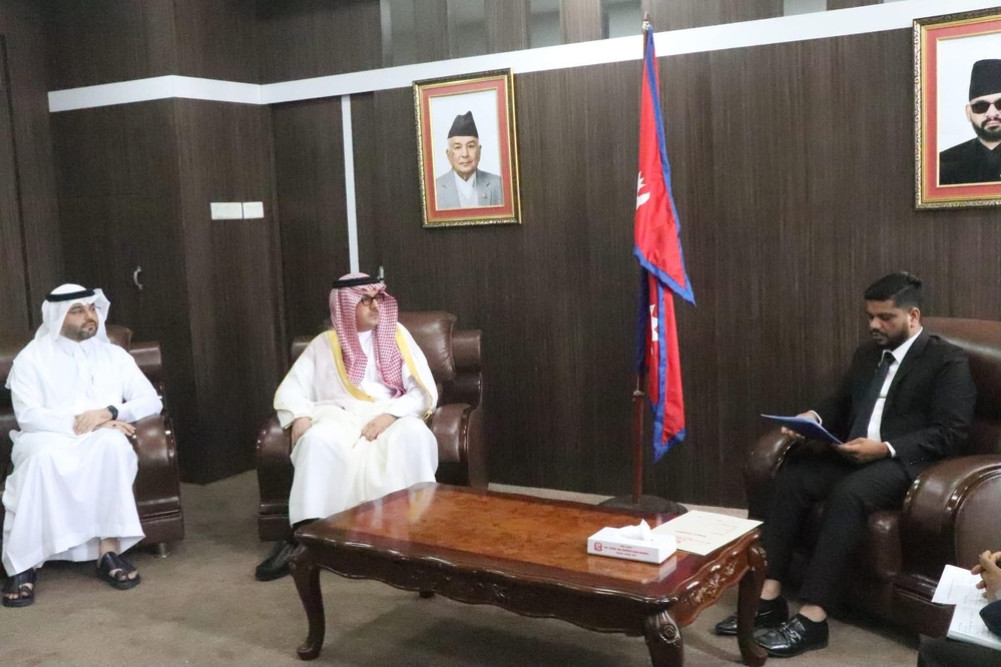
Nepal has requested Saudi Arabia to postpone the Skill Verification Program (SVP). Saudi Arabia was going to start it in Nepal from June 17. However, after the SVP was stopped, preparations are underway to implement it from July 1. Minister for Youth, Labor and Employment Ramji Yadav met Saudi Arabia's Ambassador to Nepal Fad Monaekhar on Friday and urged him to immediately postpone the skill verification process of Nepali workers.
Further information in this regard will be provided after necessary consultations with the Saudi government: Saudi Ambassador to Nepal Nepal has emphasized that all issues related to the skill verification process should be resolved through the established mechanism based on bilateral consultations and consensus. Nepal has requested that the visa process be issued as it is. The labor agreement signed between Nepal and Saudi Arabia in December last year states that a joint technical working committee will decide on issues related to the recruitment process of Nepali workers. However, there has been no bilateral agreement between Nepal and Saudi Arabia on the implementation of the skill verification program. This technical committee includes high-ranking officials from Nepal and Saudi Arabia.
Labor Minister Yadav has requested that the visa process be continued as it is. Saudi Arabia had issued a notice not to proceed with the visa process without a skill certification certificate. ‘Nepal wants the visa process of Nepali workers not to be affected due to the SVP process and the visa process to be continued as usual,’ the Labor Minister’s Secretariat said. ‘The Labor Minister urged to ensure an environment that does not hinder the employment of workers.’
Saudi Ambassador Fad Monaekhar has informed that more information will be provided in this regard after necessary consultations with the Saudi government. Saudi Arabia was scheduled to inaugurate the ‘Skill Testing Program’ (SVP) from June 17 at the ‘Industrial Training Institute Nepal Pvt. Ltd.’ in Basundhara, Kathmandu. However, after foreign employment professionals went to the training provider organization to surround it, saying that ‘they are trying to sell certificates in the name of skill testing by establishing a monopoly,’ the training institute had put up a notice of suspension. Workers will have to pay an additional fee of Rs 15,000 for this skill test. There is $50 for the exam fee and $50 for the Recognition of Prior Learning (RPL).
The Saudi Embassy in Kathmandu had posted a notice stating that it has started a skill testing program. The embassy has already made it clear that it will not issue a work visa if a certificate of passing the skill test is not submitted.
The 5 occupations for which Saudi Arabia will test skills are loading and unloading goods, porters, cart drivers, and construction workers.
If this arrangement is implemented, Nepali workers going to Saudi Arabia will have to pay an additional fee, the Nepal Foreign Employment Entrepreneurs Association has said. Once this is implemented, an additional 15,000 rupees will be added just to get the certificate.
‘It is seen that the certification process will have to spend more time and create unnecessary hassle and financial burden in the employment process,’ said the association’s president, Dik Bahadur (Kumar) Khatri, ‘This has the potential to increase the cost of workers going for foreign employment and adversely affect their interests.’
Looking at the practices of India and Bangladesh, the association claims that certification does not seem to be labor-friendly. ‘The practices of India and Bangladesh are not labor-friendly. This does not provide time for skill testing. "They are charging more than the prescribed fee to get time," he said, "This has only caused more trouble for the workers."
80,000 Nepali workers go to Saudi Arabia every year for employment. Of these, 67 percent are going on general worker visas. 8 percent are going to the service sector and 12 percent are going to the driver and operator sector.
The Saudi Ministry of Human Resources and Social Development has stated that a skill certification program has been launched to obtain a work visa in Saudi Arabia. It says that skill certification is being done to give professional recognition.
The embassy has stated that for the skill test, workers must first register online on Saudi Arabia's 'Professional Certification Portal'. Only after registering, the fee must be paid in dollars through Visa or Master Card. The applicant must select his profession from the professions available under the program. He must select an approved examination center and select the available examination date. The test will be three hours long. It is said that its results will be available within 24 hours to a week.
Workers will be given up to three chances for the skill test. If the worker fails in this, the embassy has stated that the worker will not be able to go to Saudi Arabia. Saudi Arabia has said that this program has been implemented in all source countries.
Saudi Arabia had earlier also introduced a rule requiring unskilled workers to submit certified educational certificates. But after widespread opposition, it was removed. The association has urged the Labor Minister to take necessary diplomatic initiatives with the Saudi side as soon as possible, keeping in mind the interests, convenience and smooth foreign employment process of the workers.