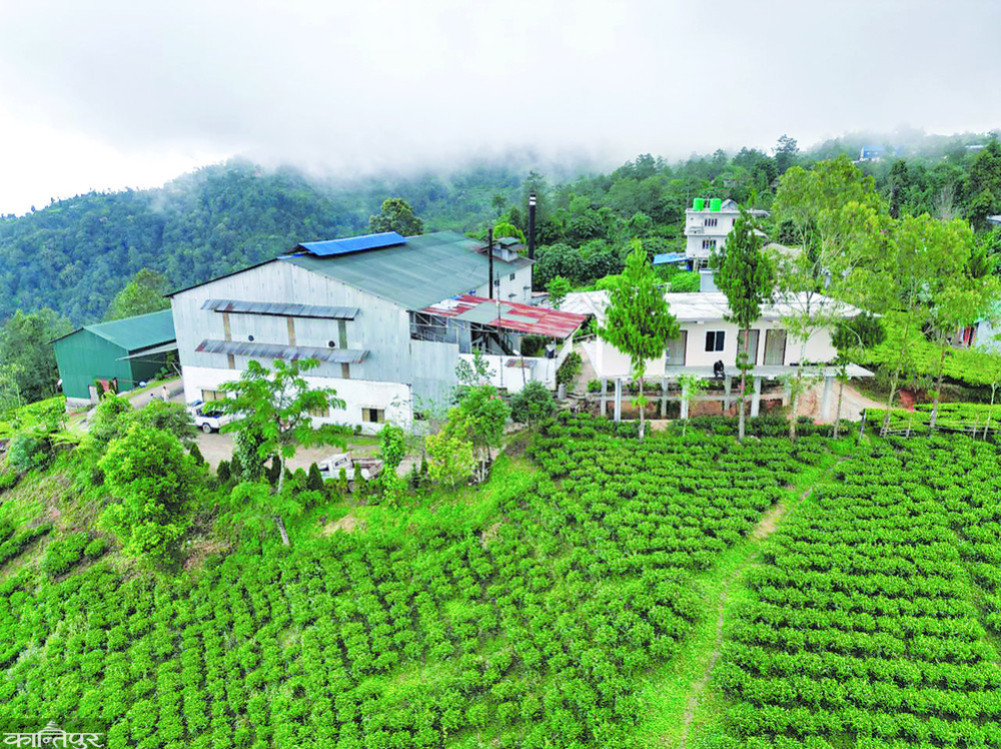
The Prime Minister's Office has formed a special task force to study and resolve problems seen in tea exports, with the responsibility of submitting a report within two weeks, including suggestions for immediate, medium-term, and long-term solutions.
We use Google Cloud Translation Services. Google requires we provide the following disclaimer relating to use of this service:
This service may contain translations powered by Google. Google disclaims all warranties related to the translations, expressed or implied, including any warranties of accuracy, reliability, and any implied warranties of merchantability, fitness for a particular purpose, and noninfringement.
India has maintained the mandatory sample testing system for 20 percent of tea imported from Nepal, which has not yet made Nepali tea exports easier. After the government's assurance, the closed tea industries in Jhapa and Ilam have resumed operations.
After the Office of the Prime Minister and Council of Ministers committed to resolving the problems seen in tea exports through diplomatic and administrative initiatives, the industrialists decided to withdraw the agitation and operate the industries from Friday. However, the industrialists say that even though the industries have opened, the uncertainty over exports remains.
Dilli Shrestha, President of Suryodaya Tea Processing Association, confirmed that tea exports have not yet started even though the plantations and industries have been operational.
‘Indian traders have said that tea can now be sent,’ he said, ‘the real situation will be clear only after the tea is sent on Monday.’
After the Office of the Prime Minister and Council of Ministers committed to resolving the problems of tea exports through diplomatic and administrative initiatives, the industrialists decided to withdraw the agitation and operate the industry. The Food Safety and Standards Authority of India (FSSAI) has implemented a risk-based testing system for tea (HSN code 0902) imports through a letter issued on June 23, with a system of ‘random interception’, i.e., selecting samples and testing them in 20 percent of the consignment.
According to FSSAI, as per the decision of a meeting held on June 16 under the chairmanship of the Commerce Secretary of India, tea imported for domestic consumption will initially be tested at a rate of 20 percent. This system will be applicable at all customs posts in India. There is no such system at the Panitanki customs post. Therefore, the samples will be taken to Kolkata for testing.
Senior Vice President of Nepal Tea Producers Association Shiva Kumar Gupta said that Indian tea buyers are urging them to send tea for purchase. The buyers claim that the Indian side will no longer stop Nepali tea in the name of laboratory testing.
‘It has been stated that it will not stop it under the pretext of testing like before,’ said Gupta. ‘A sample of one truck out of every 5 trucks will be tested, and based on the results of the sample, it will be decided whether to stop the tea or not.’
Currently, about 300,000 kg of prepared tea is stored in Indian warehouses. The Food Safety and Standards Authority will test the tea in Kolkata. According to industrialists, more than 1 million kg of tea is stored in Nepal. ‘Now, the Tea Board will not directly intervene like before,’ said Gupta, ‘That is why we have little hope.’
Industrialists in Ilam had closed their industries since 1 Ashar and industrialists in Jhapa since 4 Ashar in protest against the Indian blockade. The closure of about 99 tea industries in the east, including Jhapa and Ilam, affected work in dozens of small and large tea gardens. Aditya Parajuli, president of the Nepal Tea Producers Association, said that the decision to operate the industry was made with confidence in the government's initiative.
'All industries in the east, including Jhapa and Ilam, have been operational since Friday,' he said. 'Work has also started regularly in the gardens.'
The Prime Minister's Office has formed a special task force to study and resolve the problems seen in tea exports. The task force has been given the responsibility of submitting a report within two weeks with suggestions for immediate, medium and long-term solutions. The Nepal Tea Producers Association, which is urging Indian tea buyers to send tea for purchase, claims that it was not possible to keep the industry closed for a long time as green tea leaves were maturing in the farmers' gardens. 'We have decided to open the industry keeping in mind the daily livelihood of the laborers and the farmers' production,' Parajuli said, 'but the problem seen at the border has not been completely resolved yet.'
Industrialists, however, have reiterated their demand that the government find a permanent solution through high-level diplomatic initiatives, saying that even if industries reopen, the problem will not be resolved until the obstacles at the Indian border are removed.