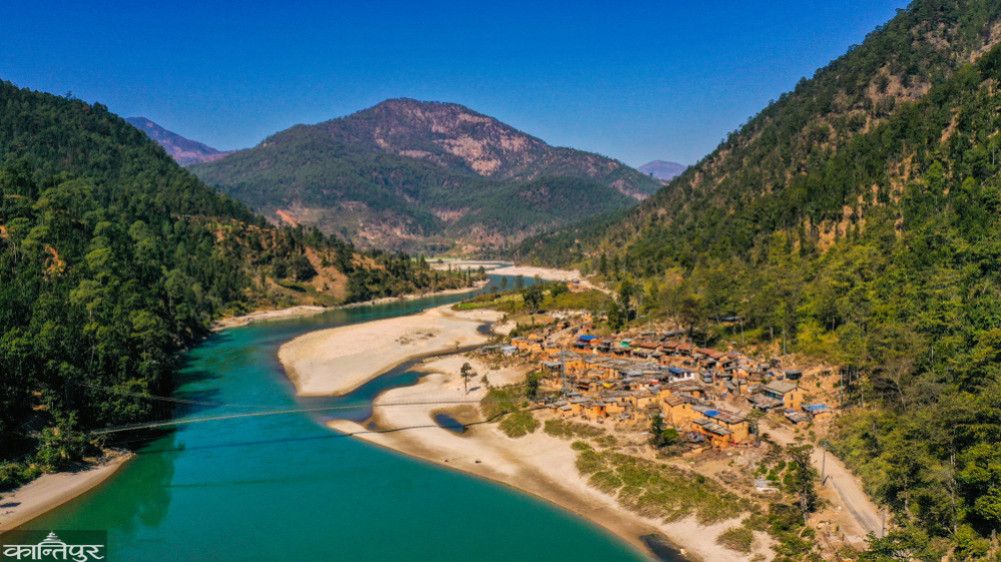
The government's policy and program for the upcoming fiscal year states that it will implement a single-door system by amending laws related to energy, forests, land, and the environment to achieve the target of 30,000 megawatts of electricity generation in the coming decade.
We use Google Cloud Translation Services. Google requires we provide the following disclaimer relating to use of this service:
This service may contain translations powered by Google. Google disclaims all warranties related to the translations, expressed or implied, including any warranties of accuracy, reliability, and any implied warranties of merchantability, fitness for a particular purpose, and noninfringement.
The PPA for the project has been stopped after the ‘take and pay’ concept of the ‘Run of River’ project was arranged in the budget for the current fiscal year. Earlier, PPA was being done automatically for projects of 10 MW.
Finance Minister Swarnim Wagle had said in the budget for the upcoming fiscal year that PPA for power projects with a capacity of less than 10 MW would be done immediately. He also said that arrangements would be made to cancel the licenses of projects that have PPA but have not started construction and make new PPAs on the ‘take and pay’ method. He had mentioned that arrangements would be made to fix the electricity purchase rate in the dry season and make agreements.
The NEA has said that by the first week of Jestha, 835.5 MW of 56 solar projects and 11,988 MW of 547 hydropower projects have been completed. The NEA says that 124.5 MW of PPA is yet to be signed for 7 solar projects. In the hydropower sector, 126 projects with connection agreements have 7,617.45 MW and 138 projects without connection agreements have 8,134.16 MW, leaving 264 projects with 15,751 MW of PPA.
On the other hand, after the directive of Minister for Energy, Water Resources and Irrigation Biraj Bhakta Shrestha on 3 Baisakh 2083, the survey permits issued by the Department of Electricity Development for all projects including hydropower and solar energy have also been stopped.
The department has not issued new survey permits since Baisakh. Shrestha has instructed to prepare a complete list of all survey and construction permits and make them public within 60 days and to issue new survey permits only after reviewing them. That is why, although applications for survey permits are being taken, no new ones have been issued, said Badri Kuinkel, the department's information officer. "We are taking new survey applications, but no new permits have been issued by the department," he said.
According to the department, as of June 19, 268 hydropower projects with a capacity of 7,188.80 MW, larger than 1 MW, have applied for survey permits. 59 hydropower projects with a capacity of 50.137 MW, smaller than 1 MW, have also applied for permits. 19 companies with a capacity of 214.70 MW have applied for solar energy and 1 project with a capacity of 1 MW has applied for wind energy.
Energy Minister Shrestha had formed a high-level committee on Chaitra 19 under the coordination of Joint Secretary Sagar Raj Gautam under the coordination of Joint Secretary Mohan Shakya to study the permission of PPAs and energy-related projects. Joint Secretary Shakya's committee has already submitted its report. Joint Secretary Gautam's committee has not submitted its report.
The ministry will take a decision based on the provisions in the budget for the coming fiscal year and high-level suggestions, says Energy Secretary Sarita Dawadi. 'There is also a provision in the budget regarding PPAs, the ministry has formed a high-level committee, and the ministry will take a decision based on its report or the committee's suggestions. And it will move forward accordingly,' she said.
The cabinet meeting held on Chaitra 13 immediately after the formation of the new government approved the '100 agendas related to government reforms'. The agenda states that all pending PPAs and licenses will be decided within a maximum of 180 days with the aim of developing the country's energy sector as the main basis for economic transformation, and ensuring rapid development by immediately removing obstacles related to electricity generation, transmission, distribution and export.
The government's policy and program for the coming fiscal year states that it will implement a single-door system by amending laws related to energy, forests, land and environment to achieve the target of 30,000 megawatts of electricity generation in the coming decade. Similarly, the government has mentioned in the budget for the coming fiscal year that it will cancel the licenses of projects that have PPA but have not started construction and make arrangements to make new PPAs on the 'take or pay' method, and that it will immediately make PPAs for power projects with a capacity of less than 10 MW.
According to the department, as of June 19, 244 hydropower projects with a capacity of 12,252.61 MW have received survey licenses. 83 companies with a capacity of 1,960.48 MW for solar energy and 4 projects with a capacity of 15 MW for wind energy have received licenses.
Shailendra Guragain, former president of Independent Power Producers Association of Nepal (IPPAN), says that he is confident that the NCP's pledge, centennial list, policy and program and budget will be in line with the NCP's pledge, says. 'Not all issues have been included in the budget.' But the government's policy and program say that PPAs for 30,000 MW and the centennial list will be done in 180 days. That is what is meant to be done,' he said, 'even though the survey license has been stopped, applications are being accepted. The same is true for PPA. It does not mean that the survey license for 30,000 MW has been reached. That is why the government must issue the license.' He said that the government is expected to prepare some criteria and start issuing the license.
In the case of a PPA on 'take and pay', the Electricity Authority purchases the quantity it needs and pays only for that. In the case of a PPA on 'take or pay', the Authority must purchase electricity as per the agreement made with the promoter, and if it does not, it must pay the promoter the price for it. If the promoter cannot provide electricity as per the agreement, it must also pay a fine to the Authority.
The Authority has been doing PPA on 'take or pay'. In cases where a hydropower project can be constructed but the new transmission line has not been completed or the capacity of the transmission line is low, the Authority has been taking electricity and paying for it on the 'take and pay' basis by setting a deadline for the PPAs made on the basis of 'take or pay'.