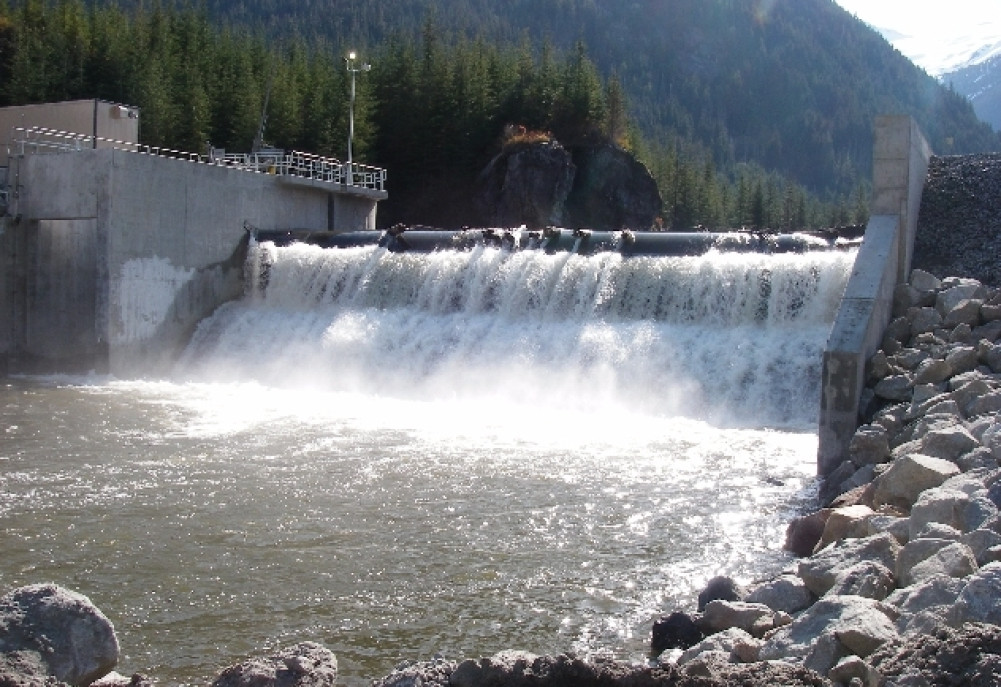
The 'License Performance Dashboard' released by the Department of Electricity Development states that 20 promoter companies with a capacity of 1,651.44 MW, which have already obtained production licenses and signed PPAs, have not been able to raise investment.
We use Google Cloud Translation Services. Google requires we provide the following disclaimer relating to use of this service:
This service may contain translations powered by Google. Google disclaims all warranties related to the translations, expressed or implied, including any warranties of accuracy, reliability, and any implied warranties of merchantability, fitness for a particular purpose, and noninfringement.
The 139.5 MW Lower Manang Marsyangdi Hydropower Project has already obtained a production license in 2075 BS. The website of the Department of Electricity Development states that its Power Purchase Agreement (PPA) was signed in 2080 BS. But so far, the promoter Butwal Power Company has not been able to raise investment for the construction of the project.
The company's Chief Executive Officer Uttar Kumar Shrestha said that the financial management is in progress as per the approval of the Department of Electricity Development. 'We will do the financial management this year, we still have time,' he said.
The promoters say that there is a provision to raise investment for 5 years after obtaining the production license. Section 14 of the Electricity Project Licensing Directive, 2075 BS, provides that a power generation license can be issued with the condition that the PPA and financial management are completed within 2 years.
Sub-section 1 of Section 16 of the guidelines states that if the financial management is not completed within the 2 years specified and the promoter applies before the expiry of the period, the period can be extended for another 1 year by calculating the previous period considering the need and justification. If the work is not completed within that period, it is mentioned that an additional 2 years can be extended based on the efforts and progress of the promoter. However, it is also mentioned that the promoter will have to pay an amount equal to the capacity royalty of the project at the rate of Rs 100 per kilowatt per year. However, in the case of projects with a capacity of more than 100 MW, the same subsection also states that an additional period of 2 years can be extended.
Whether it is before or after the PPA, the period for financial management will be applicable from the date of issuance of the license. Like the Lower Manang Marsyangdi, the 440 MW Tila-1 and 420 MW Tila-2 hydropower projects have not been able to be financially managed. Both these projects received licenses in 2075 and PPA in 2081. But financial management has not been done yet. The 'License Performance Dashboard' made public by the Department of Electricity Development states that 20 promoter companies of 1651.44 MW, which have already obtained production licenses and PPA, have not been able to raise investment.
According to the data made public by the department, there are also projects that have not been able to raise investment by doing PPA. According to the department, the 9.14 MW Super Ghalemdi Hydropower Project had a power purchase agreement (PPA) in 2075. The production license has been obtained in 2080. But the project has not been able to raise investment yet. The 5 MW Sepli Khola Hydropower Project, which had obtained production licenses in 2078, had a PPA in 2077. But financial management has not been done yet. The 63 MW Chhujung Khola Hydropower Project has already received the PPA and production license in 2079. But due to the inability to raise investment, its progress is zero.
Energy Minister Biraj Bhakta Shrestha had directed the department to establish a publicly accessible 'License Performance Dashboard' and update it monthly. The dashboard should include details of project milestone progress, compliance status and actions taken. Although the Ministry of Energy said that it should be updated monthly, currently only the details sent by the promoter are being updated.
The department has stated that the License Performance Dashboard has been made public as per the ministry's instructions. The government has pointed out that the work of 108 hydropower and solar energy projects that have received production licenses is not satisfactory.
According to the department, out of 275 companies that have received production licenses, 178 companies have shown less than 25 percent progress. Similarly, there are 65 companies with 25 to 80 percent progress and only 32 companies with 80 percent progress .
The reasons for the unsatisfactory physical progress include lack of management capacity of the promoter, availability of transmission lines/sub-stations, time spent in court due to litigation, lack of cascade agreement of other projects, falling in the inundation zone of reservoir projects, time taken in construction of access roads, delay in forest, environment and tree cutting, delay in forest, environment, land acquisition/usufruct and tree cutting, work stopped in conservation areas, national parks, etc. . There are 42 companies with up to 10 MW, 42 with 11 to 50 MW, 10 with 51 to 100 MW and 14 above that hydropower projects .
The work is also unsatisfactory in the upper Modi 'A' hydropower project of Modi Hydropower Company, a subsidiary of Nepal Electricity Authority. Its physical progress is only 9 percent. The Upper Modi Cascade is also only 0.50 percent. It is mentioned that the Tamakoshi 5 Hydropower Project promoted by Tamakoshi Hydropower, a subsidiary of the authority, has only 5.20 percent physical progress. The work of the 120 MW Rasuwa Bhotekoshi Hydropower Project, which is being built by former Energy Minister Deepak Khadka and a Chinese company, is also not satisfactory. It is mentioned that its physical progress is only 27 percent.
The department's information officer Badri Kuikel said that the percentage of physical progress submitted by the promoters till Poush has been kept. 'We have updated the physical progress submitted by the promoters till Poush, and we have updated the data on whether or not financial management has been done till Baisakh-Jeshtha,' he said.
Meanwhile, the Nepal Electricity Authority, in a notice released on Saturday, has asked the projects under construction as per the PPA to submit progress details within 7 days. The notice also mentions that if the progress report is not received by the Electricity Trade Department of the NEA, action will be taken as per the PPA. There is a provision that hydropower and solar projects must provide the NEA with a progress report on project construction at least quarterly.
Prakash Chandra Dulal, Vice President of Independent Power Producers Association of Nepal (IPPAN), says that after obtaining the production license, there will be a period of 5 years for financial management, including paying capacity royalty. 'Initially, the license is given on the condition of completing the PPA or financial management within 2 years, if it is not possible, the period can be extended by one year. If it is not possible even in that, it can be extended by 2 years by paying capacity royalty,' he said, 'It cannot be said that the progress of the projects within that period was not satisfactory. It takes another 2/3 years to prepare after financial management. 7-8 years seemed normal. The project construction period is expected to be 7-8 years, or up to 10 years in the case of large projects. Dulal says that the physical progress of the project may be slow due to various reasons, including deforestation, local obstructions and construction of transmission lines.