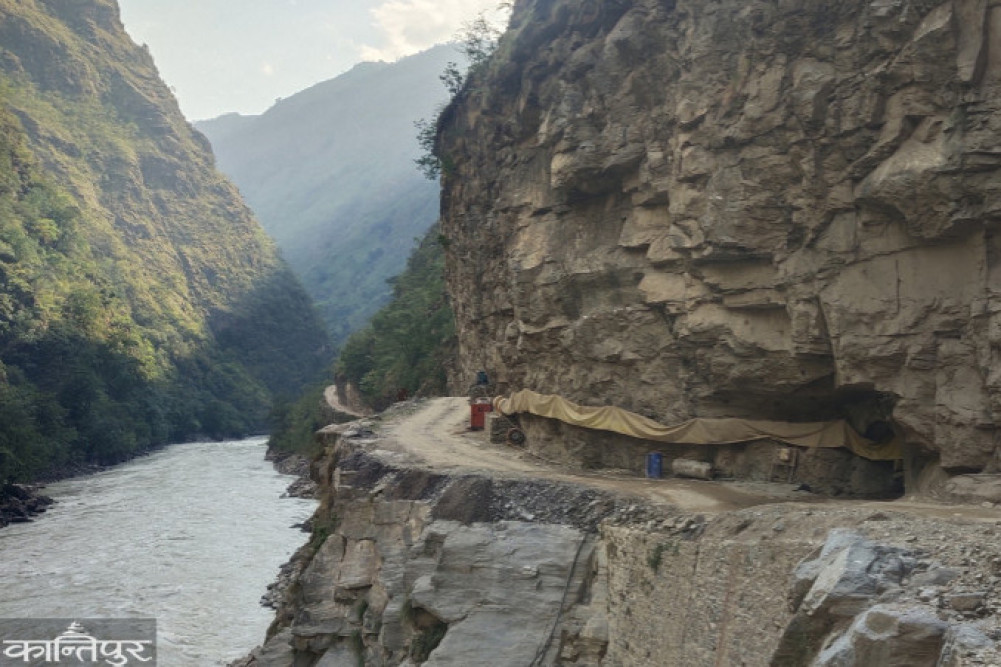
The confusion has arisen after the Supreme Court order, which was issued at a time when it was being said that the project would not be financially viable if electricity was provided free of charge.
We use Google Cloud Translation Services. Google requires we provide the following disclaimer relating to use of this service:
This service may contain translations powered by Google. Google disclaims all warranties related to the translations, expressed or implied, including any warranties of accuracy, reliability, and any implied warranties of merchantability, fitness for a particular purpose, and noninfringement.
The project is in limbo after the Supreme Court issued a directive to increase the proportion of free electricity received from the Phukot Karnali Hydropower Project (480 MW) received by the Indian government company NHPC. The promoter company has been saying that providing free electricity will cause problems in the construction of the project, and the Supreme Court's order has created further confusion.
The Nepal Electricity Generating Company (VUCL) had decided to implement the Supreme Court's decision and sent a letter to NHPC in the last week of Baisakh. VUCL has stated that a virtual meeting was held in the last week of Jestha, but it was inconclusive. 'We held a virtual meeting. But it remained inconclusive,' said the company's acting CEO Hiraman Waiba, 'During the discussion, the company said that the project is not financially viable if it provides 21.9 percent free electricity.' We have asked to send everything in writing. But NHPC has not sent a written letter.
NHPC cannot provide 21.9 percent electricity and if it has to, the government has asked for a Potential Minimum Supplementary Fund (VGF) of Rs 56 billion. The source said that the two parties should be created an environment for ‘negotiation’, saying that there will be no business as per the Supreme Court’s decision.
The company says that the Nepal government should go for a review against the Supreme Court’s decision to build hydropower projects by bringing in foreign investment, saying that 21.9 percent free electricity cannot be provided in all hydropower projects.
On 17 Jestha 2080, during the visit of the then Prime Minister Pushpa Kamal Dahal to India, an investment agreement was signed between Nepal Electricity Generating Company Limited and the Indian government company NHPC. According to the agreement, NHPC will own 51 percent of the shares in Phukot Karnali and VUCL will own 49 percent.
According to clause 5.1 of Article 5 of the agreement, 21.9 percent of the electricity will be provided free of charge after the commercial generation of electricity starts. In clause 5.2 of Article 5 of the agreement, if the project is not commercially viable, both parties can discuss the free energy of clause 5.1 along with other modalities in ‘good faith’ to make the project feasible.
Based on the same clause of the agreement, NHPC has been lobbying informally, saying that the project is not feasible if it is given 21.9 percent free electricity. However, the Supreme Court has ordered an increase in the ratio of 21.9 percent free electricity. Since then, NHPC has not said anything about leaving the project, but Waiba said that they are in touch with them.
The MoU between NHPC and VUCL was for a period of 2 years. The term expired in May 2025. The term of the MoU has not been extended since then. The Power Generation Company (VUCL) has stated that the six months lost due to the lawsuit will be extended. By mid-Ashar 2082, VUCL has spent Rs 1.53 billion 99 million on the study and pre-construction in Phukot Karnali.
Secretary of the Ministry of Energy Sarita Dawadi informed that there has been no discussion so far about the Supreme Court's decision related to Phukot Karnali. The detailed project report (DPR) of the 800 MW West Seti and 450 MW Seti River-6 hydropower projects received by NHPC has been submitted to the Investment Board. The Investment Board has stated that it has conducted a technical study of the DPR of West Seti and sent its feedback. It has been stated that the financial aspect is yet to be studied and a response has yet to be sent. The survey permit for West Seti is valid until next Kartik.
NHPC has also submitted the DPR for Seti River-6. It has been stated that it has yet to be studied and reviewed for its technical and financial aspects. The period of the survey permit for Seti River-6 has already expired in Chaitra. The Investment Board Office has also stated that it has asked the company to send a letter to extend the time as the survey license has expired. 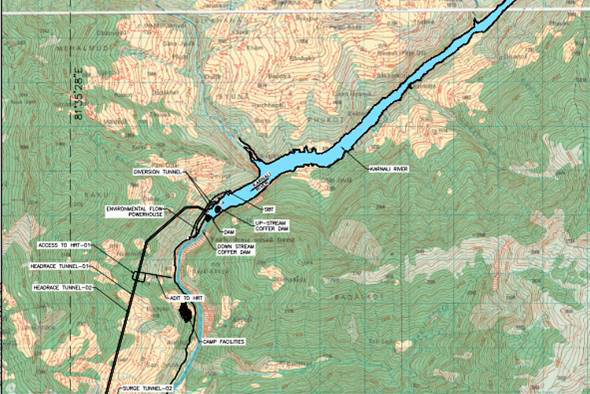
The period of the survey permit can be extended as per the Private Public Partnership and Investment Regulations, 2077. Rule 29 of the regulations makes provisions regarding permits. Sub-rule 9 of the same rule 29 states that if the period of the survey permit has expired, the concerned proposer can apply for an extension of the period within 30 days of the expiry of the period along with the grounds and reasons.
Sub-rule 10 states that if an application is received for extension of the survey permit, the survey permit can be extended by paying the prescribed fee. According to the regulations, for the extension of the permit and the permit, Rs 50 lakh per year for 200 to 500 MW and a lump sum of Rs 60 lakh per year for more than 500 MW will have to be paid. The board can extend the permit by making a decision.
NHPC has already demanded Rs 40 billion in Viability Gap Funding (VGF) for the West Seti Hydropower Project, stating that it is not financially feasible and that free electricity should also be provided. There is a provision in the Public-Private Partnership and Investment Act and Regulations that VGF can be provided. However, the Government of Nepal has not yet constructed any project or project by providing VGF.
NHPC has demanded VGF based on the project's Detailed Project Report (DPR), according to the Investment Board Office. Even though NHPC has demanded VGF, the Investment Board office is still in discussion.
The 64th meeting of the board had decided to further study the detailed report of the Paschim Seti Reservoir Project, which will have an investment of 160 billion. The Investment Board meeting held on 13 Mangsir 2081 had decided to increase the capacity of Paschim Seti from 750 MW to 800 MW.
On 2 Bhadra 2079, an agreement was signed between the Investment Board and NHPC Limited in the presence of the then Prime Minister Sher Bahadur Deuba to hand over the responsibility of the Paschim Seti and SR 6 Hydropower Projects. The MoU states that 21.9 percent of the electricity should be provided after commercial production starts. NHPC has been lobbying saying that it cannot provide free electricity.
If the project is to be taken forward after the analysis of the DPR, a Project Development Agreement (PDA) will be signed. The Investment Board office has already formed a committee for the PDA.
According to previous studies, the cost of the 750 MW West Seti project was estimated at 1,320 million US dollars and the cost of the 450 MW SR-6 project was estimated at 800 million US dollars.