The number of Nepali youth going abroad for employment has been declining in recent times due to factors such as shrinking employment opportunities in some destination countries, stricter regulations in some places, and tensions in West Asia.
We use Google Cloud Translation Services. Google requires we provide the following disclaimer relating to use of this service:
This service may contain translations powered by Google. Google disclaims all warranties related to the translations, expressed or implied, including any warranties of accuracy, reliability, and any implied warranties of merchantability, fitness for a particular purpose, and noninfringement.
Indradev Yadav of Bariyapatti-5, Siraha, has been knocking on the doors of manpower companies for two months. He arrived in Kathmandu in the first week of Chaitra to go to the United Arab Emirates (UAE). In the meantime, he has given interviews to four employing companies, but his name did not come up in any of them.
He was seen in the interview line at a manpower company in Basundhara, Kathmandu, on Friday, saying, "I thought I would be able to go abroad after paying the money, but it turned out not to be the case. My name does not come up in the interview either. This is my fifth interview." He usually attends interviews after seeing the demand letter from the manpower company. The fifth interview he gave is to go to Malaysia.
There are many unemployed youths like Yadav wandering around Kathmandu looking for foreign employment. But due to shrinking employment opportunities in some destination countries, stricter regulations in some countries, and tensions in West Asia, the number of Nepali youth going abroad for employment has decreased recently. According to World Bank data, Nepal's youth unemployment rate is 20.6 percent, the highest in South and Southeast Asia.
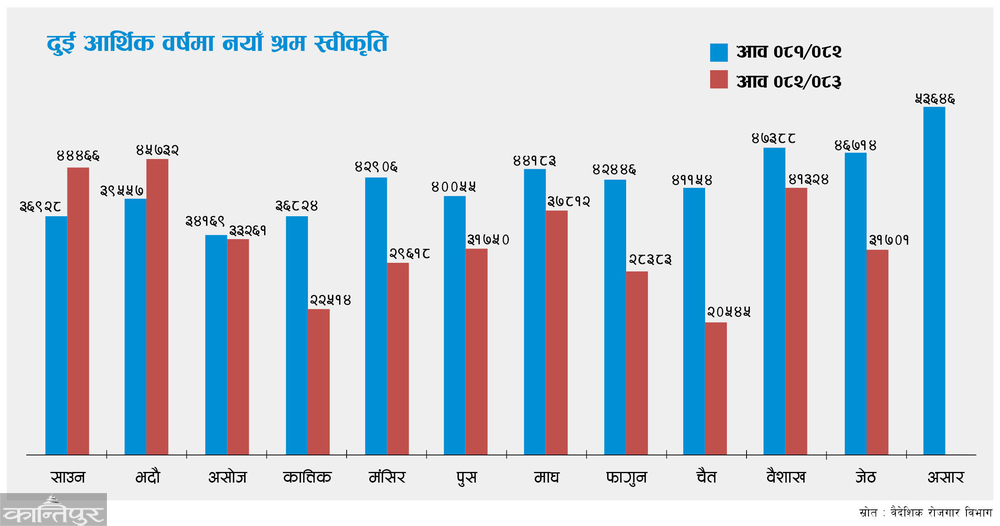
The number of new work permits for foreign employment has decreased by about 19 percent in the current fiscal year compared to the same period in the previous fiscal year (Shrawan to Jestha). From Shrawan to Jestha in fiscal year 081/82, 452,311 people obtained new work permits. In the last 10 months, the number of new work permits has been 367,100.
The top 10 destinations for Nepali workers are UAE, Saudi Arabia, Qatar, Kuwait, Romania, Japan, South Korea, Malaysia, Croatia and Bahrain. According to the records of the Department of Foreign Employment, the number of new work permits was increasing from Mangsir to Asad in fiscal year 081/82. In the month of Asad alone, the highest number of 53,646 people obtained work permits. That number was not exceeded in any month of the last fiscal year. On the contrary, it has been decreasing. In the current fiscal year, more than 40,000 people obtained work permits in Shrawan, Bhadra and Baisakh, but in the remaining seven months, between 22,000 and 31,000 work permits were issued.
The number of young people going abroad with new work permits in Jestha was 31,701, which is 9,623 less than the number going abroad in Baisakh. Recently, the number of young people going abroad has been decreasing every month. The greatest impact of employment has been in West Asia. Of those who went in Jestha, 9,000 were destined for Malaysia. The rest are scattered in more than a hundred countries.
Foreign employment entrepreneurs say that the demand for employment from major destination countries has been continuously decreasing after the Gen-G movement. Rajendra Bhandari, former president of the Nepal Foreign Employment Entrepreneurs Association, says, “We have had to face very difficult times after the Gen-G movement. The UAE, which was considered the most important destination, was closed for a few months. Then, the rule requiring police reports to be authenticated by the UAE embassy had an impact. Meanwhile, tensions in West Asia have escalated.’

In recent years, the UAE has been a major destination for Nepalis for unskilled, skilled and highly skilled workers. Out of the 500,000 new work permits issued in the last fiscal year, the UAE employed 200,000 or 39.76 percent. This has now come down to 25 percent.
After the Gen-G movement, the UAE tightened its visa policy for Nepalis. It banned labor and visit visas for about three months from Bhadra. On December 4, it introduced a policy requiring mandatory verification of police reports from the UAE embassy. This added an additional burden of Rs 14,000 on workers. On the other hand, the UAE is strictly implementing the ‘Emiratization’ quota to increase employment of its citizens in the private sector.
It has been said that by the end of 2026, 10 percent of the skilled workforce in companies with 50 or more workers should be its citizens. Since companies that do not comply with this rule will face heavy fines, the number of foreign workers has started to be reduced. Even as the US-Iran war has affected the UAE economy, workers are being laid off. 'Most hotels are not even 20 percent booked. This has given workers like us working in the hotel sector only two options. Either we have to stay in the UAE without getting salary and service facilities, or we have to go to Nepal on unpaid leave,' said Suresh Sharma from Baglung, who works at a prestigious hotel in the UAE.
The number of Nepali workers going to Saudi Arabia has also decreased. Major projects in Saudi Arabia's largest NEOM project have been closed. Nepalis working in those projects have been sent to other big projects. Those who could not be given work have been sent back home. Nearly 80,000 Nepalis were working in NEOM alone.
This destination has become even more confusing after Saudi Arabia implemented the Skill Verification Program (SVP) from June 3. Saudi Arabia has adopted a policy of issuing visas only after passing the skill test for five professions. The SVP scheduled for Ashad 3 could not be inaugurated as foreign employment entrepreneurs protested, saying that this policy was decided without the consent of the Nepal government and that there was a plan to charge an additional Rs 15,000 from the workers by selling certificates in the name of skill testing. After that, the company that was supposed to conduct the skill testing has put up a notice of postponement.
Qatar's labor market has become sluggish. Before the FIFA World Cup, Qatar was the largest destination country for Nepali workers. Nearly one lakh Nepalis used to go to Qatar every year. Qatar, which used to take up to 30,000 foreign workers a month, has now reduced it to two to three thousand. There are more old workers than new ones in Qatar. Since there are no new construction-related projects after the World Cup, even old workers are not finding work easily. 'Most employers are currently cutting the number of workers,' said an official at the Nepali Embassy in Doha.
Malaysia has reduced the quota allocated for foreign workers from 15 percent to 10 percent. On top of that, Malaysia's labor market has been unstable for the past five years. After a two-year hiatus, Malaysia has only started sending workers from Nepal to its manufacturing sector since last November. In April, the largest number of workers went to Malaysia, 9,000, which is less than in previous years. But while the Gulf is facing job cuts, Malaysia seems to be making up for it.
According to Malaysia's Human Resources Minister R. Ramanan, jobs are being lost in the labor market due to the global geopolitical crisis affecting the energy sector and international supply chains. Local media outlet Barna quoted Minister Ramanan as saying, "The number of Malaysian citizens who lost jobs in various economic sectors in the first five months of this year (2026) alone is 38,953." Ramanan said that the main sectors losing jobs are manufacturing, wholesale and retail trade, and motor vehicle repair, administrative and support service activities. Malaysia's unemployment rate is 3 percent. Malaysia has adopted a policy of sending citizens who have lost jobs to areas with high demand. This will affect the new recruitment of migrant workers, including Nepal. Malaysia is currently the top destination country for unskilled workers, paying the highest minimum wage of 1,700 ringgit (63,000 rupees). According to a report released by the International Labor Organization (ILO) on employment and social conditions in the Gulf region and the West on May 18, the crisis caused by the Iran war has had a double impact on employment than during the Covid pandemic. The ILO report states that about 40 percent of jobs in the Gulf countries are at high risk in sectors such as construction, manufacturing, transport, trade and hospitality.
The Department of Foreign Employment had suspended work permits in West Asian countries since February 17, which was lifted on April 7. Thousands of workers were deprived of using visas that had already been issued due to the suspension of work permits. According to manpower professionals, some employers did not renew expired visas.
The war in West Asia has reduced the production of employer companies and has slowed down sectors such as hotels, construction and transport, the ILO report states. This has led to job cuts, a decrease in new recruitment and a shutdown of overtime. Nearly 60 percent of Nepalis going abroad for employment are in the Gulf countries. According to the Ministry of Foreign Affairs, 1.9 million Nepalis were working in the region before the war began.
The crisis in West Asia is not just a short-term disruption but a shock that could have long-term effects, says ILO Chief Economist and author of the report, Sanghon Lee. “This crisis could leave deep wounds by undermining the foundations of decent, safe and secure work. Its full impact will take time to be seen,” he said. The war has been temporarily halted after the US and Iran reached an agreement on 20 Ashad.
Entrepreneurs hesitate to find a market
The Nepal Foreign Employment Entrepreneurs Association has stated that the environment for employment entrepreneurs to ‘market’ to find demand letters from employer companies has not been created due to the policy regarding service fees for recruitment of workers introduced by the government. Immediately after the formation of the government led by Balendra Shah, the Ministry of Labor, Employment and Social Security has tightened the policy that 10,000 rupees as service fee must be paid through banking channels. The department has started taking action against entrepreneurs on complaints of higher service charges.
The then Minister of State for Labor Tek Bahadur Gurung had decided on 26 Jestha 2072 that workers could be charged Rs 10,000 as service charges when sending workers to the Gulf and Malaysia. After the labor agreement with Malaysia and the UAE to send workers at zero cost, workers cannot be charged even Rs 10,000 as service charges, that is, workers should be sent at zero cost. According to the labor agreement between the two countries, the Nepali embassy has been verifying only zero-cost demand letters.
According to the agreement, all expenses related to labor recruitment must be paid by the employer. ‘In all files that come after the demand letter is verified by the embassy, the labor cost is zero. We issue pre-approval to select workers on this basis,’ said Mira Acharya, Director General of the Department of Foreign Employment, ‘The pre-approval permission is obtained on the same conditions. It is checked whether the worker has a recruitment fee, contract, and visa.’ The department takes action against manpower or agents who charge service charges from workers. ‘If found guilty in the monitoring, legal action will be taken,’ said Acharya.
Monitoring is also being done by the secretariat of Labor Minister Ramji Yadav. The secretariat itself receives complaints. The foreign employment entrepreneurs concerned are brought to the ministry to investigate such complaints. After that, the secretariat, some MPs and ministry employees sit down for ‘discussion’ and necessary action or reconciliation is sent to the department.
Hari Bahadur Pandey, president of Nepal Foreign Employment Entrepreneurs’ Unity Society, said that there is no environment for doing business as the policy taken by the government is not practical. ‘On the one hand, people outside the department’s body are coming in a guerrilla style. On the other hand, we have been trapped in the whirlpool of impractical policies,’ he said, ‘The day the state was announcing Rs 10,000, we were protesting in Tahachal (department). We are forced to raise more money than that. We cannot send seven overseas workers for Rs 10,000.’
Pandey says that there is no way to do ‘marketing’ without a scientific and transparent cost fee. "We have not been able to pay a single penny in taxes to the state. It has been 11 years since we started raising our voice that an environment should be created for doing business by paying taxes," he said. "There is no zero cost everywhere as written on paper. Now we will only work if there is a transparent service fee."
According to the businessman's claim, the number of workers going to Jestha has decreased due to not taking demand letters in Baisakh. In Baisakh alone, manpower companies sent 26,433 people. But only 19,455 people went in Jestha after obtaining institutional labor approval. "We can no longer live in fear. We can only work when a practical policy is put in place," said Dik Bahadur Khatri, president of the Foreign Employment Entrepreneurs Association. "Only when a reasonable cost fee is set can a business environment be created. Just like Korea and Israel, we need to determine how much money the workers will pay under which heading. This business does not run on emotion."
श्रम मन्त्रालयले वैदेशिक रोजगारीमा जाने श्रमिकसँग लिन पाइने सेवा शुल्क निर्धारण गर्न गठन गरेको उच्चस्तरीय कार्यदलसँग मंगलबार आयोजित बैठकमा वैदेशिक रोजगार व्यवसायीले श्रमिक भर्ना गर्न लाग्ने खर्चको सूची पेस गरेका थिए । भर्ना र त्यससँग सम्बन्धित लागत शुल्क नै करिब ९० हजार रुपैयाँ रहेको उनीहरूको भनाइ छ ।
वैदेशिक रोजगारी खुम्चिँदा के असर पर्छ ?
राष्ट्र बैंकका अनुसार रेमिट्यान्स आप्रवाह बढिरहेको छ । चालु आर्थिक वर्षका १० महिना (साउनदेखि वैशाखसम्म) मा १९ खर्ब १६ अर्ब रुपैयाँ रेमिट्यान्स भित्रिएको छ । यो रकम अहिलेको बजेटको आकार हारहारी हो । आर्थिक वर्ष २०८१/८२ मा १७ खर्ब २ अर्ब रेमिट्यान्स भित्रिएको थियो ।
गएको आर्थिक वर्षमा भित्रिएको रेमिट्यान्समा खाडी मुलुकको हिस्सा करिब ३९ प्रतिशत थियो । यसबाहेक गत चैतसम्म नेपाल आएको कुल रेमिट्यान्समा भारतबाट आउनेको हिस्सा १० प्रतिशत, बेलायत, अस्ट्रेलिया र मलेसियाको करिब ६–६ प्रतिशत रहेको राष्ट्र बैंकले जनाएको छ ।
नेपाल मुद्रा विप्रेषक संघका पूर्वअध्यक्ष चन्द्र टन्डनका अनुसार डलरको भाउ बढ्दा र युरोप क्षेत्रबाट धेरै रेमिट्यान्स आउन थाल्दा पछिल्ला महिनामा निरन्तर रेमिट्यान्स बढिरहेको छ । पछिल्लो समय खाडीमा कार्यरत नेपाली श्रमिक युरोपतर्फ आकर्षित भइरहेका छन् ।
श्रम रोजगारीका लागि खाडी मुलुकको विकल्पका रूपमा हेरिएको युरोप क्षेत्रमा नेपाली श्रमिकलाई सहज प्रवेश छैन । लागत उच्च छ । रोजगारीमा जान कम्तीमा ७ महिना लाग्ने गरेको छ । युरोपमा म्यानपावर कम्पनीमार्फत जान दिइएको छैन ।
वैदेशिक रोजगारीमा रहेका नेपाल बिदामा आई फर्किने हुनाले पनि रेमिट्यान्स नघटेको जानकारहरू बताउँछन् । उनीहरूका अनुसार हरेक महिना ३० हजारले आफ्नो रोजगारीलाई विदेशमा निरन्तरता दिइरहेका छन् । ‘हरेक दुई वर्षमा बिदामा आएर पुनः त्यही देशमा रोजगारीमा जाने बेला श्रम नवीकरण गरिन्छ । अहिले बिदामा आएर फर्किएका नेपालीको संख्यामा कमी आएको छैन । त्यसैले झट्ट हेर्दा रेमिट्यान्स घटेको छैन,’ श्रम प्रशासन विज्ञ पूर्णचन्द्र भट्टराईले भने, ‘यसको प्रभाव दुई वर्षपछि मात्रै देखिन्छ ।’
राष्ट्रिय योजना आयोगका पूर्वसदस्यसमेत रहेका श्रमविज्ञ गणेश गुरुङका अनुसार वैदेशिक रोजगारीले घरेलु बेरोजगारी घटाउने मुख्य विकल्पका रूपमा काम गरिरहेको छ । ‘विशेषगरी ग्रामीण युवाको आर्थिक निर्भरता विदेशबाट आउने आम्दानीमा आधारित छ । विदेशमा काम गर्ने नेपाली नयाँ सीप, प्रविधि र कार्यसंस्कृति सिकेर फर्किन्छन् । यसले दीर्घकालमा देशका लागि मानव पुँजी विकासमा योगदान पुर्याइरहेको छ,’ उनले भने, ‘नेपालमा रोजगारीका लागि विकल्प नभएसम्म वैदेशिक रोजगारी अपरिहार्य छ ।’