Urged to bring a monetary policy that creates a comfortable environment for businessmen while solving the problems seen in the banking and financial sector
We use Google Cloud Translation Services. Google requires we provide the following disclaimer relating to use of this service:
This service may contain translations powered by Google. Google disclaims all warranties related to the translations, expressed or implied, including any warranties of accuracy, reliability, and any implied warranties of merchantability, fitness for a particular purpose, and noninfringement.
The Nepal Chamber of Commerce has suggested that the upcoming monetary policy should bring policies and programs that make the country investment, production and private sector friendly.
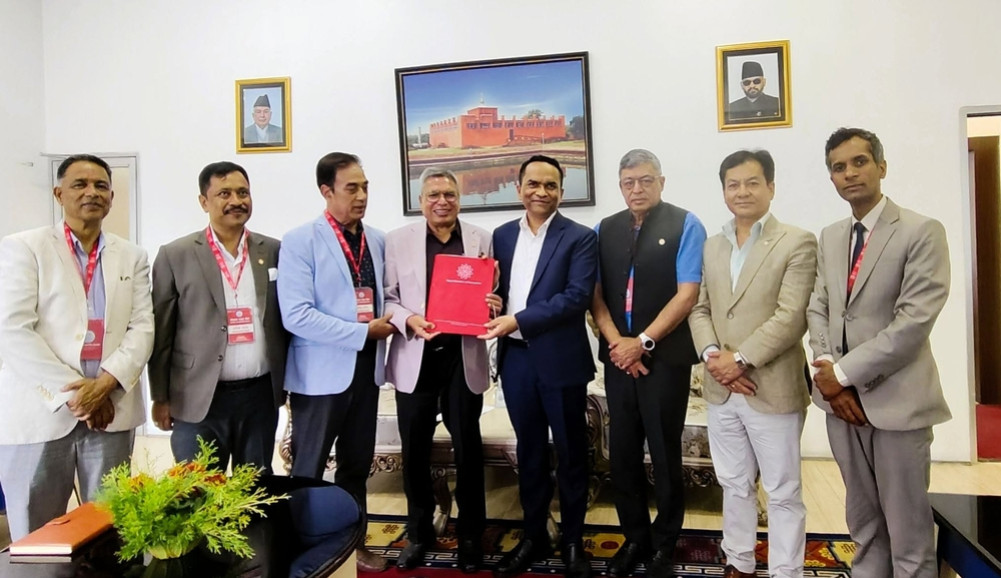
A delegation led by the Chamber's President Kamlesh Kumar Agrawal met Nepal Rastra Bank Governor Bishwanath Poudel on Wednesday and urged him to bring a monetary policy that solves the problems seen in the banking and financial sector and creates a comfortable environment for entrepreneurs. The delegation has urged him to bring a policy that will provide more than 20 percent credit to achieve an economic growth rate of 7 percent.
The country's economy has been in a state of stagnation for the past five years, the industry, trade, construction, tourism and service sectors have not been able to move as expected, and the morale of the private sector is weakening, and they have urged him to give special priority to expanding economic activities through monetary policy.
The Chamber has demanded that the single-digit interest rate be made a permanent policy, the bank rate be maintained at 5 percent, the spread rate be limited to 3.5 percent, and the Working Capital Loan Directive 2078 be immediately repealed to provide easy working capital to entrepreneurs.
The delegation has emphasized that the existing legal system related to money laundering has created unnecessary fear even among industrialists and entrepreneurs with legally acquired assets and has emphasized that the Act and its implementation should be made practical and business-friendly. Since the state mechanism has not been able to systematically record assets acquired before 2064 BS, it has been suggested that a practical approach should be adopted regarding the source of assets during that period.
Similarly, the Chamber has stated that the KYC and customer identification processes in banks and financial institutions are extremely cumbersome, duplicative, and differ from bank to bank, causing unnecessary suffering to service recipients and entrepreneurs. It has been urged to implement an integrated digital system so that once KYC is completed in a bank, the same process does not have to be repeated in other banks and financial institutions, and to make banking documents and forms uniform.
The suggestion letter states that instead of immediately blacklisting industrialists and businessmen who have failed to pay bank installments and interest on time, rescheduling and restructuring facilities should be provided based on the nature of the business. It has been urged to restructure loans, rescheduling and maintain a loan to value ratio of 80 percent to revive the housing and real estate sector in particular.
Similarly, it has been demanded to review the strict provisions related to loan-income ratio, to limit the liability of a person providing personal guarantor to the proportion of his share ownership, to effectively implement the principle of limited liability in the banking sector as per the Companies Act, and to make arrangements so that the transactions of other companies concerned are not stopped if a company is blacklisted.
The Chamber has also suggested regulating banking service charges, making banking processes simple, digital and customer-friendly, ending unnecessary administrative and police interference in cash transactions, increasing the cash deposit limit in banks, and making policy arrangements to bring capital in the informal economy into the formal banking system.
Similarly, the Chamber has also emphasized on creating an investment-friendly environment to attract foreign investment, an incentive scheme for export promotion, up to 80 percent banking facilities in electric vehicles, a system to facilitate transactions in high-rate Indian rupees for Indian tourists, and using a portion of the foreign exchange reserves in Nepal Rastra Bank to expand economic activities.
During the meeting, Chamber President Agrawal expressed the view that monetary policy should not be limited to price stability alone but should focus on production, investment, employment and economic revival, and said that a policy that restores the confidence of the private sector is necessary.
In addition, the Chamber has also emphasized the need to introduce a monetary policy to provide easy access to financial resources such as working capital loan guidelines, loan renewal process, collateral valuation, foreign exchange facilities, digital banking, small and medium enterprises, manufacturing industries, tourism, agriculture and export sectors. The Chamber was of the opinion that a policy to encourage the private sector by removing unnecessary regulatory arrangements that have become obstacles to business and investment expansion is necessary.
During the meeting, Chamber President Kamlesh Kumar Agrawal praised the various reform steps taken by Governor Bishwanath Poudel to reform the financial sector after he took office and expressed confidence that the upcoming monetary policy would address the expectations of the private sector.
In response, Governor Bishwanath Poudel said that Nepal Rastra Bank is committed to economic growth, investment expansion and private sector development and said that efforts are being made to remove unnecessary compliance through fiscal policy and regulatory arrangements.
‘We want economic growth.’ We will continue to make necessary policy reforms for the economic development of the nation, expansion of investment, and creation of a business-friendly environment. We will continue to make efforts to make investment and business more convenient through financial policies and arrangements, addressing legitimate suggestions from the private sector as much as possible,' he said.