Carpets were imported for 670 million rupees, while exports were 10.68 billion rupees, while wood products were imported for 4.77 billion rupees, while exports were 8.89 billion rupees.
We use Google Cloud Translation Services. Google requires we provide the following disclaimer relating to use of this service:
This service may contain translations powered by Google. Google disclaims all warranties related to the translations, expressed or implied, including any warranties of accuracy, reliability, and any implied warranties of merchantability, fitness for a particular purpose, and noninfringement.
Goods worth Rs 277.9672 billion have been exported in the 11 months of the current fiscal year. This is the highest point so far. According to the Customs Department, Nepal exported goods worth Rs 277.3 billion in the last fiscal year. The department has said that total foreign trade has also increased along with the increase in exports.
Foreign trade has reached Rs 217.26 billion in the 11 months of the current fiscal year. Foreign trade has also increased as exports have increased, said Krishnaraj Bajgain, Information Officer of the Trade and Export Promotion Center (TEPC). ‘As the export amount has increased, the total foreign trade has also increased,’ he said, ‘The total amount of exports and imports is foreign trade.’
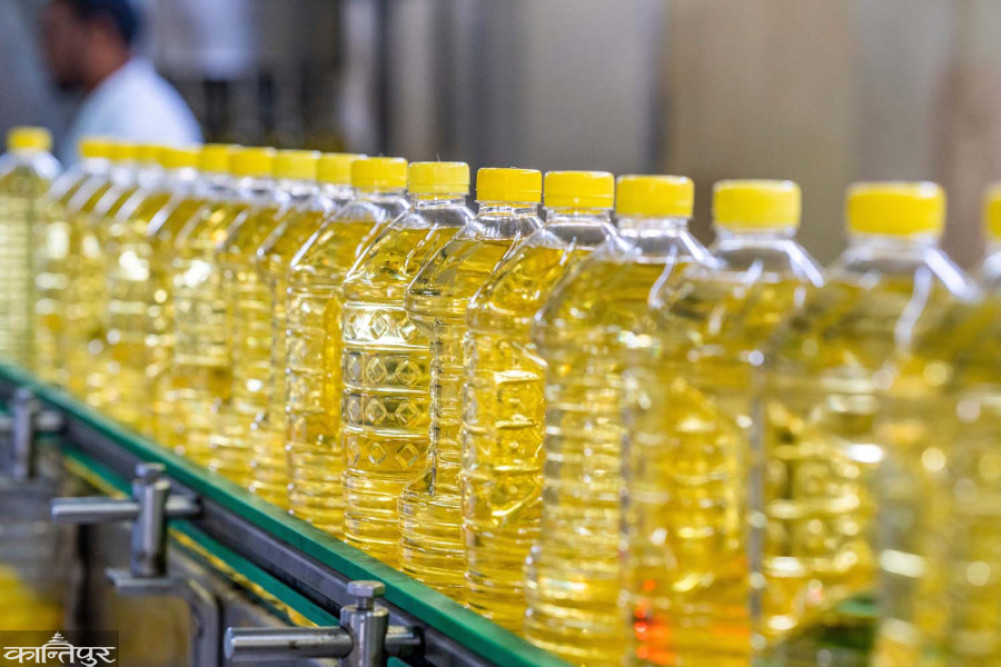
Earlier, in 2078/79, foreign trade was worth Rs 212.47 billion. At that time, foreign trade increased due to an increase in imports. According to the department, foreign trade was worth Rs 208.15 billion in the fiscal year 2081/82. Although the total export amount has increased, the share of oil is 46.2 percent. In other words, Nepal did not increase its exports by selling its own goods. The Center says that the share of processed soybean, sunflower and palm oil in exports is 46 percent.
The department has data that 726.499 thousand 90 liters of crude soybean oil worth Rs 119.63 billion was imported in the 11 months of the current fiscal year. During the same period, 538.228 thousand 938 kg of oil worth Rs 113.18 billion was exported.
Crude sunflower oil worth Rs 19.112 billion was imported and refined oil worth Rs 7.9932 billion was exported. According to the department, crude palm oil worth Rs 12.978 billion was imported in the 11 months. The department has data that 6.142 billion oil was exported during this period. In the 11 months of the current fiscal year, 6034 thousand 894 kg of cardamom worth Rs 12.114 billion was exported. While 39,95,745 kg of cardamom worth 7.19 billion 7 million rupees were exported in the 11 months of the last fiscal year. Cardamom exports are the highest ever. This year, cardamom has been exported only to India, Italy and Russia. Last year, cardamom was sent to Australia, France, India, Switzerland and the UAE.
Since the price has not fluctuated and has remained the same since the beginning, farmers were not able to keep cardamom in stock, said Deepak Nepal, president of the Nepal Cardamom Traders Federation. 'Farmers did not keep stock because they got the price, all the cardamom from the villages reached the market, and it was sold accordingly,' he said. Cardamom is being traded at 95,000 rupees per man (40 kg). This time it had reached 178,000.' Nepal also says that the price of cardamom reached from 85,000 to 188,000 last year. He complains that cardamom production and export are being done because of farmers and the government is not prioritizing its own production. ‘Cardamom grows in Nepal, and it is not about importing raw materials from outside and increasing their value, so the government should have prioritized it,’ he said.
The department’s data shows that like cardamom, ginger, herbs and other exports are also high. In 11 months, ginger worth Rs 1.21 billion, herbs worth Rs 1.86 billion and katha worth Rs 2.56 billion have been exported. ‘The export of cardamom, ginger, herbs and katha is the highest ever,’ said Bajgain, the center’s information officer. ‘The export of domestically produced goods has increased. This is a good sign.’
The items that cause the highest loss in Nepal’s imports are petroleum products, industrial machinery, iron and steel and electrical equipment. This shows that the Nepali economy is completely dependent on imports for fuel (energy) and infrastructure and capital goods, says former joint secretary Ravi Shankar Sainju.
According to the department, while vegetable ghee and oil worth Rs 162.33 billion have been imported, exports amounting to Rs 131.11 billion have been exported. Of this, there is a trade deficit of Rs 31.22 billion. Crude palm oil is imported from countries including Malaysia, Indonesia, and processed in Nepal before being re-exported to India, said Sainju. He also said that this is not a real export from Nepal's own domestic production, but only a 'value-added' trade.
Nepal has to import rice and corn in large quantities. Foodstuffs worth Rs 55.93 billion have been imported in 11 months. Carpets, tea/coffee/spices and wood products are real net profit-earning items. These products are completely based on Nepal's domestic agriculture and local handicrafts and artisans.
According to the department, while tea, coffee and spices worth Rs 9.40 billion have been imported, exports of Rs 17.29 billion have been exported. While carpets worth Rs 670 million have been imported, exports of Rs 10.68 billion have been exported. The department's data shows that while timber and its products were imported at Rs 4.77 billion, exports were at Rs 8.89 billion.
Sainju says that the high deficit in petroleum, machinery and raw material imports is not a temporary problem due to seasonality or any policy. 'This is a reflection of the country's limited industrial base. To reduce this deficit, large-scale energy production (hydropower, etc.) and large investments in manufacturing industries are necessary within the country,' he said.
Even though a large portion of the population is involved in agriculture, Nepal is importing billions of rupees worth of food and other goods annually, says Sainju. He says this exposes the serious inefficiency and weak productivity in the domestic agricultural system.