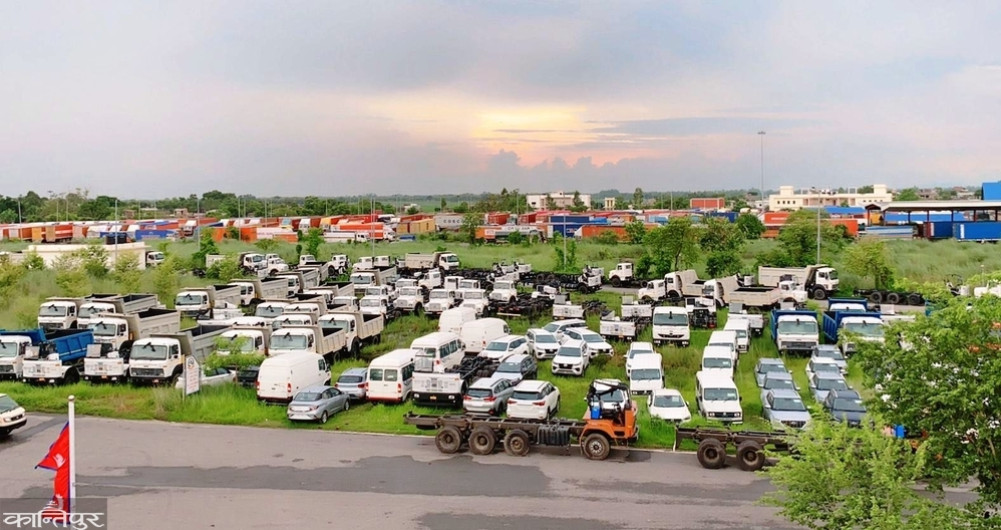
As of mid-June, imports worth more than 810 billion rupees have been received through the Birgunj border, which is about 47 percent of the country's total imports.
We use Google Cloud Translation Services. Google requires we provide the following disclaimer relating to use of this service:
This service may contain translations powered by Google. Google disclaims all warranties related to the translations, expressed or implied, including any warranties of accuracy, reliability, and any implied warranties of merchantability, fitness for a particular purpose, and noninfringement.
Birgunj, the country's main trade gateway, has maintained its leading position in import and export till mid-Jeshta of the current fiscal year. According to the data of the Birgunj Customs Office, the country's highest import and export took place through this border during that period.
By mid-Jeshta, more than 810 billion rupees have been imported from Birgunj border, which is about 47 percent of the country's total imports. Similarly, more than 99.68 billion rupees have been exported from this border, which is about 35 percent of the total exports.
The main imports from Birgunj border include fuel, vehicles and their parts, iron and steel materials, industrial raw materials and other goods. Soybean and sunflower oil, juice and other processed goods are the main exports.
In terms of imports, Bhairahawa and Biratnagar borders are after Birgunj. The Bhairahawa border has imported more than Rs 275 billion and exported Rs 31.5 billion. The Biratnagar border has imported Rs 221 billion and exported Rs 78.75 billion, according to data.
According to businessmen, the geographical proximity to the Indian ports of Kolkata and Haldia, the facility to transport goods by both land and rail, and the availability of a dry port have established Birgunj as the country's major trade border. Hari Gautam, President of the Birgunj Chamber of Commerce and Industry, said that the Birgunj border is the most suitable for trade due to the facility to import and export by both land and rail and easy access to Indian ports. "Most of the goods coming from Kolkata and Haldia ports enter Nepal through Birgunj. The facilities of the rail service, integrated check post, and Sirsia dry port have also made this border more competitive," he said.
Birgunj Customs Office has been collecting nearly 45 percent of the total revenue collected from customs offices across the country. Stakeholders say that Birgunj's contribution to revenue collection and foreign trade is significant even when economic activity is sluggish.
Senior Vice President of Birgunj Chamber of Commerce and Industry Madhav Rajpal said that a large part of the country's foreign trade is still concentrated at the Birgunj border, so there is a need for infrastructure expansion, further simplification of customs procedures and improvements in transport management. "To manage the increasing pressure of trade, it is necessary to make the customs service more technology-friendly along with infrastructure expansion," he said.