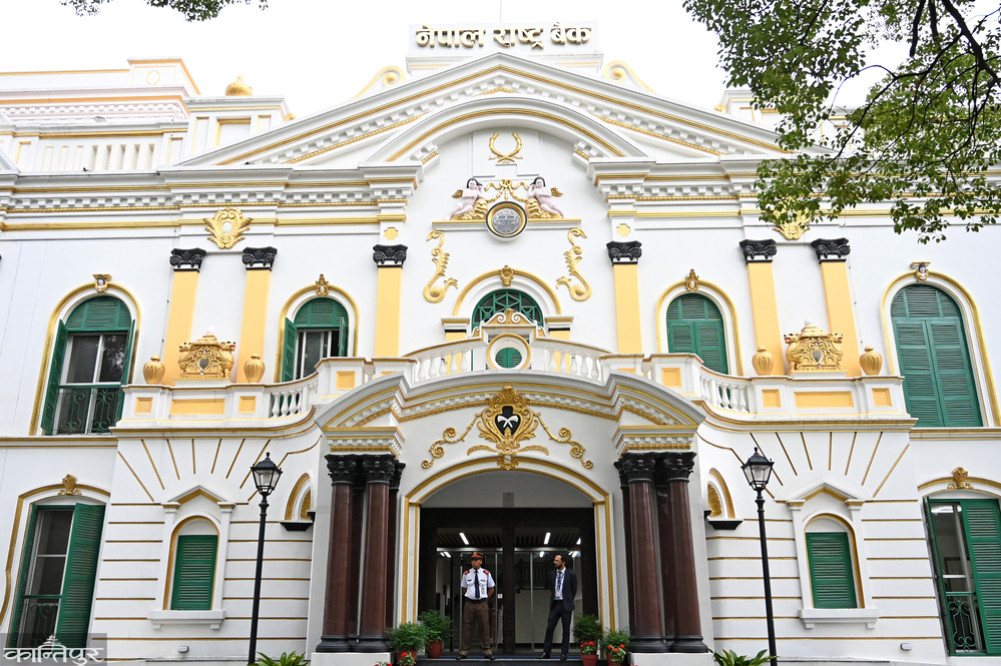
Banks have made suggestions on issues including determining loan premiums and reducing the poor category loan limit from 5 percent to 4 percent.
We use Google Cloud Translation Services. Google requires we provide the following disclaimer relating to use of this service:
This service may contain translations powered by Google. Google disclaims all warranties related to the translations, expressed or implied, including any warranties of accuracy, reliability, and any implied warranties of merchantability, fitness for a particular purpose, and noninfringement.
Banks have demanded that the premium (additional value) added while determining the interest rate of loans should be allowed to increase or decrease. In a discussion with officials of the National Bank while giving suggestions for the upcoming monetary policy, the Nepal Bankers Association has put forward 21 demands, including the possibility of increasing or decreasing the premium, reducing the limit of loans to the disadvantaged group from 5 percent.
Point 1 of the Integrated Directive 17 issued by the National Bank requires ‘A’, ‘B’ and ‘C’ financial institutions to invest at least 5 percent of their total loans in the disadvantaged sector. Banks have demanded that the limit of 5 percent be reduced. ‘Although banks and financial institutions have been investing in microfinance financial institutions to ensure credit flow to the poor, various statistics show that there has been a huge increase in the demand and size of loans to the poor and there is no demand in the market accordingly,’ the Bankers’ Association has suggested. ‘Even in the budget statement, the goal has been set to operate loans for the poor and small farmers through the Small Farmers Development Microfinance Financial Institutions. Therefore, the loan limit for the poor should be reduced from 5 percent to 4 percent.’
Similarly, in order to make the base rate of banks and financial institutions realistic, in point No. 78 of the monetary policy for the fiscal year 2081/82 and point No. 99 of the monetary policy for the fiscal year 2082/83, it was mentioned that the base rate calculation method of banks and financial institutions would be reviewed/improved, but the association has raised questions as to why this has not happened so far.
Similarly, even though the interest rate on loans is at a historic low, the demand for loans has not increased as expected. ‘Currently, banks are not able to adjust the risk premium even though the borrower’s risk has changed, which has created a situation contrary to the principle of market risk. Therefore, arrangements should be made to change the premium rate according to risk-base pricing based on the borrower’s risk profile,’ the association said. ‘As mentioned in the agreement with the borrower, arrangements should be made to adjust the premium rate based on market liquidity and borrower’s risk.’ The Bankers Association claims that only the borrower will directly benefit from this arrangement in the current situation of excess liquidity.
These are the 21-point suggestions
1. Since there is no provision to convert security certificates into cash, necessary initiatives should be taken to establish a secondary market.
2. Necessary initiatives should be taken to amend the Banks and Financial Institutions Act to provide a legal provision for banks to provide non-banking assets on rent.
3. Since there are sometimes ambiguities in the understanding and implementation of policies/guidelines issued by Nepal Rastra Bank, a mechanism should be established to provide clarity on the queries and ambiguities raised during the implementation of policies/guidelines to make interdepartmental coordination effective.
4. Although it is mentioned in point no. 76 of the monetary policy for the fiscal year 2082/83 that the existing loan classification and loan loss system will be studied and reviewed as needed, since there has been no policy change so far, necessary initiatives should be taken to bring flexibility in loan loss management in line with international practice/standards.
5. In order to make the base rate of banks and financial institutions realistic, it is mentioned in point no. 78 of the monetary policy for the fiscal year 2081/82 and point no. 99 of the monetary policy for the fiscal year 2082/83 that the base rate calculation method of banks and financial institutions will be reviewed/improved, but this has not happened so far.
6. According to point 1 of E.P.R. No. 17 of the integrated directive issued by Nepal Rastra Bank, there is a provision that category 'A', 'B' and 'C' financial institutions should invest at least five percent of their total loan portfolio in disadvantaged areas.
7. According to point 12 of E.P.R. No. 17 of the integrated directive issued by Nepal Rastra Bank, the health and education sectors, which are the country's priorities, should be included in the specified sectors.
8. Even though the interest rate on loans is at a historic low, the demand for loans has not increased as expected. Currently, despite the change in the risk of the borrower, banks are not able to adjust the risk premium, which is contrary to the principle of market risk. Therefore, arrangements should be made to change the premium rate according to risk-base pricing based on the risk profile of the borrower.
9. In order to make banks more competitive and to encourage banks to innovate and use new technologies, the limits and rates related to service charges should be left to the open market.
10. Provision should be made to create a payment fund for debentures issued for capital adequacy and issue bonus shares equivalent to the amount of that fund (reserve) without the obligation to allocate funds for the payment fund.
11. Since the capital sources available to private equity funds and venture capital funds from various banks and financial institutions may be less, arrangements should be made to facilitate and encourage investment in these funds, up to 5 percent of the primary capital of banks and financial institutions should not be reduced from the capital fund.
12. Integrated directive issued by the Nepal Rastra Bank, E.P.R.N. As per point 5(a)(1) of 14, the provision that banks should have a non-performing loan ratio of less than 5 percent to establish a branch office abroad and that the total risk-weighted assets should not exceed 2 percent in overall risk management under the supervisory review should be reviewed.
13. Although the limit of non-deliverable forward (NDF) transactions has been increased to 30 percent of the core capital, banks are not able to fully utilize the facility due to the current 30 percent limit of net open position, a certain portion of the INR position should be exempted from the calculation of net open position or the limit of net open position should be increased.
14. Initiatives should be taken to create a common digital platform for customs procedures, documents, and logistics management related to import and export by involving the main bodies involved in import and export (Nepal Rastra Bank, customs office, banks, etc.).
15. With the increasing use of digital platforms, instead of making SMS notification mandatory for every transaction for customers using digital banking, it would be more effective to provide notifications through in-app means for transactions made through omni-channel (such as mobile banking-internet banking), so arrangements should be made to send notifications through apps as well, without making SMS mandatory.
16. Although it has been a few years since Nepal Rastra Bank issued instructions for QR interconnection, there is still no interconnection in QR, so considering the situation where customers have to use different operators for QR use, interconnection should be implemented as soon as possible for the convenience of customers.
17. Necessary initiatives should be taken to create a common platform to immediately provide information to the police and the concerned banks to protect customers from digital scams and frauds caused by the increasing use of digital channels.
18. Although the Monetary Policy of FY 2080/81 announced the establishment and implementation of a central customer identification system in point 103, the work has not been completed yet. Under an appropriate regulatory framework, a system should be established to record customer identification details, including due diligence details, in a centralized system (central KYC) and necessary arrangements should be made to update customer details as per the details of that system.
19. Rastra Bank's Directive No. 14, point 2(1), has been made that the bank can close branches under the metropolitan city without the prior approval of the Rastra Bank. It seems appropriate to broaden this provision and apply this provision to sub-metropolitan cities and municipalities with many branches.
20. Under the provisions of point 3(3) of the Integrated Directive No. 16 issued by Nepal Rastra Bank to banks and financial institutions, the provision for closing accounts with zero balance and no transactions for 10 years by publishing a public notice should be revised and the period for closing the above-mentioned accounts should be reduced to five years.
21. In order to further advance the programs being carried out by banks under corporate social responsibility in a more effective manner, arrangements should be made to include financial literacy programs conducted by the Association of Banks and Financial Institutions within the scope of the order issued by the Honorable Supreme Court and the guidelines on corporate social responsibility issued by Nepal Rastra Bank.