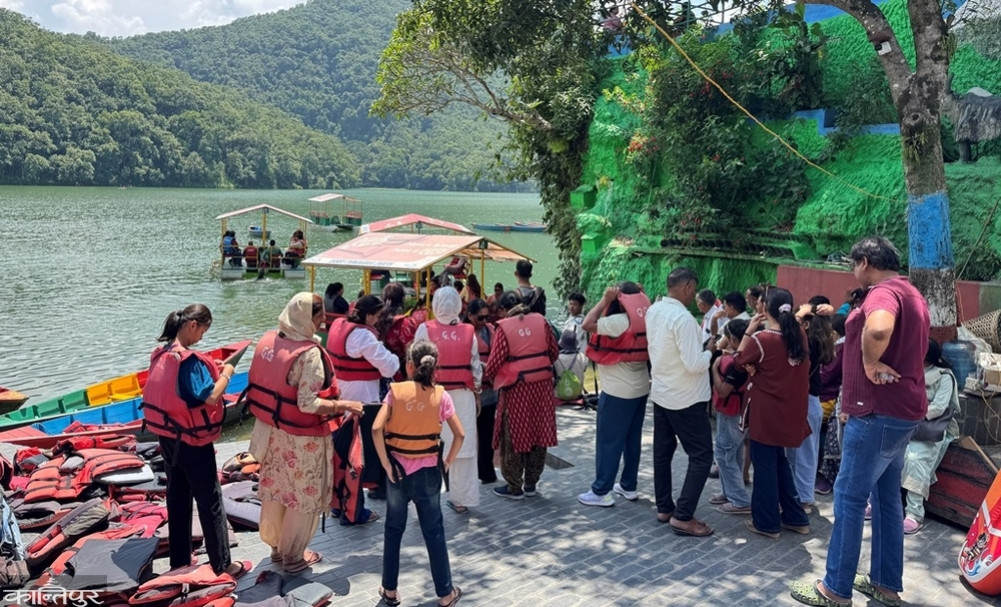
This year, occupancy of five-star hotels in Pokhara by Indian tourists has increased by 25 percent compared to last year.
We use Google Cloud Translation Services. Google requires we provide the following disclaimer relating to use of this service:
This service may contain translations powered by Google. Google disclaims all warranties related to the translations, expressed or implied, including any warranties of accuracy, reliability, and any implied warranties of merchantability, fitness for a particular purpose, and noninfringement.
Saeed Sah from Uttar Pradesh, India, known as 'Blogger Bhaiya' on Facebook and Instagram, has made more than 20 'reels' about Pokhara alone. Those reels have been viewed millions of times. Similarly, Indian 'vloggers' including Aaradhya Singh, Mohd Umar, Ronak Rider Ji have made reels of places like Pokhara, Muktinath, Ghandruk. Ronak Rider returned from Varanasi, India, via Mustang via Pokhara with his friends on a motorcycle.
Two years ago, a blog posted on YouTube by famous Indian artist Ashish Vidyarthi about Pokhara gained equal attention. Social media publicity, the increasing heat in India, the Modi government's dollar-saving policy, the activism of tourism organizations, and Bihar's liquor ban have attracted thousands of Indian families to Pokhara this year. But the increasing pressure has also added new responsibilities to hotels, roads, and border checkpoints.
Nafis Alam, a businessman from Patna, Bihar, who entered Nepal through the Birgunj border on Monday, returned home on Friday via the same route. He had come to Pokhara with his friends Mohsin Ali, Imtiaz Alam and Anjar Alam. ‘I came to Nepal to spend time with my friends in the lap of the Himalayas,’ he said. ‘It is summer, we reached Ghandruk in search of coolness and saw the culture of the village.’
This is Nafis’ first trip outside India. ‘But I don’t feel like we are outside India at all,’ he says. ‘The people here are friendly, the city is clean.’ They had come to know about Pokhara through social media. He says that the suggestion of a friend who had returned from a motorcycle trip led them here. The night lakeside market, the peaceful shores of Fewa Lake and the experience of the Nepali people putting the saying ‘Atithi Devo Bhava’ into practice have made Nafis fall in love with Pokhara. But with every beautiful experience, Nafis also shared some complaints. The customs management at the border checkpoint is lax, there is a shortage of staff, a lack of toilets and there are not enough signboards on the road.
Pramod Agrahari, a businessman from Gorakhpur, Uttar Pradesh, has come to Pokhara with a team of nine people including his family and relatives. After visiting Butwal, Tansen in Palpa and Rani Mahal, they have now planned to go to Kathmandu. ‘We visited Fewa Lake, Sarangkot, Pumdikot, everyone is having fun,’ he said. He said that he made the travel plan after seeing the beauty of Pokhara on social media. He has learned a lot about Pokhara, Mustang and Ghandruk from Facebook reels. ‘I want to tell everyone in India, come to Pokhara once,’ he said, who came to Pokhara to make the most of his children’s school holidays.’
For the Khurana family, who run a textile business from Punjab, Pokhara is an ‘adventure’.’ Krishna Khurana, who came by road through a travel agency, says, ‘We found Pokhara to be the best city when we searched on the internet. Paragliding, bungee jumping, Gupteshwor Cave and Fewa Lake, we chose Pokhara for these.’
According to his father Gaurav Khurana, his relatives had previously visited Pokhara and returned. ‘We had heard about Pokhara, now we have seen it firsthand.’ Krishna’s mother Kashish Khurana really liked the food and the nature of the people here.’
Thousands of Indian faces like Nafis, Pramod and the Khurana family have broken the occupancy record of Pokhara hotels this time. According to Pancham Lama, who has been the general manager of Pokhara Grand Hotel for four and a half years, the occupancy of five-star hotels during the summer season was usually only 40 to 45 percent. This time, it has increased by another 20 to 25 percent. He has experienced that the extreme heat in India and the publicity on social media have increased the overall hotel occupancy in Pokhara more than expected.
He has also observed the behavior of Indian travelers. ‘They are ‘last minute travelers’. The booking window is not 15 days or a month in advance,’ he said. ‘If they get a two-day holiday or the heat increases, they plan and arrive within 48 to 72 hours.’ But now, there is also an increasing number of high-class tourists who travel in their free time, who book three-star, four-star, and five-star hotels through online agencies like Make My Trip, Expedia, Agoda, and Booking.com. Spending capacity is also good. ‘Most of the passengers come by road from Uttar Pradesh, Bihar and West Bengal, which border Nepal,’ he said, ‘and, it is a common habit of Indian tourists to eat at least one meal a day in hotels.’
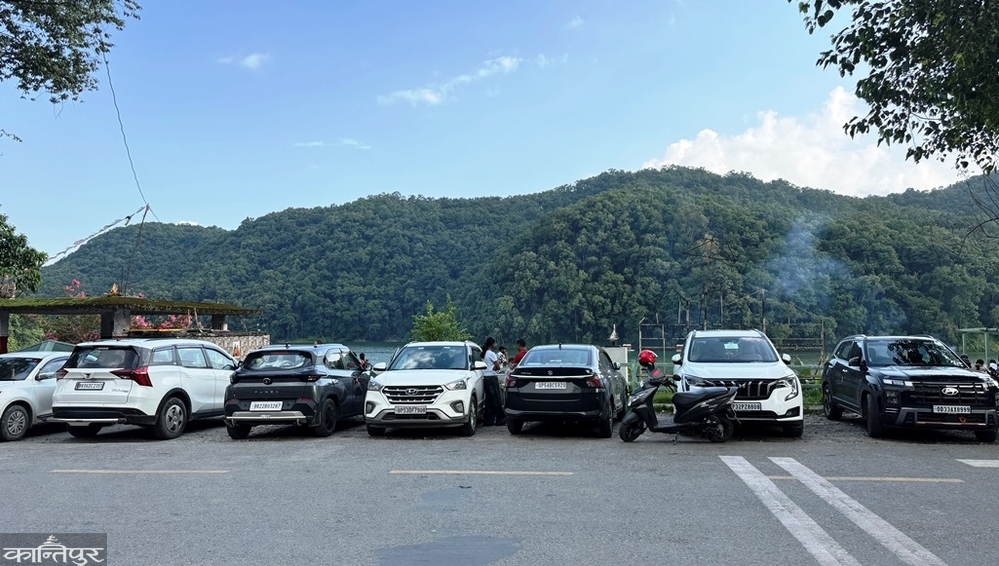
This year has also been extraordinary for Laxman Subedi, president of the Pokhara Hotel Association, who has spent 32 years in the tourism sector. ‘In my opinion, this is probably the first time that such a large number of Indian tourists have come,’ he says.
According to him, the occupancy of hotels was around 90 percent until a few days ago, and since the beginning of the Nepali New Year, the flow of Indian passengers has been significant not only in Pokhara but also in other destinations in Gandaki Province, including religious sites and trekking routes.
He does not see a single reason behind this surge. Last year, the massive promotion of places like Muktinath on Facebook and Instagram, Indian Prime Minister Narendra Modi's encouragement to citizens to visit countries where the rupee is used to save dollars, and geographical proximity - all these have made Pokhara the choice of Indian travelers. He also mentioned an interesting point. "Since alcohol is completely prohibited in Bihar, Nepal has become a nearby open option for young people who want to have fun with friends," he says.
In addition, the financial concessions given by the government to Indian senior citizens for religious visits are also keeping Pashupatinath and Muktinath as the first choice, says Kishor Dahal, President of Nepal Association of Tour and Travel Agents (NATTA) Gandaki.
Efforts to institutionalize the growing pressure have also been underway. On 29 Jestha, Nepal Association of Tour and Travel Agents (NATTA) Gandaki organized a B-to-B networking program in Kolkata, India under the ‘Pokhara-Nepal Promotion Campaign 2026’. Indian tourism entrepreneurs who participated in the program stated that Pokhara is one of the best destinations in South Asia and pledged to send more passengers.
Outgoing Chairman of Pokhara Tourism Council Pom Narayan Shrestha says that the government should take the initiative to provide direct flights from Pokhara to Indian cities as the number of Indian tourists has increased due to the improvement in the road network.
According to Maniraj Lamichhane, Gandaki Province Chief of Nepal Tourism Board, the foundation of this boom is the May-June summer vacation of Indian schools and colleges. “The tourism board launched a campaign called ‘Garmise Behal, Chalo Nepal’, and Pokhara businessmen have also been promoting the border city with the ‘Chalaye Pokhara’ campaign for years,” he said. “Adding to this, the voluntary publicity by Indian bloggers and influencers has spread the beauty of Ghandruk, Muktinath and Annapurna regions across social media.”
As part of the simple policy introduced by Nepal Rastra Bank, middle-class Indian families can now pay through Nepal’s own PhonePe through mobile wallets like Indian PhonePe and UPI, the problem has become one step less for middle-class Indian families. He believes that the Indian pressure has increased this year because most families come with their own vehicles and the road access is easy. He also informed that the tourism board has brought ‘guidelines’ on what to do and what not to do to manage passengers coming by road.
Stating that the management aspect is equally important with the increase in tourists, Lamichhane pointed out the need to put up more signboards in Hindi and English. ‘Most of the Indian groups coming on pilgrimage are cooks.’ That is why even three-star hotels in Kathmandu have adopted the practice of arranging separate kitchens and this practice is also seen in Pokhara,’ he says, ‘but until rest houses with toilets, kitchens and bathrooms are built on main roads and religious sites, the problem of stopping vehicles wherever they can and cooking and defecating will persist.’
He said that the current need is to increase such rest houses that can be operated for a fee and vegetarian restaurants on the route from Pokhara to Muktinath.
In the view of Pokhara Grand General Manager Pancham Lama, the most important thing is to look at Indian tourists. ‘They are our guests, ultimately a guest is a guest, we need guests,’ he says. He argues that some of the negative things seen when coming in a vehicle cannot be solved by criticizing it on social media alone. He says, "Instead, we should set standards, distribute brochures at checkpoints, or arrange for proper briefings. If we remind people what to do and what not to do, many things can be solved easily."