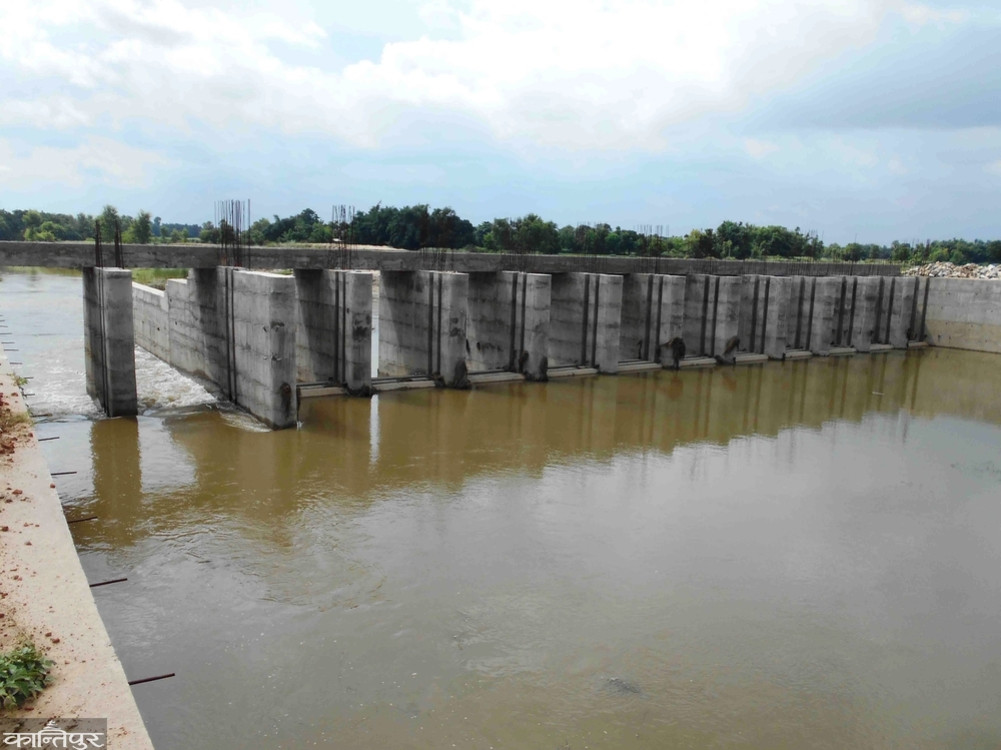
Due to the lack of regular maintenance and upgrading of the five-decade-old Gandak Canal system, bridges, gates, siphons, and distribution systems have deteriorated, affecting irrigation facilities.
We use Google Cloud Translation Services. Google requires we provide the following disclaimer relating to use of this service:
This service may contain translations powered by Google. Google disclaims all warranties related to the translations, expressed or implied, including any warranties of accuracy, reliability, and any implied warranties of merchantability, fitness for a particular purpose, and noninfringement.
The Gandak Canal System, the largest and most historic irrigation project in Madhesh Province, built five decades ago in Nepal-India cooperation, is falling into disrepair. Due to the government's neglect in regular maintenance, upgrading and reconstruction, most of the infrastructure, from the canal structures to bridges, gates, siphons and water distribution systems, have fallen into a dilapidated state. Technicians have said that at least three of the 22 bridges built over the canal are in a very dangerous condition.
The bridges over Bangari Khola in Feta Rural Municipality of Bara, Sirsia Khola in Birgunj Metropolitan City of Parsa and Oriya Khola in Jagarnathpur Rural Municipality are in urgent need of repair or reconstruction. These bridges have been used daily for the movement of thousands of ordinary people, farmers, students and freight vehicles.
The Gandak Canal System is considered an important achievement of the Gandak Agreement signed between Nepal and India. The Indian government had constructed the Gandak Barrage on the Nepal-India border at Triveni Bhainsalotan in Nawalparasi with the aim of expanding irrigation facilities in the agricultural areas of Nepal and India by utilizing the water of the Narayani (Gandak) River. Two main canal systems, eastern and western, were brought into operation from the barrage.
The eastern canal, which comes towards Nepal, was constructed in two phases in 1975 and 1976 and handed over to the Nepal government. After traveling about 92 kilometers inside India, the canal enters Nepal from Jankitola, Jagarnathpur Rural Municipality-1, Parsa. Its total length towards Nepal is 81 kilometers. Inaugurated on 21 Jestha 2031 by the then Prime Minister Kirtinidhi Bista, this canal system is now falling into disrepair. At the time of construction, the target was to provide irrigation facilities throughout the year to 31,400 hectares of land in Parsa, Bara and Rautahat. Currently, about 37,400 hectares of land are considered irrigated.
The canal is the 'lifeline' road for three districts.
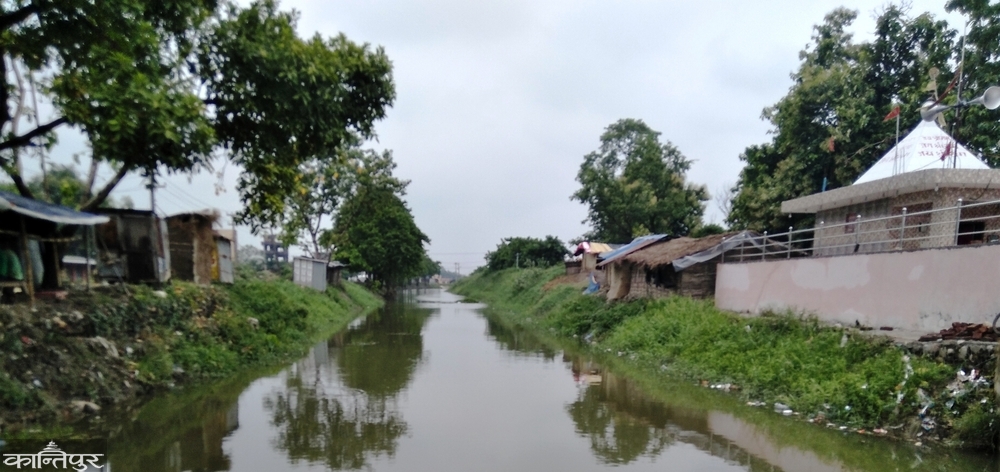
Along with the construction of the canal, service roads and bridges over various rivers were built on both banks of the canal. In the initial phase, these roads were used only for canal operation and maintenance. After being opened to the public after 2046 BS, the canal approach road developed as the main alternative road for the southern regions of Parsa, Bara and Rautahat.
The federal government has blacktopped most of the roads along the canal in recent years. After the Postal Highway, this is considered an important road connecting the rural areas of southern Madhesh. Thousands of locals have been using this road to transport agricultural produce to the market, reach schools and health institutions, and conduct daily business activities.
Over the past decade and a half, industrialization has expanded rapidly in the Birgunj-Jagarnathpur region. Hundreds of trucks, tippers and containers transporting raw materials and finished goods to industries in the industrial corridor use this road daily. But the bridges built with limited load capacity five decades ago are now struggling to withstand the pressure of heavy goods vehicles. Locals complain that the bridge over Sirsia River in particular is in a weak condition. Any damage to the bridge would directly affect the industrial area, rural settlements and agricultural production transportation system of Birgunj.
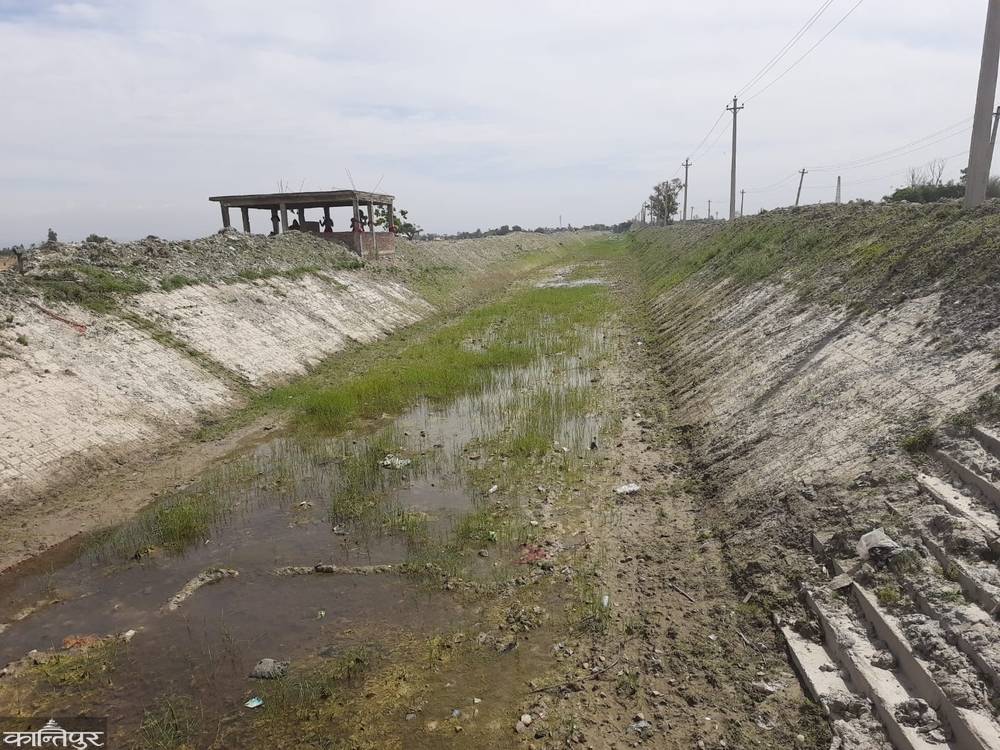
The Gandak Canal system is currently being managed by the Narayani Irrigation Management Office, Birgunj. At one time, the office, which was run by a special category employee (GM), had more than 350 employees. Currently, the number of employees has been reduced to 70. Of these, 20 are permanent, 25 are contractual and 25 are daily wage employees. The regular maintenance of the 81-kilometer-long canal, its associated bridges, gates, siphons and other structures has become a challenge due to the lack of staff, says Engineer Suresh Sah, Information Officer of the office.
System divided into 15 blocks
After entering Nepal, the canal has been divided into 15 blocks. There are blocks 1 to 6 in Parsa, 7 to 12 in Bara and 13 to 15 in Rautahat. Along with the main canal, an extensive system of branch canals, sub-branch canals, branch canals, tertiary, field channels and drain canals was constructed. But over time, tertiary and field channels have disappeared in most places. In some places, farmers have buried them themselves, while in some places, the local level has built roads and other structures in the canal area, thus disrupting the old distribution system.
According to the Gandak Agreement, India has agreed to provide 850 cusecs of water to Nepal for the paddy crop from Ashar 15 to Kartik 15 and for the wheat crop from Poush 15 to Falgun 15. But according to farmers and irrigation officials, Nepal has not been able to get water as per the agreement every year.
They say that usually only 450 to 650 cusecs of water is received. The Narayani Irrigation Management Office has stated that during the wheat crop season this year, India's two branch canals did not provide any water to Nepal, citing cleaning work in their area as the reason. About 7 kilometers of the canal was cleaned on the Nepal side during the period when water was not received.
Although gates and structures have been built at necessary places in the canal to control water, water leakage is excessive due to the lack of such equipment on the Indian side. Therefore, the problem of insufficient water reaching Nepal has been recurring for years. Water user committees have also expressed dissatisfaction over this. According to Lalbabu Singh, chairman of the Narayani Irrigation System Users' Committee under Block No. 10, Nepal has never received the amount of water mentioned in the agreement. 'Despite the agreement to provide 850 cusecs of water, there is no experience of receiving that much water in practice,' he said. 'Sufficient water does not reach the end of the long canal system. Farmers have been suffering from this for years.'
He accused the relevant bodies of Nepal of failing to take effective initiatives to ensure water as per the agreement with India. He said that many areas under the canal have not been fully irrigated due to insufficient water.
Completion of Jamuni Project will bring relief to farmers in the end
The Jamuni Irrigation Project, which was started with the aim of solving the problem of water shortage in the last section of the Gandak Canal, has recently started gaining momentum again. Engineer Sah said that the project, which has been affected for more than five years due to the compensation dispute and the lack of electric gates to be installed in the barrage, is now moving towards the final stage of implementation.
The Irrigation Department has completed the contract process for the electric gates required for the barrage. He said that the contractor company has also started the design work for the gates. According to him, the project will move forward at a faster pace after the remaining compensation of about 60 million rupees in the barrage area is completed.
This project, which is being constructed with the grant of the Government of Nepal and the loan assistance of the World Bank, is located on the border of Adarsh Kotwal Rural Municipality and Pachrauta Municipality in Bara. So far, about 350 million rupees have been spent on the project.
There is a plan to mix the canal water drawn from the barrage constructed on the Jamuni River with the Gandak Canal. After the project is completed, it is expected that around 9,500 hectares of arable land in eastern Bara and western Rautahat will be irrigated throughout the year. It is believed that farmers in block numbers 11 to 15 of the Gandak Canal will directly benefit from this.
The electric gates to be installed in the barrage will also play an important role in flood management. During floods, when there is excessive water flow in the river, if the gates cannot be operated in time, there is a risk that the river will change its course and damage the barrage and embankment. It is expected that such risks will be reduced after the electric system comes into operation.
Damodar Yadav, a farmer from Harpatganj in Parsa, remembers that in the past, most of the farmlands around Birgunj were irrigated with water from the Gandak Canal. ‘Earlier, the water from the canal was sufficient for rice and wheat cultivation,’ he said, ‘but now many canal systems have been destroyed, and water is not coming in enough.’ The lack of irrigation has become more serious due to the drought in recent years. Farmers have now started understanding the real importance of the canal.'
According to Engineer Sah, the problem is not limited to the bridge. The entire canal system has reached the end of its design life. 'The design life of the canal and most of the structures is about 50 years,' he said. 'It has now been 45-50 years since construction. Most of the infrastructure, including gates, siphons, sluice gates, cross drainage structures, etc., have deteriorated.'
According to him, the problem can no longer be solved by simple repairs. The office has prepared a detailed study, survey and DPR and sent a proposal for restructuring with a cost estimate to the Federal Water Resources and Irrigation Department. If the Gandak Canal system is not comprehensively restructured by allocating the necessary budget in a timely manner, not only the important irrigation system of Madhesh, but also the alternative road network used daily by millions of locals in three districts will be at risk.
The Gandak Canal system, which is directly linked to agricultural production, rural transportation, industrial transportation, and the local economy, is currently struggling to survive. The question of whether the revival of this historical infrastructure, which was built as the basis of Madhesh's prosperity five decades ago, should now be a priority for the government, has begun to arise seriously among locals, farmers, and water users. In recent years, the office's total annual budget has been around Rs 150 million. Out of that, about Rs 120 million is the development budget. Engineer Sah says that such a small budget is not enough to even maintain the canal system.