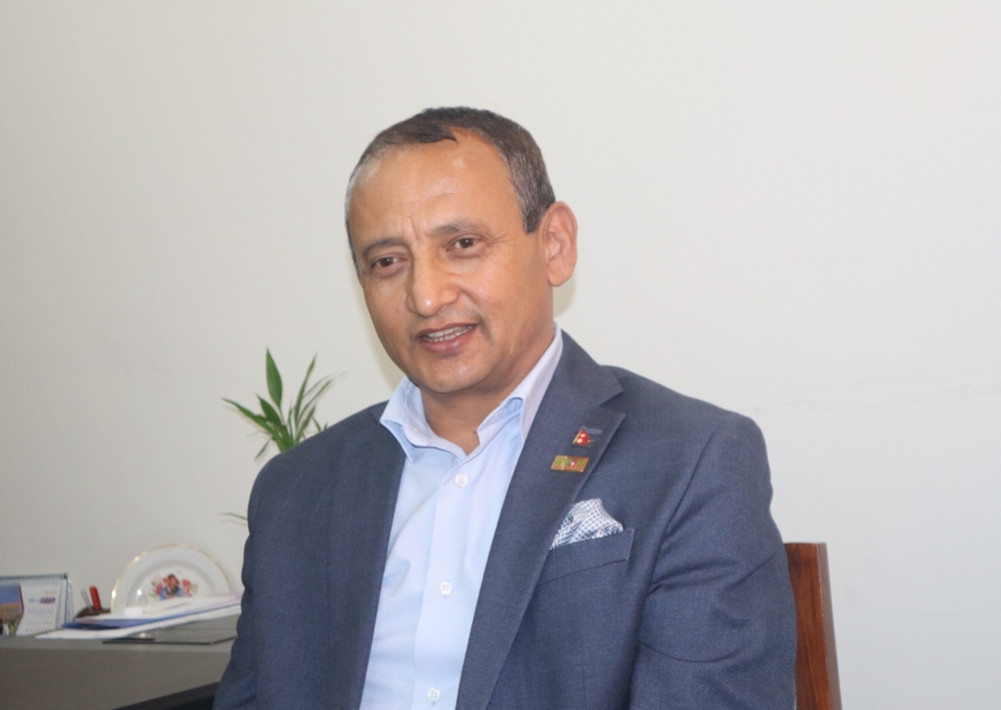
IPPAN President Mohan Kumar Dangi has emphasized collaboration with the government to ensure private sector participation in PPAs, transmission lines, and trade.
We use Google Cloud Translation Services. Google requires we provide the following disclaimer relating to use of this service:
This service may contain translations powered by Google. Google disclaims all warranties related to the translations, expressed or implied, including any warranties of accuracy, reliability, and any implied warranties of merchantability, fitness for a particular purpose, and noninfringement.
As of last Chaitra, 4,296 megawatts of electricity have been connected to the national system in the country. The private sector accounts for 80 percent of it. The rest is the share of Nepal Electricity Authority and its subsidiaries. The Power Purchase Agreement (PPA) has been stopped since the budget of the current fiscal year, and energy entrepreneurs are demanding that the transmission lines and electricity trade be opened to the private sector. Mohan Kumar Dangi, who was elected as the president of the Independent Power Producers Association of Nepal (IPPAN), an umbrella organization of energy entrepreneurs, at the 24th annual general meeting and eighth session, was interviewed by Seema Tamang for Kantipur: He has been elected as the president of the Independent Power Producers Association of Nepal (IPPAN) at the 24th annual general meeting and eighth session. How do you plan to advance your term? What are your priorities? I have been working on the energy sector agenda for many years. I have been involved in IPPAN for the past eight years. The eighth session of IPPAN has added a big responsibility. Earlier we were scattered. Now we are standing in one place. I have been given a big responsibility along with challenges and opportunities. There are pressing issues in the energy sector such as PPAs, transmission lines, forests, land, etc. Promoters are forced to visit eight ministries, 24 departments and more than 200 tables. These old problems are still there. We will shortlist it and now move towards doing it differently. A new and stable government has come. Even when discussing with the government, it is said to cooperate. From energy trading licenses to involving the private sector in transmission lines. How can this be made private sector-friendly? We will move forward in cooperation with the government. There is a strong government with a close to two-thirds majority . At this time The time has come to make the Forest Act of 2029, the Electricity Act of 2049, and the policy of 58 relevant to the times . When there is a strong government, our cooperation will be mainly in making laws/acts . Many have realized that energy will lead the country to the path of prosperity . It is a sector with a share of about 7 million of the general public . That is why we work responsibly. There is a plan to work together with the government in a way that is private sector-friendly and beneficial to the country .
The study task force on licenses formed by the Ministry of Energy has recommended revoking the licenses of 38 projects with a capacity of 1,388 MW that have not been operating for a long time despite being PPAs. The government's decision on this is yet to come . How justified is this ?
I have not read the report yet. I have seen and heard it in the media. It says that projects that have not been implemented under PPA are being managed financially. Forests do not allow trees to be cut. They do not allow entry into parks. If such projects are stalled due to the government, they cannot be canceled. On the other hand, if they are in trouble or cannot be implemented or cannot be implemented at all, the government should give them a chance to be heard. If it is not possible to build it due to the private sector, I think we should not advocate too much. If it is not possible to build it, then it is not possible to occupy it. It remains to be seen what projects the government has selected.
According to the Electricity Act, 2049, a survey license is available for five years. As soon as the sixth year passes, you have to go and get a production license. There is no other way . When issuing a generation license, if financial management is not done within two years, the license will be canceled . But about 16,000 MW are waiting for PPA . Without PPA, there is no financial management . But if a government agency says that it will take action if financial management is not done, it is not consistent . That is not consistent . If the delay is due to the government, the government should not take action .
Earlier, many used to come to the river in a bag . 1300 means The bag will go to the river. In that, those who have not been or have not been able to do it due to the promoters, and some of them are not even feasible to do it now, should be considered Some measures should be taken to protect the people's investment . The government has the responsibility to protect the people's property in the constitution. In the energy sector There are no irregularities, they need to be corrected. Now 20-50 crores have been raised, people are absconding, and your project has not been built. But if the project is good, the government should rescue and take over the investors and let them build. Those investors' investments should be maintained and taken action. We will discuss this issue after we say, "Let's protect the investment and do everything." I do not support what is being done in a very unfair way.
You have been demanding that the private sector should be involved in the transmission line. A few months ago, the Nepal Electricity Authority had sought a letter of intent saying that it would be built on a tariff base. But there were few applications from the private sector in Nepal. Why didn't you go?
We are saying that we should be involved in the transmission line. The government has also asked for a letter of intent for the transmission line. But that is very conservative. The authority is now doing a PPA with us on a one-off basis. Similarly, a letter of intent has been requested. The bank had to make it eligible for investment after consulting us. We cannot do it by bringing all the money from home. We have to see a 15%-17% return on equity (ROE). The bank will invest on that basis. That is why it is very conservative. At that time, we also went and discussed it. We have said that we have to be flexible and make it bankable. If the bank does not see it as eligible for investment, we cannot bring money from home. There are many issues including the company's experience, total capital, license period. The authority should have discussed it with us. And finally, we also participated. Since it was done on a one-off basis, it was not feasible. If it was not feasible, there was no point in us participating.
For a long time, IPPAN has been demanding that a tax be imposed on electricity. This government has imposed a value-added tax (VAT) in the budget. It seems that VAT will be applied only to consumers, not to promoters. What do you say about this?
From the day after VAT was introduced in the budget, VAT started to be 5 percent or 13 percent. That's when we were convinced that we would not get it. The financial bill also made provisions that we would not get it. I myself asked the Finance Minister at an event. He said what would happen if many people were charged 5 percent? He said that if you charge 5 percent on a thousand, it would be 50 rupees. But we are worried that consumption will decrease even if we raise 50 rupees. The government should have given incentives to increase electricity consumption. For example, when calculating all types of new and old, the average cost of the NEA is 5.52 paisa per unit. Nepal's law says that it cannot make a profit of more than 20 percent. If the NEA follows that law, it should have gotten electricity for seven rupees. But the NEA has not given electricity for seven rupees. If the government is going to collect tax, should it be 5 percent or 10 percent? There is already profit there. The government should have given 20%, 30% discount to those consuming more than 100 kilowatts, 200 kilowatts, 500 kilowatts to increase consumption. It is not just a matter of 5 rupees. The risk of consumers using less has increased. Consumption does not increase even if VAT is imposed at 5 percent. That is our reservation. That will remain.
The NEA has not done a PPA. You have been demanding PPA. Without PPA, there is no financial management. What is the solution?
The budget brought by the government on 15 Jestha has said that PPA will be done on a take-or-pay basis up to 10 MW. Before this year's budget, PPA up to 10 MW was automatic. It was done again like that. But above 10 MW, nothing has been said. Since the budget is silent, it seems that it will not do PPA above 10 MW. The government cannot say that it will not do PPA of 16,000 MW while giving licenses and paying revenue. According to our estimates, more than one trillion rupees have been invested in that alone. The government cannot move because one body of the Ministry of Energy grants licenses and another does not do PPA. But now it is time to find a holistic solution to this. I This problem has been created when businessmen talk only about businessmen or the government talks only about the government or the administrator talks only about the administrator. A high-level discussion is needed. The solution to that is an electricity trading license and transmission line. There is no other solution. I am not trying to be too 'sure' by saying that. The authority buys 4.80 paisa of Barkha. India is coming to buy it for 4.50 rupees. A trading license had to be given. Now, if you don't give a trading license, you won't get it because you won't do PPA anymore. We have to think about it from the perspective that it is everyone's problem.
Will the private sector get an electricity trading license immediately?
It won't happen today, it won't happen tomorrow. If the Electricity Authority does PPA today, it won't happen tomorrow. It will happen in five years at the earliest. For example, if a new trading company gets permission now, it will become a basis. We will be able to do any business in the next five years. The company itself can do PPA. IPPAN has already signed a memorandum of understanding with Manikaran Power of India to sell 2500 MW of electricity. At that time, the government had sent an ordinance. Unfortunately, it was not approved because it was on the eve of elections. If we had got the license then, we would have been selling electricity now. Today, there would be no waste. Now, a tender for 4,000 MW has been opened in Uttar Pradesh of India. If we had a license, we would have put out a tender. But we do not have a license. Now, the NEA is finding it difficult to send 1,200 MW. Even if the private sector does business, money comes to the country. Even if the NEA does it, money comes to the country. What is the need to be conservative?
The government's process of not being able to find a market, not being able to increase consumption, not even doing PPA, but still issuing surveys and production licenses is not right. These issues are being discussed in the interest of the country, in the interest of the businessmen, and in the interest of the government. I will take that initiative.
India and Bangladesh have received export permits for 1,200 megawatts. You always complain that electricity is wasted with the onset of the rainy season. What is the situation this time?
The current maximum peak load is 2,200 megawatts. That too is not regular. 1,200 megawatts are exported to India and Bangladesh. Including exports, domestic consumption has reached 3,400 megawatts. Currently, 4,300 megawatts are connected to the grid. There is already a difference of 900 megawatts. 900 megawatts have been wasted. The authority or the government has If we wait and see, the state's money will be wasted. Some projects are in contingency. Next year, 53/5400 MW will be connected to the national transmission line. If the NEA does not increase its selling capacity, how much electricity will the private sector waste? This problem is already there. Let's hope that the government will take action to solve it. We will also take the initiative.
It has been three months since the new government came. How did you feel about the government's start?
The government's start in the energy sector was bad. When the government gets caught in the trap of employees, negativity starts coming from there. As soon as the Energy Minister came, he formed a task force under the leadership of one joint secretary to study the project license and another joint secretary to study the PPAs. Currently, 80 percent of energy production is in the private sector. But there is no representative in the task force formed by the government. If we were represented, we would argue. The task force has unanimously recommended that the 1388 MW permit be revoked. If we were there, we would have chosen. Those who have not done their work should not be given. But they did not even mark it. If we had a discussion with the Minister of Energy, a solution would be found.
A separate panel was formed before the 24th Annual General Meeting and 8th Convention of IPPAN saying that the statute should be amended. A new working committee has been unanimously formed after amending the statute. There was also a plan to make IPPAN a federation. What happened to that? Can we call IPPAN a federation?
There is the National Directive Act 2018. It is possible to form a federation by registering it and taking a decision from the Council of Ministers. But since 2071, the Ministry of Home Affairs has been saying that it will not accept applications. A federation cannot be formed through that. On the other hand, a federation can only be formed by creating a structure according to the province. But IPPAN will also be a member of it. We have tried to make IPPAN a federation. That is why our general assembly has left the agenda of forming a federation. Our general assembly has already decided not to form a federation. But if it is decided by the Council of Ministers to make IPPAN a federation, we will try.