Due to the lack of morale in the private sector, economic activity has not been buoyant and market demand has not increased. Despite money piling up in banks and interest rates at their lowest in decades, demand for credit has not increased.
We use Google Cloud Translation Services. Google requires we provide the following disclaimer relating to use of this service:
This service may contain translations powered by Google. Google disclaims all warranties related to the translations, expressed or implied, including any warranties of accuracy, reliability, and any implied warranties of merchantability, fitness for a particular purpose, and noninfringement.
‘Has anyone followed you? Have you had to check around the office or house to see if there are any strangers?’ This is a conversation that industrialists often ask each other when they meet. They say, ‘It was like the old system, we also worked according to it. But knowingly or unknowingly, how many mistakes were made, it is impossible to say, but there is fear.’
Former president of the Federation of Nepalese Chambers of Commerce and Industry Shekhar Golchha was always saying that he was always ready for questioning when he was arrested from the premises after office hours. There were plainclothes police around his office since noon. ‘That is why businessmen have started looking around now,’ said a businessman on condition of anonymity, ‘Shekharji, who is a member of the family that opened the first industry in Nepal and has become the president of the federation, was arrested directly, anything can happen to us.’
As the morale of the private sector has not increased, economic activity has not been dynamic and market demand has not increased. Despite the accumulation of money in banks and the lowest interest rates in a decade, demand for loans has not increased. The rent dispute in 10 industrial zones across the country has flared up again, while the dispute over the dedicated trunk line, which has been going on for decades, has started to flare up.
Ministers are continuing to threaten construction entrepreneurs, especially. For other reasons, the entrepreneurs are worried about how to protect themselves, their investments and businesses rather than expanding their businesses and making profits. They say that weak morale and a fearful business environment have put the private sector on the defensive. Despite statements from Finance Minister Swarnim Wagle, not to shut down the private sector, but to impose financial penalties based on offenses, entrepreneurs are being arrested.
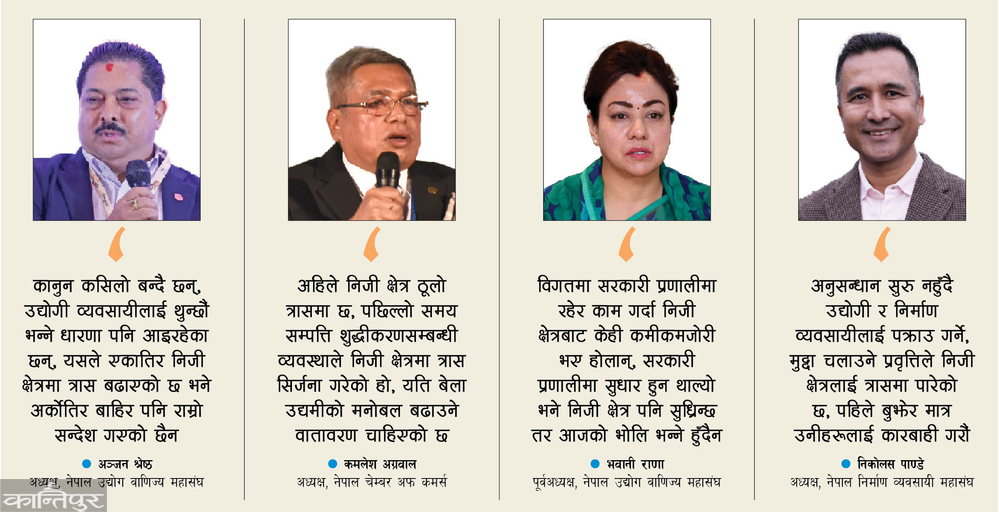
Anjan Shrestha, president of the Federation of Nepalese Chambers of Commerce and Industry, says that business people are now more concerned about investment, industry and business than profit. ‘Mainly after the private sector (individuals and businesses) were targeted in the Gen-G movement last Bhadra, the fear among business people still persists. "While there is a lot of concern about how to protect oneself and one's business, profit is not the priority," he said. "There is a concern that doing business will lead to crime. Strict laws are being made everywhere. There are also comments that industrialists and businessmen will be imprisoned. On the one hand, this has increased fear in the private sector, but on the other hand, it has not sent a good message to the outside world."
Nepal Chamber of Commerce President Kamlesh Agrawal also said that the private sector is currently in great fear. He said that the recent provisions related to money laundering have created fear in the private sector. He pointed out that there is a need for an environment to boost the morale of industrialists, businessmen and investors. Agrawal stressed that businessmen are in a state of fear due to the intervention of many bodies in the same sector and that the concept of 'one sector, one regulator' should be implemented.
Former president of the Federation of Nepalese Chambers of Commerce and Industry Bhawani Rana said that the private sector fully supports the government's desire to maintain good governance. "The government has talked about good governance. It is the obligation of the private sector to operate as the government system is." Because the private sector has more responsibilities and risks. In the past, while working within the government system, there must have been some shortcomings in the private sector as well,' she added, 'If the government system starts improving, the private sector will also improve, but it is not possible to say today or tomorrow, it takes time.'
Although the government claims to have made a policy that is easy to attract foreign investment, Rana says that foreign investment is not possible without promoting domestic investment. 'Before foreign investors come, they seek information from domestic investors. Therefore, foreign investment cannot come until domestic investors' confidence increases,' she added, 'The state and society's approach towards the private sector is 'profit-seeking' and it should be improved.'
Chairman Shrestha says that the culture of 'stinging' businessmen based on suspicion should end. "Arrests made during investigations without proving economic crimes have a negative impact on the investment-friendly environment," he said. "The government should adopt a policy of listening first and taking financial action if the crime is proven." He said that arrests made by the police during investigations without proving any crime in the economic sector have created fear in the entire industrial and commercial investment-friendly environment. Nicholas Pandey, President of the Federation of Nepal Construction Entrepreneurs, said that the private sector is worried about the trend of arresting and prosecuting industrialists and construction entrepreneurs before the investigation begins.
These statements by entrepreneurs have also been confirmed by market activities. The trading volume and indices have decreased on most trading days after the government announced the budget for the coming fiscal year. Since then, out of the 15 days the stock market has been open, the NEPSE has fallen for 10 days, increased for 4 days and remained almost stable for one day. The NEPSE, which was at 2,755 points before the budget announcement, fell to 2,700 points on Thursday.
After the government announced the budget for the fiscal year 2083/84, there has been no enthusiasm in the stock market as the NEPSE index and the trading amount have decreased significantly. During this period, the NEPSE index and the trading amount, the number of transactions and the number of shares traded have also decreased, confirming that investors are not enthusiastic about the stock market.
Even though the government announced that the capital gains tax rate imposed on the stock market has been increased through the budget and that it is final, enthusiasm has not increased. ‘Not much trading has been done because the morale of investors is weak. However, there are activities taking place in the market,’ said a broker, ‘Investors are in a wait-and-see mode.’
Even though most of the policies are favorable to the stock market, the stock market is declining due to the failure to increase investor confidence, said Bharat Ranabhat, former president of the Stock Brokers Association. ‘Currently, the government has asked civil servants (retired and working), public sector representatives (formerly/currently) to fill in their asset details in a hurry. Private sector industrialists and some civil servants were also active in shares, he said, “They were busy submitting their asset details and were also afraid, so they could not invest.”
Even though the government appointed Gopal Bhatta as the chairman of the Securities and Exchange Board, the regulatory body of the capital market, just two months after the post was vacant, new appointments have not been made in the Insurance Authority and Nepal Stock Exchange.
The National Bank has been continuously withdrawing money from the market for the last three years. To prevent interest rates from falling further, the National Bank is regularly withdrawing money from the market twice a week. But banks maintain an average of more than 1.5 trillion rupees of investable liquidity every month. Loan demand has not increased. Experts say that this is a problem somewhere because investors are not looking to invest even when interest rates are low.
On the other hand, bad loans are continuously increasing. This has a direct impact on the capital adequacy ratio of banks. Due to the failure to increase the primary capital of banks, about half a dozen banks are unable to invest more even though they have ample liquidity.
Rents in 10 industrial zones across the country have skyrocketed again. The dispute has flared up after the Industrial Zone Management Limited started cutting off water and electricity lines to industries operating within various industrial zones that have not paid their dues for land, buildings, water, electricity, etc. However, water and electricity lines have been connected to industries that have paid rent.
The number of new industries being added is also shrinking. In the first 6 months of the current fiscal year (Shrawan to Poush), 461 additional industries, including small, medium and large, have been registered across the country. The number of newly registered industries this year is 120 less than the same period last year. In the first 6 months of the last fiscal year, 581 additional industries were registered across the country.
The share of manufacturing industries in the economy is continuously declining. In the last 30 years, this share has decreased from 10 to less than 6 percent. This is one of the lowest in South Asia. 'For a long time, industries have been operating at less than half their capacity utilization. Although the problem has existed since the establishment of the industrial zone, it has not been resolved yet. Market demand has not been able to increase. There is concern that the government is constantly placing industrialists and businessmen in police custody,' said Federation President Shrestha, 'The budget for the upcoming fiscal year seems to be trying to address some issues, but the policy implementation aspect needs to be looked at for results.'
Finance Minister Swarnim Wagle has reiterated the government's commitment to create a private sector-friendly environment and adopt a strategy to accelerate economic reforms. At a public event last week, Finance Minister Wagle said that the economy would be taken forward in a new direction by collaborating with the private sector.
Finance Minister Wagle said that the government is committed to reactivating entrepreneurs and businessmen by solving problems seen in business due to past policy and administrative complexities. He claims that priority has been given to making the tax system systematic, expanding the digital system, and investment-friendly policies.