As the burden of public debt increases, the challenge of raising development resources increases, and the size of public debt increases as revenues are not even enough to pay the government's mandatory obligations.
We use Google Cloud Translation Services. Google requires we provide the following disclaimer relating to use of this service:
This service may contain translations powered by Google. Google disclaims all warranties related to the translations, expressed or implied, including any warranties of accuracy, reliability, and any implied warranties of merchantability, fitness for a particular purpose, and noninfringement.
The government has reached a point where it has to borrow to pay the principal and interest on public debt. Due to the continuous increase in payment obligations, the government has to borrow public debt to pay off the previous public debt.
Finance Minister Swarnim Wagle has mentioned in the budget for the upcoming fiscal year presented on 15 Jestha that 145 billion 311 million rupees will be spent on revenue and 61 billion 740 million rupees will be spent on foreign grants. The remaining 657 billion 290 million rupees will be spent on loans. The target is to collect 247 billion 280 million rupees from foreign loans and 410 billion rupees from domestic loans.
According to Finance Minister Wagle, 245 billion 890 million rupees will be spent on domestic debt in the upcoming fiscal year. In addition, the government also has the responsibility to pay the interest on domestic debt and the principal and interest on foreign loans.
Finance Minister Wagle has been publicly stating that the size of public debt has increased since revenue is not even enough to pay the government's mandatory obligations. He says that as the burden of public debt increases, the challenge of raising development resources is increasing.
A large part of the debt taken in this way had to be used to pay the principal and interest on the debt in the past as well. In the current fiscal year, the government has set a target of raising public debt of Rs 595.66 billion. Out of this, Rs 411.10 billion has been allocated for paying the principal and interest on the debt (service expenditure). In the fiscal year 2081/82, the government had set a target of mobilizing Rs 547 billion, but Rs 428.50 billion was allocated for paying the principal and interest on the debt. Out of this, Rs 459 billion was mobilized and Rs 361 billion was paid as principal and interest. This shows that most of the public debt raised annually has to be spent on paying the principal and interest on the old debt.
Former Deputy Chairman of the National Planning Commission, Prakash Kumar Shrestha, says that in recent years, there has been a situation where loans have to be taken to pay the debt. "Even though the government uses about Rs 1 trillion from revenue to pay interest on the loan, it has to use the loan amount to pay the principal," he said. "The size of the loan is increasing every year. If we increase the economic growth rate and revenue collection, the size of the loan may decrease in the coming days. This issue depends on how efficiently we utilize the loan taken now and how much return we get. Shrestha estimates that the size of the loan will increase in the coming year as the current government has continued some of the anomalies of the past, allocated about Rs 35 billion in the plans recommended by the MP, continued some unnecessary programs, and did not prioritize and review the projects of pride. "For these reasons, it is not possible to say that the loan amount is spent only in places that provide returns," he said. "In such a situation, since the size of the loan is constantly increasing, there is a situation where loans are taken to pay off the loan."
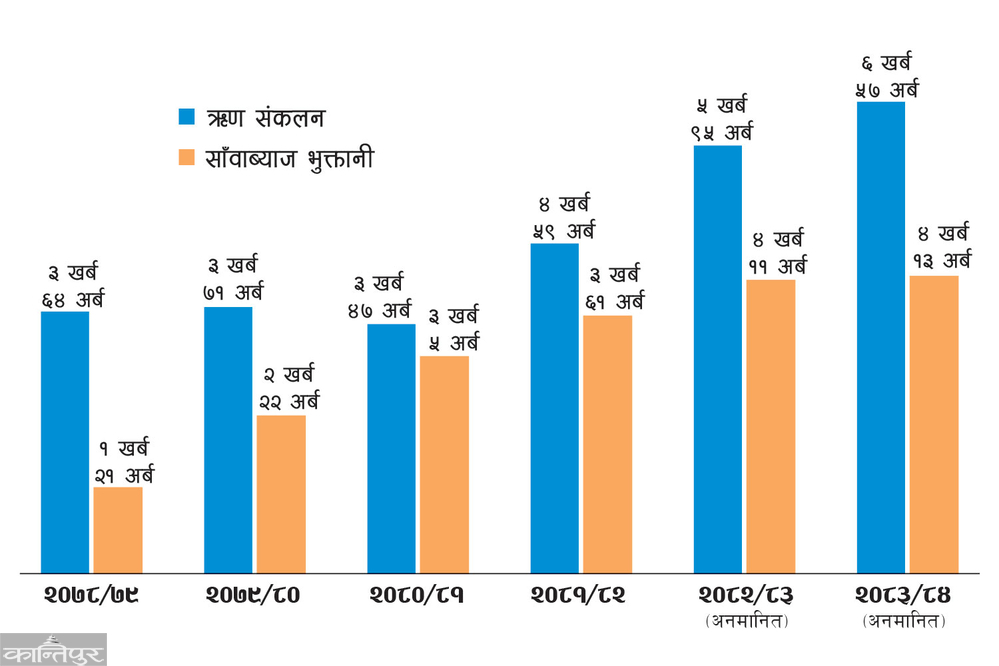
According to the actual and estimated details of debt service expenditure prepared by the Public Debt Management Office, the debt service expenditure will be Rs 413 billion in 2083/84, Rs 424 billion in 2084/85, and Rs 472 billion in 2085/86. In 2083/84, the principal interest on foreign debt will be Rs 74.19 billion and the principal interest on domestic debt will be Rs 339 billion.
In the fiscal year 2084/85, the principal interest on foreign debt will be Rs 80.13 billion and the principal interest on domestic debt will be Rs 344.57 billion. Similarly, in 2085/86, the principal interest on foreign debt will be Rs 86.54 billion and the principal interest on domestic debt will be Rs 385.53 billion. Experts say that the country is under pressure due to high trade deficit, slow economic growth, declining development assistance, and relatively low foreign direct investment and capital inflows from the external sector.
The government's Medium-Term Debt Management Strategy also shows that the government's total outstanding public debt has been on a continuous rise from 2076/77 to 2081/82. Accordingly, the total public debt was 1433 billion in 2076/77, and reached 2674 billion by 2081/82.
The average annual growth rate of public debt during this period is 10.96 percent. The ratio of debt to gross domestic product (GDP) has increased from 38.05 percent to 43.79 percent. 'Although the pace of debt accumulation is somewhat higher than the growth rate of gross domestic product, this growth rate is relatively balanced,' the government's Medium-Term Debt Management Strategy states, 'this indicates that the current public debt structure is still within the desired limits of sustainability.'
The strategy states that this gradual increase in public debt reflects the fiscal pressure created by low growth in revenue mobilization, recurrence of external economic developments, and increasing need for public spending. Experts say that it is essential to balance the debt structure, improve the efficiency of expenditure implementation, and ensure long-term debt sustainability to manage this pressure.
From the perspective of debt management strategy, Nepal's public debt structure has increased both domestically and internationally from 2076/77 to 2081/82. Although the size of foreign debt appears to be somewhat higher than domestic debt during this period, the mobilization of both sources has been continuously increasing. The outstanding domestic debt in 2076/77 was Rs 614 billion, but by 2081/82 it had increased to Rs 1268 billion. During the same period, foreign debt has increased from Rs 820 billion to Rs 146 billion.
This trend confirms that the growth rate of foreign debt has been somewhat higher than that of domestic debt in recent years. It also points to the increased dependence on concessional loans from development partners and the role of foreign aid mobilization. ‘Nepal appears to be trying to maintain a balance between domestic and foreign sources,’ the strategy states, ‘The expansion of the share of foreign debt confirms the importance of low-interest concessional sources for long-term development projects.’ On the other hand, the mobilization of domestic debt is making a major contribution to liquidity management, government treasury operations, and the development of the domestic capital market.
The strategy also points out that there is a challenge to balance the risk of foreign currency exchange rates, including the US dollar, and the cost of interest rates. As debt obligations increased, more budget had to be allocated for financial management than for capital expenditure since 2080/81. But that has not been the case in the last two years.
Economist Dilliraj Khanal says that the maturity period of large amounts of debt taken in the past is beginning to come to an end. ‘This situation seems to pose a major problem in the effective management and sustainability of government debt in the coming days. If this situation is not improved, the increasing amount of public debt indicates a high risk,’ he says. ‘The experience of Sri Lanka and Pakistan shows what happens if any country falls into a debt trap and cannot repay its debt.’
Khanal says that the continuously increasing public debt poses a risk. ‘Since 2080/81, the allocation under the heading of financial management has exceeded the size of capital expenditure. There is a risk of this situation repeating itself next year,’ he says. ‘With the increasing debt repayment obligation, the gap between the level of capital expenditure and the budget allocated for financial management widens, which risks shrinking the government’s ability to invest in the future, and as a result, there is a risk of fiscal imbalance.’
Khanal says that as the government breaks fiscal discipline and increases the budget deficit, the imbalance will increase, which could lead to instability in the macro economy. "Due to the increasing interest payments on the government debt, the government will have to further reduce capital expenditure in the coming year. After that, there will be no sufficient budget allocation for productive and infrastructure sectors, nor for poverty reduction. Nor can budget be given for programs to increase income and employment," he says. "One solution is to reduce current expenditure, to which the government has not been at all sensitive. This indicates the possibility of a serious budget crisis in the coming year."
Nepal's outstanding public debt as of last Jestha was Rs. 2961.19 billion. Last year, the outstanding government debt in Asad was Rs. 2674.04 billion. By last Baisakh, such debt had increased to Rs. 2975.04 billion. After paying off a lot of debt in Baisakh, it decreased by a few points. The debt as of Jestha is 44.87 percent of Nepal's gross domestic product (GDP). The government has set a target of maintaining the outstanding public debt as a proportion of GDP at 43 percent by the end of the current fiscal year.
The Public Debt Management Office's data for the month of Jestha shows that Rs 287.14 billion has been added to public debt in the last 11 months. However, not all of the added amount has been borrowed by the government. Due to the increase in the value of foreign currencies, including the US dollar, Nepal has started to face additional burden on its outstanding public debt. Of the outstanding debt, foreign debt accounts for 53.57 percent and domestic debt accounts for 46.43 percent.
From last Shrawan to Baisakh, the increase in the value of foreign currencies has added an additional burden of about Rs 167.75 billion to the government's outstanding public debt, says Gopikrishna Koirala, head of the Public Debt Management Office. 'The value of foreign currencies, including the US dollar, is increasing, and the Nepali currency is continuously weakening. Due to its direct impact, additional liabilities have been added to the outstanding debt of the government,' he says. 'Except for the losses caused by fluctuations in foreign exchange, Nepal's public debt situation is satisfactory.'
Nepal benefits when the dollar exchange rate falls, while it loses when it rises. Due to the exchange rate change, there has been a loss in 4 of the last 7 fiscal years, while the rest have been profitable. This year too, Nepal has been facing losses in most months. Till last Jestha, the government has spent Rs 351.74 billion on loan principal and interest payments. This is 85.58 percent of the annual target. Based on the gross domestic product, the total debt service expenditure till Jestha is 5.33 percent. This year, the government has allocated Rs 411.1 billion for loan principal and interest payments. According to the office, out of the total amount paid by the government till last Jestha, Rs 284.45 billion was spent on principal and the remaining Rs 67.29 billion was spent on interest.