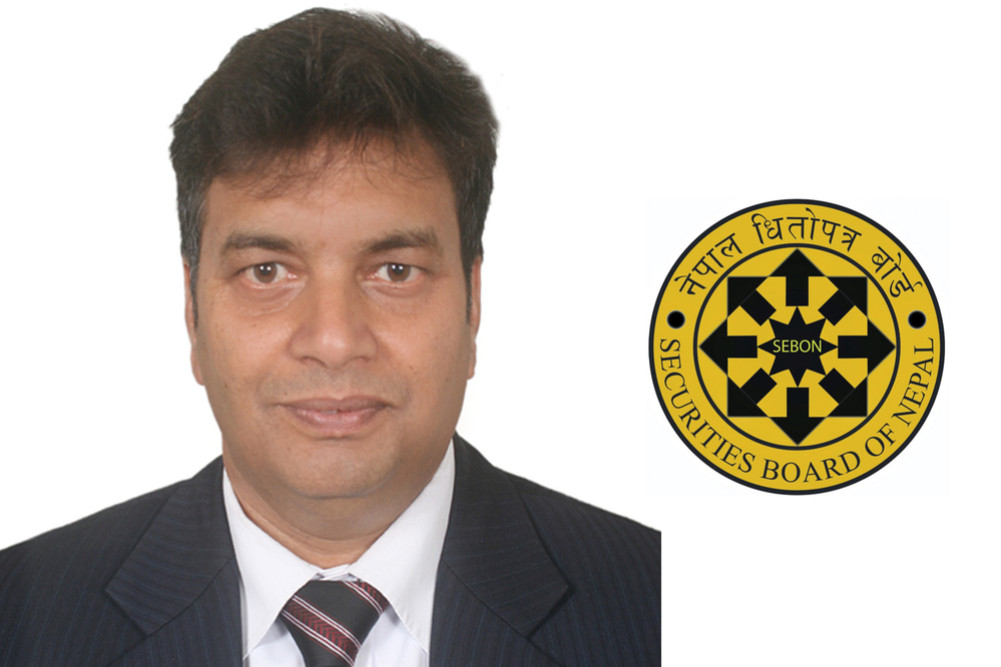
Bhatta, who has been speaking and writing against the distortions of the capital market, has the responsibility to reform it.
We use Google Cloud Translation Services. Google requires we provide the following disclaimer relating to use of this service:
This service may contain translations powered by Google. Google disclaims all warranties related to the translations, expressed or implied, including any warranties of accuracy, reliability, and any implied warranties of merchantability, fitness for a particular purpose, and noninfringement.
The government has appointed Gopal Bhatta as the chairman of the Nepal Securities Board. The cabinet meeting on Friday decided to appoint Bhatta as the board chairman after two months of the position being vacant. The vacancy arose after former chairman Santosh Narayan Shrestha resigned on April 4, 2083.
The then government had appointed Shrestha as the chairman for a period of four years on November 10, 2081. Shrestha resigned on April 4, 2083 on the instructions of the current government. The government has appointed Bhatta for the remaining term of his term.
The Nepal Securities Act, 2063, contains provisions regarding the filling of vacancies. It provides that if the post of chairman or any member falls vacant before the completion of the term, the Nepal government shall complete the process as per this act and appoint a person to the post for the remaining term. Accordingly, Bhatta has been appointed for the remaining term of Shrestha.
Bhatta, an expert in the financial sector, is the former executive director of Nepal Rastra Bank. Bhatta, who holds a master's degree in business studies (MBA) from Tribhuvan University, has done his master's degree in Nepal's stock market. He had been speaking and writing against the irregularities in the capital market in recent years. Now the responsibility of correcting the irregularities in the capital market has fallen on the shoulders of the same Bhatta.
Stakeholders say that many works have been stalled due to the lack of appointment of a chairman on the board for a long time. Even now, more than a hundred companies are waiting for the initial public offering (IPO). There is a risk of increased market manipulation. Experts say that regulation and supervision are weak in the absence of a chairman, while the influence of vested interests in the market has increased. In such a situation, good people are not able to compete fairly, and citizens' trust in the market has decreased.
The Securities Act provides that the Joint Secretary representing the Ministry of Finance on the Board of Directors takes over the responsibility of the chairman when the chairman is vacant. Accordingly, Joint Secretary Uttar Kumar Khatri, representing the Ministry of Finance on the board, has been holding the post of chairman. However, the board has held only two meetings of the board of directors in the last two months. In the absence of a chairman, regulation and supervision have not been effective, not only the approval of all types of share issuance including IPOs, but also the internal transfers of the board, changes in responsibilities, hearing of complaints and action, etc. have been stalled.
As of last week, 104 companies have applied to the board for 472,294,163 units of IPO worth Rs 69.3 billion. This number is much higher when other groups including right shares, bonus shares, debenture issuances that are in the process are also included.
Even though the government formed a recommendation committee immediately after the chairman's post fell vacant, it took two months to make the appointment. In recent years, there has always been a problem in appointing a board chairman. Earlier, the board was without a chairman for about 11 months before Santosh Narayan Shrestha was appointed as chairman. The board was without a leader since 21 Poush 2080 after the term of the then chairman Ramesh Kumar Hamal ended. The government appointed Shrestha only on 10 Mangsir 2081.
This time, after the chairmanship fell vacant in the first week of Baisakh, the government had formed a chairman recommendation committee under the coordination of National Planning Commission Vice Chairman Gunakar Bhatta. The committee, which had Finance Secretary Ghanashyam Upadhyay as a member and former banker Bhuwan Dahal as an expert member, had opened applications for the chairmanship on 15 Jestha.
47 candidates had applied for the board chairmanship. Coordinator Bhatta resigned from the selection committee coordinator, saying that there would be a conflict of interest after applications were received for the chairmanship candidate from among his relatives. After that, the government appointed National Planning Commission member Sanjay Acharya as the coordinator. After that, the committee had shortlisted Nawaraj Adhikari, Binaydev Acharya, Mukunda Kumar Chhetri and Gopal Bhatta.
Out of those selected in the shortlist, the committee had recommended three people on 8 Jestha, namely Bhatta, Acharya and Chhetri. And out of the three, the government appointed Bhatta as the chairman.
Mainly, the tenure of the recent chairpersons has been very controversial. The then chairman Bhishma Raj Dhungana was dismissed by the then government for conflict of interest. At that time, the government appointed Ramesh Kumar Hamal for the remaining 2.5 years of his term. Hamal's tenure was not free from controversy due to various attempts to distribute licenses for the new stock exchange, granting permission to issue shares to companies with poor financial condition, and distributing broker licenses. The tenure of Santosh Narayan Shrestha, who was appointed after him, also became controversial over IPO approval. He was also unable to serve his full term.