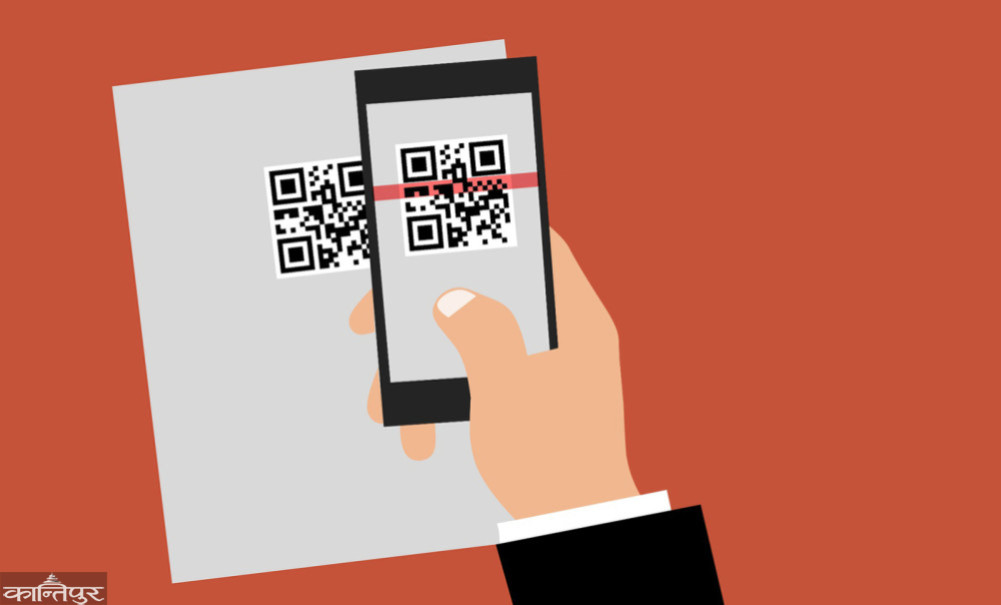
In a single month, more than 59.263 million transactions were made through QR codes, and 162.58 billion rupees were paid.
We use Google Cloud Translation Services. Google requires we provide the following disclaimer relating to use of this service:
This service may contain translations powered by Google. Google disclaims all warranties related to the translations, expressed or implied, including any warranties of accuracy, reliability, and any implied warranties of merchantability, fitness for a particular purpose, and noninfringement.
Paru Ghimire, from Kathmandu, who runs ‘Paru Collection’ on TikTok, has sold 375 pieces of clothing in different cities across the country in two months. She collects money from customers through mobile banking before or after selling the goods. Even when she buys goods from wholesale, she pays digitally. Paru, who does business in her spare time after finishing her housework, has found digital banking to be very convenient for her work, except when the internet is down.
‘If it weren’t for mobile banking, I wouldn’t have been able to do online business,’ she told Kantipur. ‘Digital payments have made it easier for women like us with children to run an online shop and do business online from home.’ She said that she has stopped carrying cash when going to the shop. She also mentioned that when doing business online, it is easier to settle accounts, understand income and expenses, and spend them economically when the income from business is deposited in a lump sum in the bank.
Financial transactions done using technology like Paru’s are financial technology, or fintech. Services like e-Sewa, Khalti, Connect IPS, Phone Pay, Ezilon, Prabhu Money Transfer Digital, Tig, TMS are examples of financial technology. These have removed the hassle of having to go to the bank and stand in line. Services like opening an account, trading shares, online booking, online ticketing, video KYC, and closing an account have been made possible by financial technology.
According to Santosh Tamrakar, Managing Director of IMS Software Pvt. Ltd., a financial technology company that builds daily transactions, digital billing, and accounting systems for businesses, cashless transactions have intensified in Nepal after the COVID-19 pandemic. ‘Now, the general public can buy goods even without having cash in their pockets,’ he says. ‘Technologies like Phone Pay or Nepal Page have also saved money from going abroad from Nepal and made transactions transparent.’
Subash Sharma, Executive Director and Spokesperson of F1Soft, says that the foundation of digital payments under fintech has been laid in Nepal. FOne Soft developed Nepal's first wallet and payment gateway e-service in 2009. Currently, 22 mobile wallets are in operation. Financial technologies such as digital wallets and mobile banking apps have introduced the facility of keeping records of a person's transactions and banks providing unsecured loans based on that data.
'So far, we have only made it easy for customers to spend, now fintech should also help people earn, save and invest money,' Sharma points out, 'Digital lending is just beginning. Fintech startups can explore other areas as well.'
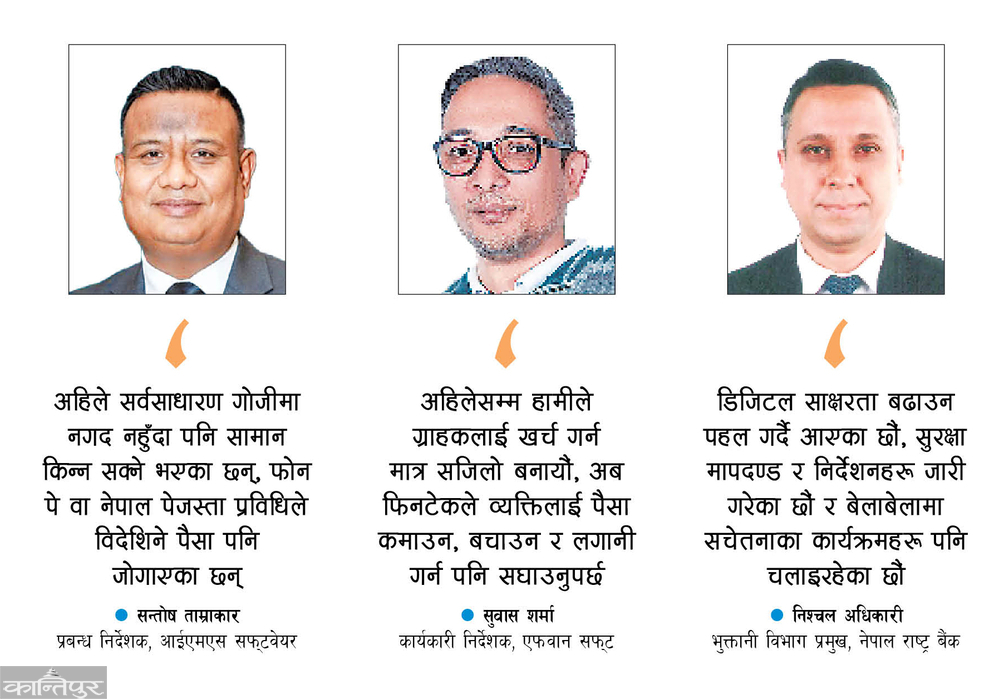
When assessing the successful startups in Nepal, which can be counted on the fingers, the names of companies in the fintech sector come to the fore. Both the number and size of digital transactions in Nepal are constantly increasing. This is positive for the economy, says Nischal Adhikari, Head of the Payments Department at Nepal Rastra Bank. 'This accelerates the flow of money and helps bring the informal economy into the formal sphere,' he said.
He says that financial technology has brought great convenience to the lives of the common man and businessmen. ‘Earlier, a trader used to have to wait for some time to get the money after selling goods, but now, due to digital payments, money arrives in the account instantly. This allows businessmen to accurately estimate their cash flow and increase their business with confidence,’ said Adhikari.
Adhikari’s analysis is that since individuals can receive money immediately in a crisis or emergency, it has greatly helped in personal expense management. ‘These days, the general public has stopped carrying cash in the city and market. From public transportation to vegetable shops and carts, it seems that QR payments have also started being accepted,’ he said.
What services are included in financial technology?
An electronic payment service has been established in Nepal. However, fintech includes not only payments but also loans, remittances, regulatory technologies such as e-KYC, cryptocurrency, central bank digital currency, various e-commerce services, and stock market tools. The practice of digital lending is gradually becoming popular, and some fintech startups like Tig have started appearing in services such as digital insurance and AI-based accounting.
Recently, the Payments Department of the National Bank has revised the guidelines on digital lending and added this facility to micro, small and medium entrepreneurs. According to this arrangement, entrepreneurs can obtain short-term digital loans of up to Rs 5 lakh for a maximum period of 1 year and long-term digital loans of up to Rs 1 million. Earlier, electronic loans of up to Rs 5 lakh and 2 lakh were available to natural persons with salary, professional and business income accounts in banks and financial institutions.
The National Bank has initiated studies, legal amendments and preparations related to the Central Bank Digital Currency (CBDC). To bring it into use, the bank had prepared a prototype (sample system) of the CBDC in 2082 Shrawan. Now, the National Bank has stated that the CBDC will be developed as an initial version with limited features by modifying this prototype.
CBDC is a digital currency that lives on mobile. After the issuance of such a currency, there is no need to carry notes or small amounts of money in your pocket. A bank account or wallet account is required to use current mobile banking or wallets. However, since CBDC will be issued directly by the National Bank, citizens who do not have bank accounts will also be able to make and receive digital payments through their mobiles. However, the National Bank has planned to introduce digital currency only for businesses in the first phase and only then for the general public.
Risks of financial technology
Technology in the financial sector has increased risks along with ease and convenience. Users are becoming victims of digital fraud every day. Paru of Paru Collection shared an experience of fraud in the digital market. ‘As soon as a video of clothes is posted on TikTok, scammers mislead customers by putting a different WhatsApp number in the comments and telling them to send money to it,’ she said. ‘Just a few days ago, a customer ordered goods from me and sent the money to the scammer’s number.’
Paru’s experience shows that people easily fall prey to fraud if they rely on information in the comments without carefully checking the profile and official number of the real seller. To put it more simply, millions of rupees have been stolen from the online banking accounts of many users when they click on misleading scam advertisements on social media claiming that they can watch the ongoing FIFA World Cup for free. Anil Dangol Maharjan of Chabahil tried to download the app by clicking on a suspicious link in a similar advertisement, and his mobile bank account was emptied.
According to the ‘Strategic Analysis Report 2024’ of the National Bank, 1 in 2 youths involved in cyber technology-based fraud are between the ages of 19 and 24 and 1 in 3 are students. The report states that the main methods used for cyber-based fraud include gifts/parcels, misuse of social media, fake online platforms, one-time passwords (OPTs), and lottery tickets.
Some time ago, when the old DPS server of the then Lakshmi Capital Market (now Lakshmi Sunrise Capital) was attacked by cyber-attacks, personal details such as citizenship and phone numbers of about 100,000 citizens were leaked on the dark web. Hackers have been trying to steal the username, password, and OTP of users by creating fake domains that resemble the official name of the wallet or bank and sending messages saying, "Congratulations, you have won a gift" or "Update your KYC or your account will be closed." The bureau has stated that most of the wallet-related complaints registered with the Cyber Bureau of Nepal Police are of this nature.
Are there ways to be safe?
To minimize the risk of cyber security, one thing is that the security system of the electronic system should be strong, and the other is that the user should be aware. Tamrakar, Managing Director of IMS Software, urges users to never click on unfamiliar links and not share their OTP with others. ‘You should understand that no bank or payment company will ever ask for your password or OTP,’ he said, ‘You can’t believe that you won the lottery.’ According to him, most frauds are committed due to the carelessness of the user rather than the service provider’s system.
The National Bank has been taking various initiatives to increase digital literacy. ‘Along with this, we have issued the necessary security standards and instructions and are also running awareness programs from time to time,’ said the Chief of the Payments Department, ‘Such frauds happen not only in Nepal but also all over the world. No matter how strong the technology is, as long as the person is not aware, the risk remains. Therefore, one should be aware that one can be cheated at any point while making financial transactions. If a tempting offer or message comes from somewhere that money has been received, it should always be viewed with suspicion.’
There are now ample opportunities for new entrepreneurs in the fintech sector. According to Nischal Adhikari, the NRB has created structures like ‘Innovation Hub’ and ‘Sandbox’ for those who come up with new ideas. New technologies and solutions can be worked on there. Santosh Tamrakar also says that it is important for newcomers to come up with new technologies and solutions rather than just payments. Overall, if people use it safely and consciously, fintech seems to make both life and business easier.’
Leap in financial technology
According to NRB data, more than 59.263 million transactions have been made through QR codes in a single month till April/May of the current fiscal year. During this period, payments worth Rs 162.58 billion have been made. Mobile banking has become the most used medium in Nepal. Up to April/May, payments worth Rs 612.39 billion have been made through mobile banking. For small payments, payments worth Rs 53.1 billion have been made through wallets like e-sewa and Khalti.
Five years ago, looking at the data for the fiscal year 2077/78, 2.5 billion rupees were paid through QR codes, 48 billion through mobile banking, and a total of 10 billion rupees were paid through digital wallets. Five years ago, the QR market, which used to have a monthly turnover of 2.5 billion rupees, now has a turnover of more than 162 billion rupees, which is a thousand-fold increase. ‘The current achievement is the increase in digital transactions and the expansion of banking access for the common man,’ said Sharma of FOne Soft. ‘This is also confirmed by the opening of 60 million savings accounts in a country with a population of 30 million.’
Various reports have pointed out that out of the eight pillars of the ‘Digital Nepal Framework’ introduced in 2076 BS with the aim of transforming the country’s socio-economic life through the use of information technology, only the financial sector has been successful. ‘Compared to other pillars of the Digital Nepal Framework, Nepal has achieved transformational success in initiatives under the finance pillar,’ the ‘Digital Financial Services in Nepal’ report published by the World Bank Group and the International Finance Corporation states, ‘Due to the framework and the policy efforts of the National Bank, there has been a major change in digital payments during the Covid pandemic. When comparing the last month of the fiscal year 2019/20 and the same period of 2021/22, digital payments increased by 125 percent to Rs 2.8 trillion from Rs 6.2 trillion. This is a digital transformation in line with the goals of the framework.’
The National Bank believes that such success in financial technology has been possible when the government, regulators and the market work together. ‘The National Bank has worked strategically and brought the Payments and Forsight Act and implemented various systemic development strategies. It has been seen that such transformation is possible when all stakeholders in the government, the National Bank and the market work together for the same purpose,’ said the Chief Officer of the Payments Department. Analysts say that the dream of Digital Nepal can only be realized if digital infrastructure, agriculture, education, tourism, health, urban development, and energy sectors of the Digital Nepal Framework, as in the financial sector, are digitized and integrated. They say that this will make government and non-government services more efficient, transparent, and hassle-free, making the daily lives of ordinary citizens easier.