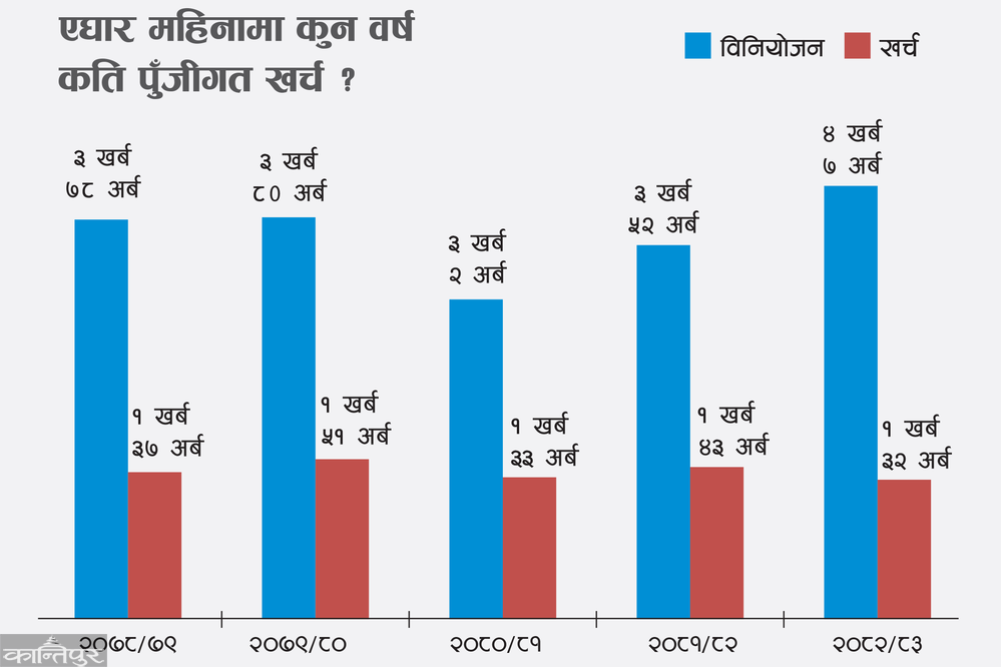
The practice of initially introducing a large budget by including arbitrary plans and then making heavy cuts through the semi-annual review has been on the rise in recent years.
We use Google Cloud Translation Services. Google requires we provide the following disclaimer relating to use of this service:
This service may contain translations powered by Google. Google disclaims all warranties related to the translations, expressed or implied, including any warranties of accuracy, reliability, and any implied warranties of merchantability, fitness for a particular purpose, and noninfringement.
The trend of allocating a large budget but allocating only a small amount for capital expenditure and spending only about half of it has been repeated this year as well. Looking at the data of the last three decades, it is seen that on average, only about 60 percent of the annual capital expenditure has been spent.
In the current fiscal year, the government had allocated Rs 47.88 billion under the capital heading. With only one month left for the end of the current fiscal year, the government has spent Rs 132.6677 billion in capital. This is 32.53 percent of the annual target. To spend all the remaining allocated amount, the government needs to spend more than Rs 9 billion in capital every day. But experts say that this is not possible.
The capital expenditure till Jestha of the current fiscal year is about Rs 10.72 billion less than the same period of the last fiscal year. In the last fiscal year 2081/82, the government had spent Rs 143.3888 billion, or 40.69 percent of the annual target, on capital expenditure.
‘Due to the Gen-G agitation of last Bhadra, government and private offices and bodies were damaged. They could not be operated for some time. In addition, the impact of the ongoing conflict in West Asia also led to an increase in the price of construction materials in Nepal,’ said Amrit Lamsal, spokesperson for the Ministry of Finance. ‘As there is a loss when purchasing and constructing at a higher price, businessmen have had to stop work. This has also affected the capital expenditure.’
However, spokesperson Lamsal claims that the Ministry of Finance has made a policy ‘departure’ to increase capital expenditure. ‘Earlier, the Ministry of Finance had to make the final decision on the transfer of funds. This year, the authority has been delegated so that the concerned ministry (secretary) can decide on the transfer of funds within the limits,’ Lamsal said. ‘This arrangement had the potential to increase capital expenditure. But due to the circumstances created by the Gen-G movement, the conflict in West Asia, etc., capital expenditure could not be spent as expected.’
Economic growth has been affected by the weak allocation, spending and quality of the capital budget. In the last one decade, capital expenditure has averaged only 19 percent of the annual total federal expenditure and the annual average of 64.1 percent of the total capital expenditure. On the one hand, low capital expenditure and on the other hand, non-spending of a significant portion of the allocation has affected the goal of long-term economic transformation.
The Ministry of Finance has stated that there is a need to increase capital expenditure by efficiently allocating the highest return on available financial resources and overcoming the complexity of project implementation. The share of current expenditure in total expenditure is high. In the past one decade, the average share of current expenditure, capital expenditure and financial arrangements in total expenditure is 66.8, 19.0 and 14.2 percent respectively. In the fiscal year 2081/82, such shares are 63.2, 14.8 and 22.0 percent respectively.
The ministry has stated that it is necessary to restructure the government structure, create a clear division of labor between the three levels of government, and manage current expenses in a way that prevents them from increasing by cutting unnecessary institutions and staff positions in a federal environment.
Ram Prasad Gyawali, head of the Central Department of Economics at Tribhuvan University, says that due to the lack of government's readiness to address the issue of expenditure, only minimal capital expenditure is being made. 'There is a tendency for employees who make capital expenditures to not start/avoid work because they may be embarrassed,' he said. 'In the past, there was a game of commission in the project construction sector, so a lot of capital expenditure was made. We need to understand what the situation is now.'
Gyawali said that the fact that most construction entrepreneurs have connections with high-level leaders of political parties, and that they tend to win a lot of contracts but not do the work, is another reason for the lack of capital expenditure. "When I worked as a member of the High-Level Economic Reforms and Suggestions Commission, it was found that government employees took a long time to approve the budget allocated for projects," he said. "There are also many complexities in the law on government spending. Those complexities should be simplified to increase capital spending." He said that capital spending can also be increased by rewarding those who do good work and punishing those who do bad work.
Revenue of Rs 1081.31 billion has been collected in the 11 months of the current fiscal year. This is 73.06 percent of the annual target. This year, the government has set a target of collecting Rs 1.48 trillion in revenue. The revenue collected till Jestha is slightly higher than the same period last year. By Jestha of the last fiscal year, the government had collected 71.56 percent of the target of Rs 1015.69 billion. Although the revenue collected from customs was around 89 percent, the revenue collected from other sources was less than the target, said Lamsal, spokesperson for the Ministry of Finance.
Up to last Jestha, 76.91 percent of the annual target, or Rs 98.26 billion, has been spent on current expenditure. This is more than the current expenditure of the same period of the last fiscal year. This year, the government has spent some amount from current expenditure and other miscellaneous headings for elections. This is also why the current expenditure has increased. Up to 2081 Jestha, the current expenditure was Rs 851.58 billion, or 74.66 percent of the annual target.
In the last 11 months, the government has paid Rs 355.71 billion (81.47 percent of the annual target) on principal repayment of government loans and investment in government institutions (financial management). Up to 2081 Jestha, the government had spent Rs 287.97 billion, or 78.41 percent of the target, on this heading. In the current fiscal year, the government has allocated Rs 375.24 billion under the financial management heading.
In the last 11 months of this year, the government has received Rs 22.88 billion 59 million in foreign grants. This is 42.82 percent of the annual target. This year, the government had set a target of receiving foreign grants of Rs 53.44 billion 69 million. By Jestha of the last fiscal year, the government had received grants of Rs 17.85 billion 54 million (32.65 percent of the target).
Looking at the income and expenditure of the government in the 11 months of this year, there is a government fiscal deficit of about Rs 236.16 billion. During that period, the government earned Rs 1110 billion 49 million and spent Rs 1346.65 billion. By Jestha of the last fiscal year, there was a government fiscal deficit of about Rs 238.57 billion.
This year, the government initially announced a budget of Rs 1964 billion 110 million, but it has been fixed at Rs 1688 billion 320 million through the half-yearly review. The distortion of initially bringing a large budget by including arbitrary plans and making heavy cuts through the half-yearly review has been growing in recent years.
Unable to raise and spend resources, the then Finance Minister Rameshwor Khanal initially reduced the total allocated budget by Rs 275 billion 783.3 million in the half-yearly review of the current fiscal year's budget. Bishnu Prasad Poudel, who became Finance Minister from UML in the current fiscal year, had made public a budget worth Rs 1964.11 billion.
In the half-yearly evaluation report of the budget for the current fiscal year 2082/83, the current expenditure has been reduced from Rs 1180.98 billion to Rs 1125.97 billion.
In the beginning of the current fiscal year, Rs 478.88 billion was allocated for capital expenditure, but this has been reduced to Rs 243.33 billion.34 million. The allocation for financial management has been reduced from Rs 375.24 billion to Rs 319.4 billion.