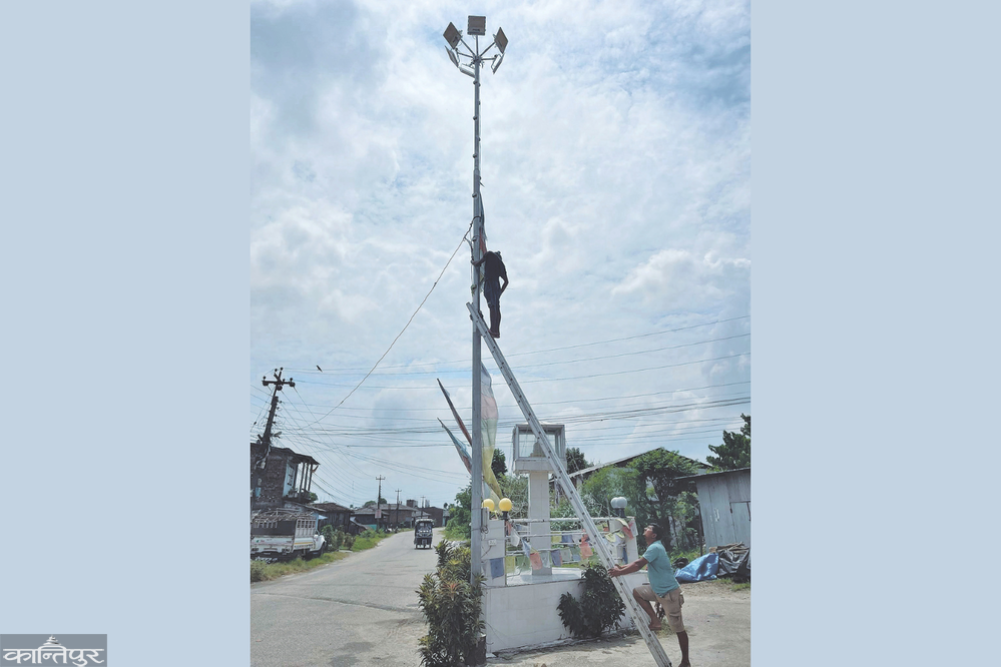
Nepal Electricity Authority claims that the amount payable by municipalities has increased when they connect random lines without meters and install street lights.
We use Google Cloud Translation Services. Google requires we provide the following disclaimer relating to use of this service:
This service may contain translations powered by Google. Google disclaims all warranties related to the translations, expressed or implied, including any warranties of accuracy, reliability, and any implied warranties of merchantability, fitness for a particular purpose, and noninfringement.
The Nepal Electricity Authority (NEA) has said that there are 7.9487 billion rupees in arrears for street lighting across the country, excluding additional fees. The NEA has stated that including the additional 25 percent fee, this amount is 9.9359 billion rupees. Of this, 2.349 billion rupees is for street lighting in Madhesh Province. The NEA has stated that the amount to be paid by municipalities when they connect random lines without meters and install street lights has increased.
The NEA has now sent letters nationwide to collect the arrears under all headings including dedicated, trunk lines, internet service providers, and street lighting. Almost all of the 136 municipalities in 8 districts of Madhesh have not paid the street lighting fees. Shambhu Kusait Yadav, Chief of the Nepal Electricity Authority Provincial Office, Janakpur, said that the arrears have increased due to the tendency of municipalities to install random street lights without meters but
refusing to take responsibility for it.
‘We have been requesting the payment of the arrears for street lights. But the current mayors are trying to avoid it by saying that it is from the previous mayors’ time,’ Yadav said, ‘Due to the trend of installing unmetered lines on the pretext of making the roads flicker during festivals, a large amount of money is yet to be paid by the municipalities. Now we are preparing to cut the lines of the municipalities that do not pay the amount.’ According to the NEA, some municipalities have not even paid the fees for their administrative buildings.
Energy Minister Biraj Bhakta Shrestha has already directed the NEA to prioritize the process of collecting electricity arrears on its daily agenda. He said that since the arrears have been pending for a long time and the amount is also large, it should be settled quickly. Minister Shrestha is raising this issue in separate meetings of the NEA’s Board of Directors and the NEA’s Deputy Executive Directors.
‘There is no need to wait for instructions from the minister to collect the arrears. Many studies, investigations and decisions have been made in the past. There is no need for further decisions on this. Do as per the act, rules and procedures. There is no favoritism or discrimination. The top management of the Authority should focus on mobilizing its own mechanisms rather than waiting for the ministry's instructions in collecting dues,' said Minister Shrestha.
Minister Shrestha said that dues from all sectors, including dedicated feeders and trunk lines, as well as internet service providers, industrial sectors, street lights, should be collected. He said that the Authority should not hesitate to collect dues in areas other than those under legal process. According to the Authority's provincial office, more than 44.1 million rupees have to be collected in the Janakpur region alone.
The Authority has stated that Birgunj Metropolitan City has yet to pay 230 million rupees for street lights. Jaleshwor Municipality has an arrears of 77.741 million rupees and Malangwa Municipality has an arrears of 91.277 million rupees. 16 municipalities and 2 rural municipalities in Rautahat have yet to pay a large amount to the Electricity Authority for street lights and office purposes.
Homanath Subedi, Chief Administrative Officer of Mangalwa Municipality, said that the government should pay for the street lights. ‘It was not lit by individuals. It was lit on the road,’ he said, ‘The government should pay. In some places, it may have been lit all day and there may have been a leak.’
All municipalities including Vrindavan, Gujra, Fatuwa, Vijayapur, Garuda, Chandrapur, Kataharia, Debahigonahi, Rajdeshi, Ishanath are on the list of municipalities that have not paid electricity bills. The Authority says that the problem is caused by the installation of random street lights (high mast lights and LED) without technical approval from the Authority and meters, the municipalities not allocating sufficient budget in their annual policies and programs for the payment of electricity charges for street lights, and the municipalities arguing that the federal government or the Authority should bear the charges themselves, saying that the street lights are lit by the public.
Two months ago, the Electricity Authority Chandranigahapur branch had cut the wires of street lights installed by Chandrapur, Vrindavan and Gujra municipalities without meters. The Authority cut the wires after connecting the wires directly to the electricity poles and installing tower lights. The Authority had requested the municipality to pay the electricity charges while installing the tower lights. But the municipality refused, so the lines were cut.
After street lights/tower lights started being installed without meters, targeting intersections, playgrounds and temples, the Authority has started cutting the lines as a campaign. Chandrapur Municipality has yet to pay more than Rs 26.5 million for tower lights installed in various villages and chowk bazaars. Similarly, Vrindavan Municipality has yet to pay more than Rs 20 million and Gujra Municipality has yet to pay more than Rs 20 million to the Authority for tower and pole lights.
Kanthamani Jaiswal, the mayor of Garuda Municipality in Rautahat, said that payments for street lights and other issues have not been made because the Chief Administrative Officer is not regularly present in the office.
According to the Electricity Tariff Collection Regulations, the responsibility to pay the street light tariff lies with the concerned municipality. However, in practice, the municipality is reluctant to pay the tariff by arguing that the Authority has not paid tax for using the land in its area.
Due to this kind of swindling by the municipality and the Authority, billions of rupees of the Authority are being frozen. On the other hand, just as the NEA has become aggressive in collecting industrial dues, similarly, if the NEA does not collect the street light dues from the municipalities, the financial crisis of the NEA will surely deepen, said an employee of the NEA.
The NEA has stated that the size of the electricity tariff arrears from the country's large industrial houses to the municipalities has reached more than 50 billion. In the arrears details of 'dedicated feeders and trunklines' made public by the NEA, the industries under the Madhesh Provincial Office have the highest arrears. The government and the NEA's interest has increased after the 63rd report of the Auditor General showed the total arrears of the NEA at 50 billion and 10 million rupees.
The NEA has now started collecting arrears under all headings, including dedicated feeders, trunklines, internet service providers and street lights. A large part of the NEA's arrears is for street lights used by the municipalities of the country.
According to the data released by the Authority, municipalities in all seven provinces have yet to pay a large amount for street lighting. Dhirendra Yadav, head of the Gaur branch of the Authority, said that the municipalities have not come to pay the arrears for street lighting. “We have cut the lines of some municipalities after they have delayed paying the amount for office operation,” he said, “No municipality has paid the crores of rupees for street lighting.” The Authority, however, has clarified that it is the responsibility of the local government to pay the fee after using the service.