Industrialists say that the industry is losing its appeal due to the fact that the industry is not a priority for the state and long-standing problems such as land, forests, and employees have not been resolved.
We use Google Cloud Translation Services. Google requires we provide the following disclaimer relating to use of this service:
This service may contain translations powered by Google. Google disclaims all warranties related to the translations, expressed or implied, including any warranties of accuracy, reliability, and any implied warranties of merchantability, fitness for a particular purpose, and noninfringement.
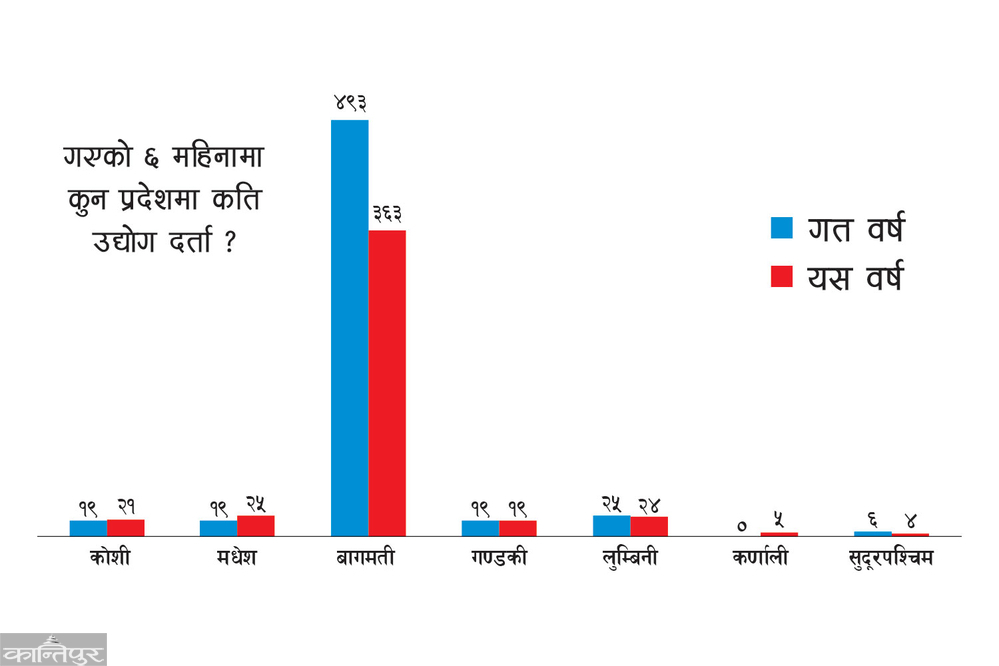
In the first six months of the current fiscal year (Shrawan to Poush), 461 additional industries, including small, medium and large, have been registered across the country. The number of newly registered industries this year is 120 less than the same period last year. In the first six months of the last fiscal year, 581 additional industries were registered across the country.
The decrease in the number of industry registrations this year compared to the previous fiscal year has been linked to the country's investment-friendly environment that has not improved. Industrialists say that the industry is losing its appeal due to the fact that the industry is not a priority for the state and that long-standing problems in the industry, including land, forests, and employees, have not been resolved. Recently, the Economic Activity Study Report of the Nepal Rastra Bank has shown that the number of newly registered industries has decreased in the same period this year compared to the six months of the last
year.
The statement made by Haribhakta Sharma, Executive Director of Deurali Janata Pharmaceuticals and former President of the Confederation of Nepal Industries, in the Finance Committee of the Federal Parliament in the second week of Jestha, confirms that an industry-friendly environment has not been created in Nepal.
‘In our previous life, we committed great sins and opened industries in this life. Now we have done nothing, we have looted the land in our previous life and are now running industries,’ Sharma had said in the Finance Committee meeting, ‘In this life, we have not done anything bad, but in our previous life, we must have looted the land and now we are running industries.’
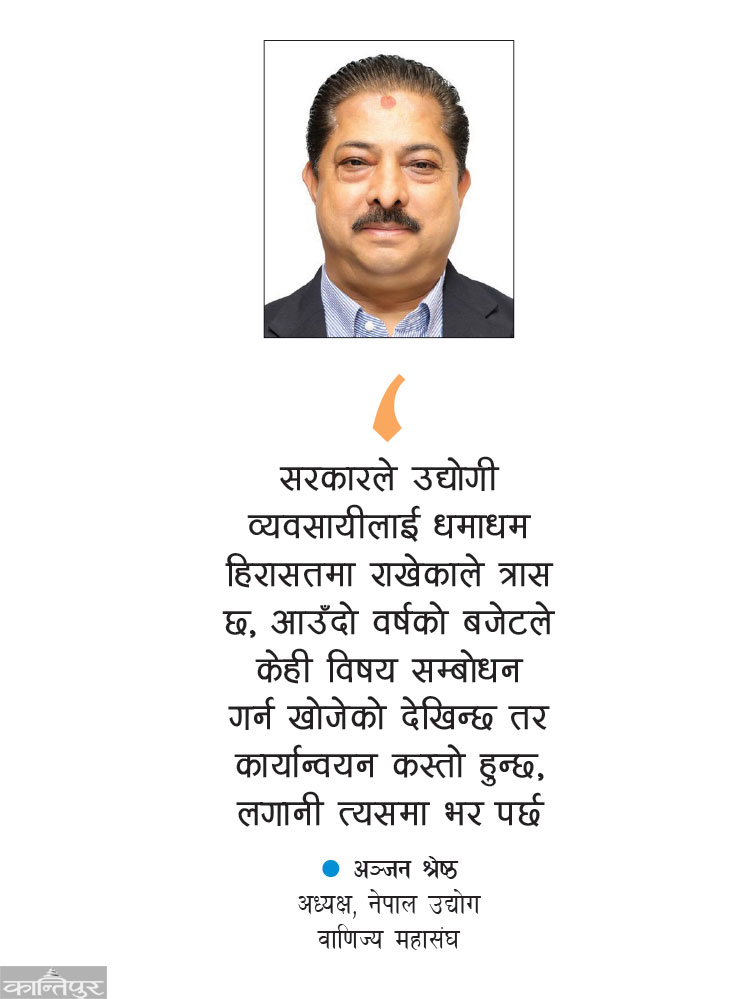
 Sharma’s statement reflects the problems of Nepal’s manufacturing sector. The share of manufacturing industries in the economy is continuously decreasing. In the last 30 years, this share has decreased from 10 to less than 6 percent. This is one of the lowest in South Asia. "For a long time, industries have been operating at less than half their capacity utilization. Although the problem has been there since the establishment of the industrial sector, it has not been resolved yet. Market demand has not been able to increase. There is fear as the government is constantly detaining industrialists and businessmen," said Anjan Shrestha, President of the Federation of Nepalese Chambers of Commerce and Industry. "The budget for the upcoming fiscal year seems to be trying to address some issues, but the policy implementation aspect needs to be looked at to get results." President Shrestha said that the morale of industrialists and businessmen has been weakened as the private sector has been targeted in the Gen-G movement. "The problem of dedicated trunk lines, which has been entangled for the past 10 years, has started to flare up again. The Supreme Court has already decided on the dispute regarding the rent of about 700 industries operating in the industrial sector. But the concerned ministry has been saying that it will take action against the industrialists within a week," said Shrestha. "In such a situation, industrialists and businessmen cannot make further investments." He said that the attraction to registering new industries has decreased as industrialists are in a wait-and-see mode.
According to the economic activity study, the highest number of new industries registered in the first 6 months of the current fiscal year is 363 in Bagmati Province. The lowest number of industries is 4 in Sudurpaschim. The proposed foreign investment in the registered industries during this period is 55.83 billion. The report mentions that these industries have created employment for 22,885 people.
The average capacity utilization of the industry in the last 6 months is 42.11 percent. The capacity utilization of the industry has also decreased this year compared to the same period last year. According to the data of the Nepal Rastra Bank, the average capacity utilization of the industry last year was 42.94 percent. In the first 6 months of the current fiscal year, the capacity utilization of the garment industry was 95.74 percent and the capacity utilization of other textile manufacturing industries was 90 percent. The capacity utilization of the hydropower generating industry was 82.74 percent, the tire and tube manufacturing industry was 76.20 percent, and the noodle manufacturing industry was 70.06 percent.
In the last 6 months, the capacity utilization of industries producing garments, sugar, steel products, soybean oil, aluminum products, beer, processed leather, ointments, tires and tubes, other chemicals, sawn wood products, light beverages, alcohol, biscuits, yarn, cement, etc. has increased.
However, the capacity utilization of industries producing GI pipes, raw leather, vegetable ghee, cigarettes, bricks, GI wires, iron rods, sheets and accessories, slippers, wheat flour, processed tea, processed milk, paper, electrical wires and cables, household metal products, etc. has decreased, the report states. ‘Provincially, the capacity utilization of industries is highest in Lumbini (50.44 percent) and lowest in Sudurpaschim (30.82 percent),’ the report says. ‘In the last 6 years, the average capacity utilization of industries in Madhesh, Bagmati, Lumbini and Karnali has increased. The average capacity utilization of industries in Koshi, Gandaki and Sudurpaschim provinces has decreased.’
Along with the decrease in new registrations of industries, the growth rate of industrial credit has also decreased in the first 6 months of this year. According to the National Bank, the growth rate of credit flowed by banks and financial institutions to the industrial sector in the last 6 months is 7.99 percent. With this, the total credit flowed to the industrial sector has reached Rs 1,778.3 billion. Industrial credit expansion had increased by 17.66 percent in the first 6 months of last year.
The share of credit flowed to the industrial sector out of the total credit flowed by banks and financial institutions is 30.82 percent. ‘Among the industrial loans, 0.67 percent has been in the mining-related industries, 20.64 percent in the agriculture, forestry and beverage-related industries, 35.67 percent in the non-food manufacturing industries, 12.26 percent in the construction-related industries, 26.62 percent in the electricity, gas and water-related industries, and 4.14 percent in the metal products, machinery and electronics-related industries,’ the report said.
The report suggests that the government should accelerate the construction of industrial infrastructure, increase industrial production and productivity, properly manage raw materials, enhance the competitiveness of domestic products, and diversify exportable goods to increase investor attraction in the industry. The Rastra Bank has stated that the industry sector is facing problems such as lack of adequate capital, high production costs, technological backwardness, full capacity utilization, development of skilled manpower, manpower exodus, as well as management and operation of environmentally friendly industries.
 In fact, Nepal's economy has expanded from agriculture to the service sector without industrialization. While the contribution of industry and agriculture to the economy is shrinking, the contribution of the service sector is expanding. In the fiscal year 2072/73, the contribution of the agriculture sector was 28.4 percent, compared to 25.2 percent in 2081/82, while the contribution of the service sector has increased from 57.5 percent to 62.0 percent. However, during the same period, the contribution of the industry sector has shrunk from 14.1 percent to 12.8 percent. Experts say that structural changes are needed to be oriented towards income and productivity growth.
The state of manufacturing industries is weak. Over the past decade, the contribution of the manufacturing industry to the gross domestic product has averaged only 5.4 percent. During this period, while the overall economy expanded by an average of 4.2 percent, the expansion of the manufacturing industry has averaged only 2.9 percent. Experts say that the country's industrialization status is weak due to factors such as insufficient investment, high dependence on imported raw materials, low adoption of innovation and advanced technology, and high production costs.