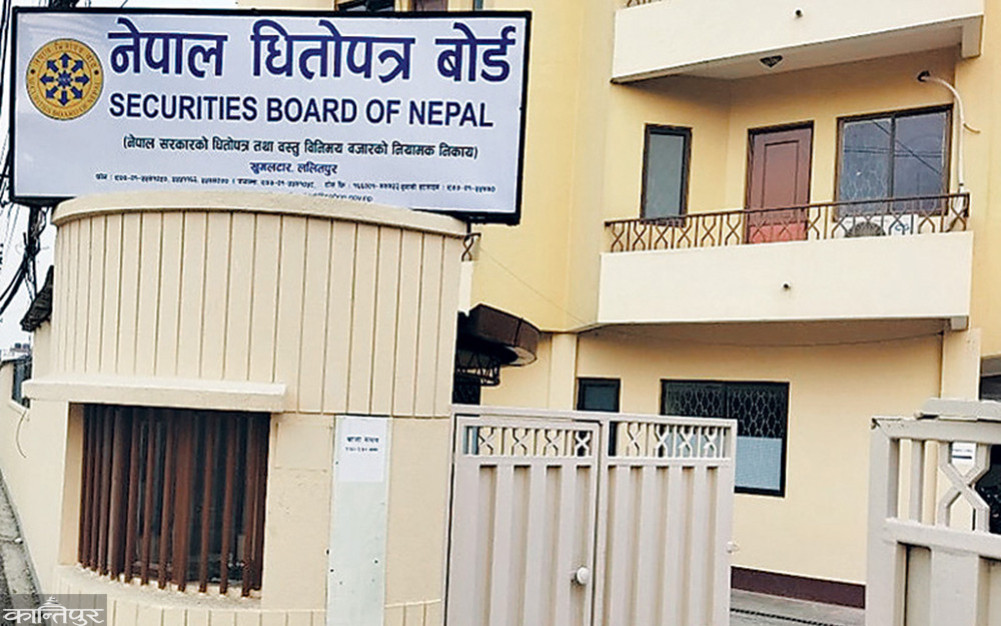
The situation has further worsened as the capital market regulatory body, which has not been well-governed even under its chairman, has been without leadership for a long time.
We use Google Cloud Translation Services. Google requires we provide the following disclaimer relating to use of this service:
This service may contain translations powered by Google. Google disclaims all warranties related to the translations, expressed or implied, including any warranties of accuracy, reliability, and any implied warranties of merchantability, fitness for a particular purpose, and noninfringement.
The then Maoist Center Chairman Pushpa Kamal Dahal used to say that one of the reasons for the collapse of the government he led on 28 Ashad 2081 was somehow related to the issue of appointments, including the chairman of the Nepal Securities Board. The then Finance Minister Barshaman Pun has also been mentioning the same issue.
Pun repeated the same issue in his last conversation with Kantipur. He said, ‘In the past, there was pressure to appoint people from the same interest group to the Securities Board. When we tried to stop it, the government fell. At that time, we tried hard to stop the influence of interest groups, but we could not. That is why we had to leave the government.’
Pun claims that the government after his exit appointed people from the same interest group as the board chairman. The process of appointing a chairman to the board was very complicated at that time. He suspects that the disease has spread to the current government led by Balendra Shah. This time, even after three weeks of the recommendation of three people, the board chairman has not been appointed.
Stakeholders say that many works have been stalled due to the lack of appointment of a chairman on the board. Even now, more than 100 companies are awaiting initial public offering (IPO). There is a risk of increased market manipulation. ‘Without a chairman, regulation and supervision are weak. Due to which the influence of vested interests increases in the market,’ Pun added, ‘In such a situation, good people are not able to compete fairly. Citizens also lose faith in the market.’
Although the selection of the chairman of the vacant board has reached the final stage for two months, the government has not been able to finalize the appointment. The post has been vacant since the resignation of the then chairman Santosh Narayan Shrestha on April 4. The Securities Act provides that the joint secretary representing the Ministry of Finance on the board of directors assumes the responsibility of the chairman when the chairman is vacant.
Accordingly, joint secretary Uttar Kumar Khatri, representing the Ministry of Finance on the board, has assumed the post of chairman. But the board of directors has met only twice in the last two months. ‘The board has barely met twice. In the absence of a chairman, regulation and supervision have not been effective. Not only the approval of all types of share issuance including IPOs, but also internal transfers of the board, changes in responsibilities, hearing of complaints and action have been stalled,' a board source said. 'Employees are waiting for the appointment of a chairman.'
Currently, 104 companies have applied to the board for 472,294,163 units of IPO worth Rs 69.3 billion. This number will be much higher if we add other groups including right shares, bonus shares, debenture issuances that are in the process.
However, Khatri, Joint Secretary at the Ministry of Finance, who has assumed the responsibility of the chairman, claimed that daily administrative work has not stopped in the board. 'I am looking into it now. Daily administrative and urgent work has not stopped,' he said. 'However, the work that needs to be done after the chairman comes has not been done.'
Khatri also said that the government will soon appoint a chairman from among the three recommended people. Recently, there has been talk of the government canceling the recommendation process for the board chairman. But Khatri says, ‘As far as I know, the government will soon appoint one of the currently recommended people as the chairman, the process will not be canceled.’
In recent years, there has always been a dilemma in the appointment of the board chairman. Earlier, before Santosh Narayan Shrestha was appointed as the chairman, the board was without a chairman for about 11 months. The board had been without a chairman since 21 Poush 2080 after the term of the then chairman Ramesh Kumar Hamal ended. The government appointed Shrestha only on 10 Mangsir 2081.
This time, after the chairman position fell vacant in the first week of Baisakh, the government formed a chairman recommendation committee under the coordination of National Planning Commission Vice President Gunakar Bhatta. The committee, which had Finance Secretary Ghanshyam Upadhyay as a member and former banker Bhuvan Dahal as an expert member, opened applications for the chairman on 15 Jestha.
47 candidates applied for the board chairmanship. Coordinator Bhatta resigned from the selection committee coordinator, saying that there would be a conflict of interest after applications were received from among his relatives for the chairmanship. After that, the government appointed National Planning Commission member Sanjay Acharya as the coordinator. After that, the committee shortlisted Nawaraj Adhikari, Binaydev Acharya, Mukunda Kumar Chhetri and Gopal Bhatta.
The committee had recommended three people from the shortlist on 8 Jestha. But till Saturday, the government has not been able to appoint a chairman. Experts say that the delay in the chairmanship appointment process, which went to the election with the slogan of controlling corruption and establishing good governance, has raised suspicions.
Former Finance Minister Prakash Sharan Mahat says that reforms are necessary in many institutions and structures in Nepal, and since the board is not immune to that disease, it has affected the appointment of the chairman. ‘There is a lot of work to be done within the scope of the Securities and Exchange Board of Nepal (SEBON), including the process of issuing shares of companies, distributing licenses,’ he said. ‘There may be many people interested in the chairman because they can benefit from appointing their own people there.’
Former Finance Minister Mahat commented that the new government, which came to power with the promise of improving the shortcomings of the past, has not been able to work as expected. ‘It is not good for the new government, which says it will work transparently and on a fast track, to delay appointments too much,’ he said. ‘Institutional reforms will have to be done in many places, there are many problems.’
However, he said that since the chairmanship of the Securities and Exchange Board of Nepal was not vacant when he was the Finance Minister, he was not very knowledgeable about the appointment process there. Recently, problems have started to appear in the good governance of the Nepal Securities and Exchange Board of Nepal (NESB) due to the entry of middlemen, low priority of the government, and compromises on honesty by the leadership, former Chairman Rewat Bahadur Karki said. "Due to the influence of vested interests, if a person who lacks qualifications and experience in leadership selection is appointed as the chairman, even if he is qualified, there is no honesty," he said. "The problem has started to appear when the main regulatory body, the government, also started working incorrectly under the influence of vested interests." Karki claims that a lot of work has been done for capital market reform during his tenure as chairman of the board.
Karki suggests that the government should give priority to institutional reform as the scope and role of the board is greater than that of the Nepal Rastra Bank. "The issue of how leadership comes to the regulatory body is of great importance," he added. "Therefore, the government should appoint a qualified, experienced and honest person as the chairman of the board."
The tenure of the recent chairman has been very controversial. The then chairman Bhishmaraj Dhungana was dismissed by the then government for conflict of interest. At that time, the government appointed Ramesh Kumar Hamal for the remaining 2 and a half years of his tenure. Hamal's tenure was not free from controversy due to various attempts to distribute licenses for new stock exchanges, granting permission to issue shares to companies with poor financial condition, and distributing broker licenses. The tenure of Santosh Narayan Shrestha, who was appointed after him, also became controversial regarding IPO permits. He too was not able to serve his full term. After that, the government has not yet been able to appoint a chairman to the vacant post.