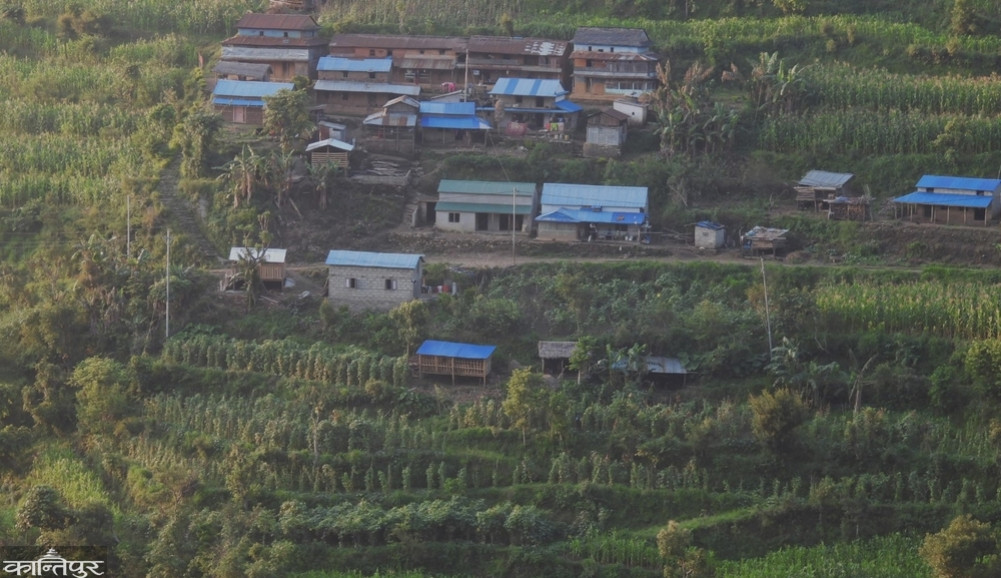
The Chepang community here has not faced any shortage of food grains since they started earning income by planting vegetables in their fields in Ichchakamana Rural Municipality-2, Hapni, a hilly village in the northern part of Chitwan.
We use Google Cloud Translation Services. Google requires we provide the following disclaimer relating to use of this service:
This service may contain translations powered by Google. Google disclaims all warranties related to the translations, expressed or implied, including any warranties of accuracy, reliability, and any implied warranties of merchantability, fitness for a particular purpose, and noninfringement.
After not seeing any way to earn an income in the village, Tek Bahadur Chepang went to Malaysia and worked for three years. When the earnings were not good, he returned home. Tek Bahadur of Kaule Hapani, a village in Ichhakamana Rural Municipality-2, a hilly village in northern Chitwan, decided to start vegetable farming. He started vegetable farming 10 years ago and is able to earn a good income by staying in the village.
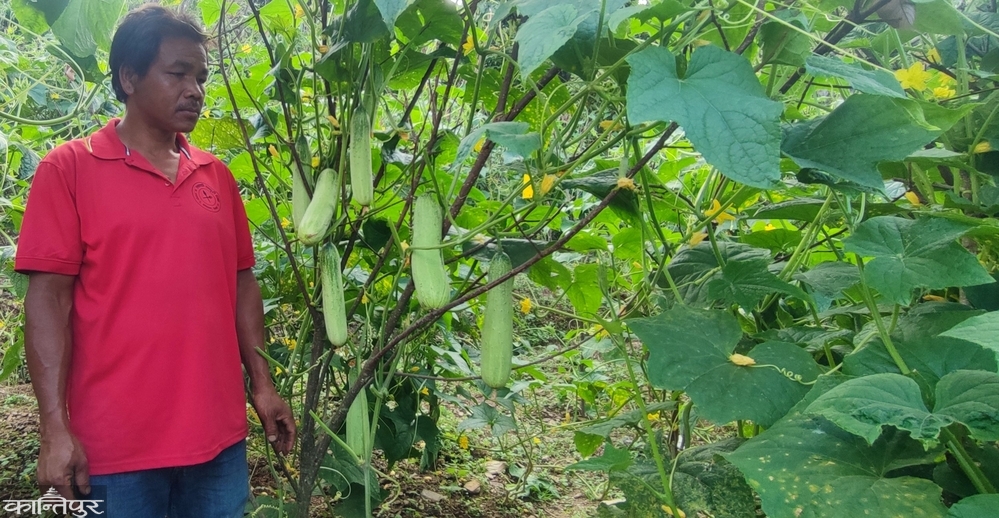
He has now started selling the cucumbers he has grown in his garden. He sold five quintals of cucumbers on Friday morning alone. The cucumbers that were ready to be picked after two days were in the garden. ‘I started picking from 15th of Jestha. I initially picked 80 kg. I reached two quintals in the second lot. I sold five quintals in the third lot. In the first week of Ashar, more than one ton is produced,’ he said.
He picks cucumbers and sends them for sale at intervals of two to three days. They pick and sell cucumbers until 15/16th of Shrawan. ‘After that, tomatoes are planted. Cucumbers are the main crop. I have also been raising goats for the past four/five years. I earn about 1.5 million rupees a year from all this,’ said Tek Bahadur. He has planted Bhaktapure local variety cucumbers.
In Chepang village, there was a time when people worried about what to eat during this season. According to 81-year-old Dil Bahadur Praja Chepang of Hapani, the corn planted in Falgun would start ripening by the end of Shrawan. The village’s paddy fields would produce corn and a little millet. When the corn ran out, there was a shortage of food. It was customary to go to the forest to find yams and yams to eat. Dil Bahadur says that nowadays the Chepang community of Hapani does not have to face such a crisis.
Pancha Bahadur Praja Chepang, the ward chairman of Ichchakamana Rural Municipality-2, is also from Hapni. He also cultivates vegetables. ‘Others plant cucumbers. I plant more tomatoes. Now, I have to plant tomatoes around Shrawan,’ said Pancha Bahadur.
He also sells tomatoes worth Rs 5 lakh a year. He says that there is no compulsion to leave the village to earn cash like there was 10/15 years ago. ‘But that is not the case now. There are about 35 households in the village. Everyone has done some farming. There are those who earn at least Rs 1-2 lakh. In Hapni, there is no need to go out and earn money to buy food,’ said Tek Bahadur.
He is also the chairman of the Hapni Farmers’ Group. He said that many people planted vegetables after seeing that they could earn money even by staying in the village after working hard. Earlier, there was no road in Hapni. Cars did not work. Tek Bahadur said that in the beginning, when growing vegetables, they used to carry 40/50 kg of vegetables for four hours. After the road was opened, a mini truck would come and collect vegetables from all over the village. After the road was improved, a Bolero jeep has been going to the field to collect vegetables for the past four years. ‘After two or four days, my Bolero is filled with cucumbers. It is gradually getting better than before,’ said Tek Bahadur.
According to Ward Chairman Pancha Bahadur Chepang, the rural municipality has also adopted a policy of encouraging vegetable farming. The locals were excited after the municipality provided a Bolero vehicle for transportation as an agricultural ambulance under subsidy. Fisling, which is located on the Prithvi Highway, is the main market.
Along with Fisling, vegetables from Hapni go to Ratnanagar Tandi and Narayangadh Bazaar. But the road is still not as good as it used to be, says Ward Chairman Panch Bahadur Chepang. Hapni village is southeast of Orlyang on the Shaktikhor Fisling road. Although the Shaktikhor Fisling road is mostly blacktopped, Orlyang is still a bit of a problem.
There is no bridge built over Rigdi River at Orlyang. The road from Orlyang to Hapni is completely unpaved and narrow. It is difficult to reach the market during the rainy season. Panch Bahadur said that if this problem is solved, vegetable farming can grow further.
Panch Bahadur used to work as a social worker in various organizations. An organization trained him in vegetable farming. 'After receiving training in vegetable farming, I had to train my brothers and sisters in the village as well.' I started farming myself and started selling fish in Doko. After that, this house after that, almost all the houses have been converted to vegetable farming,' said Panch Bahadur. Nowadays, farmers in this village produce cucumbers, tomatoes, beans, cauliflower, and coriander. Panch Bahadur said that he is happy that the campaign he started about 12 years ago is bearing fruit. Tebakhadur sent his two brothers and sons to Bharatpur for education. The eldest has passed the 12th standard. The younger one has given the 12th standard exam this time. His sons also help him.
He has attached four katta fields near Shaktikhor. He bought a plot of land in Jyamire, east of Ratnanagar. 'I grow vegetables on one bigha. I do not own all the land. I have rented eight or nine kattas. "It is necessary to invest in planting again from here. Even if you do not earn much, you can do something by staying in the village," he said. The commercial vegetable farming that has flourished in Hapani has changed the traditional identity of the Chepangs. "Otherwise, the Chepangs would be living on the sidelines, and if they did not have enough to eat for six months with their farming by cutting the sorghum, they would make a living by bringing tubers from the forest," he said.