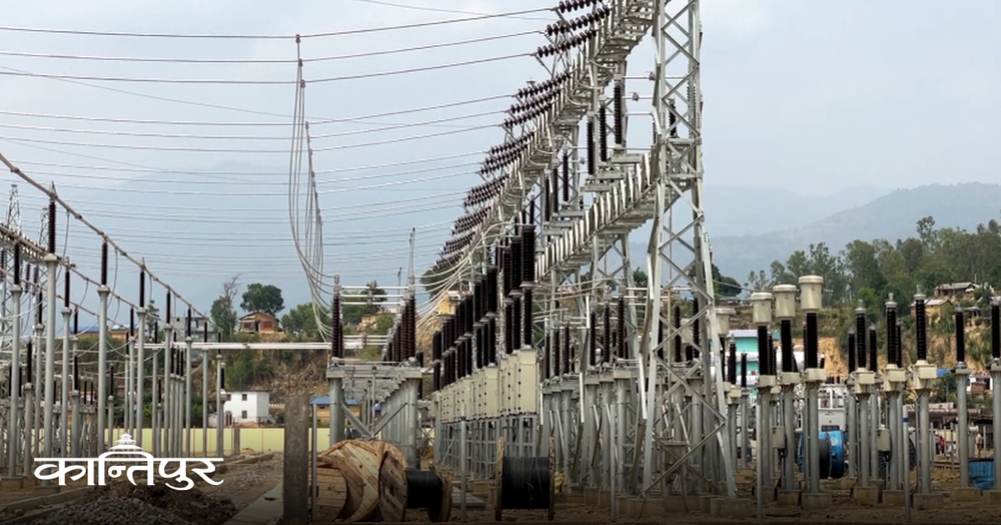
The NEA had sought letters of intent for the construction of four main transmission line projects under the 'Build, Operate and Transfer' (BOT) model under a rate-based competitive bidding structure.
We use Google Cloud Translation Services. Google requires we provide the following disclaimer relating to use of this service:
This service may contain translations powered by Google. Google disclaims all warranties related to the translations, expressed or implied, including any warranties of accuracy, reliability, and any implied warranties of merchantability, fitness for a particular purpose, and noninfringement.
Nepal Electricity Authority (NEA) has invited applications from 18 domestic and foreign companies and joint ventures for the first time in the letter of intent (LOI) to invite private sector participation in the transmission sector. The NEA had sought letters of intent for the construction of four main transmission line projects under the 'Build, Operate and Transfer' (BOT) model under a rate-based competitive bidding structure.
The 95-kilometer-long 400 kV Sheetalpati (Arunhub)-Inruwa (Transmission Line-1) transmission line to be constructed in Sunsari, Sankhuwasabha, Dhankuta and Bhojpur will have 243 towers. Its survey has been completed and it will supply 4,400 megawatts of electricity.
The 400 kV Tingla-New Khimti-Sunkoshi-Dhalkebar (Transmission Line-2) covering Solukhumbu, Okhaldhunga, Ramechhap, Dolakha, Sindhuli and Dhanusha will be 133.99 km long and 385 towers will be constructed. Its survey and initial environmental testing have been completed and the capacity is expected to transmit 4,080 MW.
The 132 kV Dandakhet-Burtibang (Transmission Line-3) transmission line to be constructed in Myagdi and Baglung is 33 km long. This double circuit line has a capacity of 250 MW and is currently under survey. 132 kV Ridi-Tamghas (Transmission Line-4) will be constructed in Palpa and Gulmi. This double circuit line, about 28 km long, is also currently under survey.
Companies from Nepal, India, China and the US have expressed their interest in building four different transmission lines (Transmission Line-1 to Transmission Line-4) individually or by forming joint ventures. China's TBEA Company Limited, China National Machinery Import and Export Corporation and India's Resonia Limited and Megha Engineering and Infrastructures Limited have applied for the construction of all four transmission lines (Transmission Line-1, Transmission Line-2, Transmission Line-3 and Transmission Line-4).
India's Power Grid Corporation of India Limited has applied for Transmission Line-1, Transmission Line-2 and Transmission Line-3 and Ashoka Buildcon Limited has applied for Transmission Line-1 and Transmission Line-2. Similarly, Techno-Enterprise/Rosina Industries/Ananda Solar India, Paradise Builders/Applied Engineering Nepal/Absolute Projects India and Nepal's Sigma Con and Hulas Steel Industries Limited have applied for Transmission Line-1, Transmission Line-3 and Transmission Line-4. K&A EPC- K&A Engineering - Cosmic Joint Venture (USA/Nepal), Viviana Power Tech (India) and Universal-Mountain Consortium (Nepal) have expressed interest for Transmission Line-3 and Transmission Line-4.
Nepal's Balefi Hydropower/Litmus Cable/Sharma & Company has applied for Transmission Line-3 and Sharma & Company/Balefi/Litmus/Hulas Steel Joint Venture has applied only for Transmission Line-2. Similarly, Power Transmission Company Nepal, High Himalaya Hydro Construction, Shivashree-Danfe Joint Venture and Balefi Hydropower/Sharma & Company/Litmus Cable/Z Infra Joint Venture have submitted applications only for Transmission Line-4.
Although the intention to involve the private sector in the construction of the transmission line was sought for the first time, Indian companies have shown more interest, said NEA spokesperson Rajan Dhakal. 'Although the private sector has requested to participate in the transmission line, there has been no significant interest,' he said, 'Indian companies are more interested than Nepal. '
He said that the NEA itself has taken the risk of electricity flow to attract the private sector and has sought a letter of intent. 'Now, a 2,000-megawatt capacity transmission line will be built. It is not known which hydropower project will come up in which year,' he said, 'It is risky to invest now.' But after they were told to build a 2,000-megawatt line, its capital cost, investment, etc. and code the tariff, they were not at risk. There is a risk that the authority may or may not pay the money.'
He also said that since the specified transmission line will be built and provided, the company will not have to bear the risk of whether or not electricity is supplied according to its capacity. According to the letter of intent, a short list will be made public after evaluating all 18 applicants in the first phase. A detailed request for proposal (RFP) will be issued only to the companies on the shortlist. The RFP will have to propose a detailed rate, including the 'broadcast service fee', for service provision.
The selected private company (broadcast service provider-TSP) will have to bear all the work and risks, including the project survey, detailed study report, raising investment, land acquisition and compensation distribution, obtaining forest and environmental approvals, construction and operation.
The Authority will seek permission from the government agency to transfer the survey or transmission license it has to the successful bidder or the Special Purpose Vehicle (SPV) established by it and will provide necessary facilitation as per the agreement.
The private company will have to complete the design, financial management, construction and commissioning of the project within the specified time frame specified in the Transmission Service Agreement (TSA). From the date of commencement of commercial operation of the project, the private company will have to operate and maintain it for 20 years in compliance with the prevailing laws and the TSA.
After the 20-year operation period specified in the agreement, the private company will have to hand over the transmission line and related structures to the Authority in their operational condition. Ganesh Karki, the outgoing chairman of the Independent Power Producers Association of Nepal IPPAN, said that the private sector has not been attracted due to such conditions. 'Many conditions have been imposed while requesting for the transmission line,' he said, 'those conditions need to be improved.' And the private sector is also attracted.'