The market has come to a standstill as trucks carrying Nepali tea to Kolkata have been stopped for weeks due to new standards implemented by the Tea Board of India.
We use Google Cloud Translation Services. Google requires we provide the following disclaimer relating to use of this service:
This service may contain translations powered by Google. Google disclaims all warranties related to the translations, expressed or implied, including any warranties of accuracy, reliability, and any implied warranties of merchantability, fitness for a particular purpose, and noninfringement.
Tea manufacturers in Suryodaya Municipality, Ilam, have announced to close their industries from Asad 1 in protest against the restrictions imposed by the Tea Board of India on Nepali tea exports.
Suryodaya Orthodox Tea Producers Association Nepal has said that it has been forced to close its industries due to the inability to sell ready-made tea, full storage capacity and inability to pay the price of green tea leaves purchased from farmers. 53 industries affiliated with the association have decided to close their industries.
According to the manufacturers, the market has come to a standstill as vehicles carrying Nepali tea to Kolkata have been stopped for weeks due to the new standards implemented by the Tea Board of India. More than 300,000 kg of Nepali tea that has already reached the Indian market has been stopped for quality testing, while more than 700,000 kg of ready-made tea is in stock in the industries.
Association President Dilli Shrestha said that there is no option but to close the industries due to the lack of space for storage and the unsold tea.
'The green tea purchased from farmers and processed has not been sold. The warehouses of the industries are full. "The industry is not able to operate because farmers have to be paid," he said.
Chaitra and Baisakh are the main seasons for producing high-quality 'first flush' tea, but India has hit industrialists hard after implementing a new cumbersome process during this time. According to the 'Standard Operating Procedure' (SOP) implemented by the Tea Board of India from May 1, every consignment of tea exported from Nepal must undergo mandatory quality testing.
According to industrialists, it will take more than two weeks for the test report to arrive, it cannot be sold until the report arrives, and if the sample test fails, the tea must be destroyed or returned. They say this has greatly increased the commercial risk of Nepali tea.
Association general secretary and industrialist Gopal Kattel said that this time the problem is more serious than the previous obstacles. "India used to obstruct it on various pretexts before. But now it has created a situation where even tea that has reached the market cannot be sold. This seems to be an attempt to block the Nepali tea market more than quality testing," he said.
Industrialist Poonam Rai commented that it was a double standard for the Indian side to allow tea to enter through customs and then stop it at the warehouse. 'If the problem is with the quality, then the inspection should have been done at customs. Stopping the sale after it reaches the market is not justified in any way,' he said.
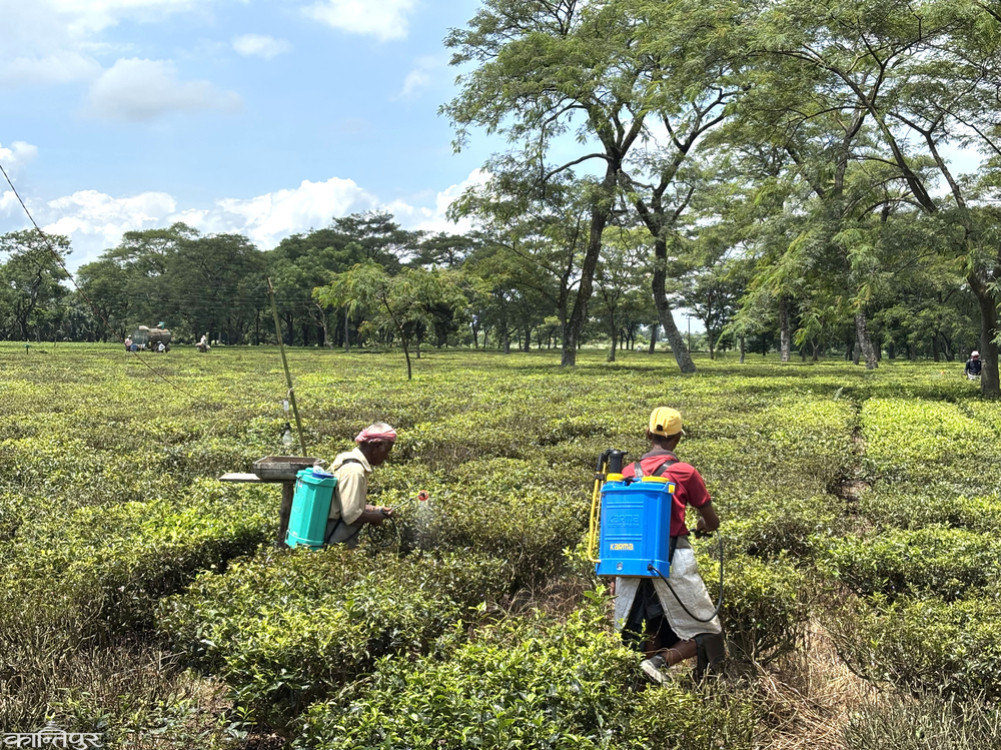
Thousands of tea farmers will be directly affected after the industry is closed due to Indian obstruction. According to the association, there are 2,995 tea farmers affiliated with Suryodaya Municipality alone. Tea is cultivated in an area of 33,655 ropanis of the municipality, from which about 20 million kg of green tea leaves are produced annually.
Meanwhile, Suryodaya Municipality has demanded a high-level diplomatic initiative with the Indian government through the Ministry of Foreign Affairs to immediately remove the Indian obstruction. The municipality has termed the latest move by the Indian Tea Board as a non-trade obstruction and warned that it will have a serious impact on the tea industry, farmers, workers and the overall economy.
According to the National Tea and Coffee Development Board, Nepal exports more than 7 million kg of orthodox tea annually, of which more than 90 percent is dependent on the Indian market. Nepal has been exporting prepared tea worth about Rs 4.25 billion annually.