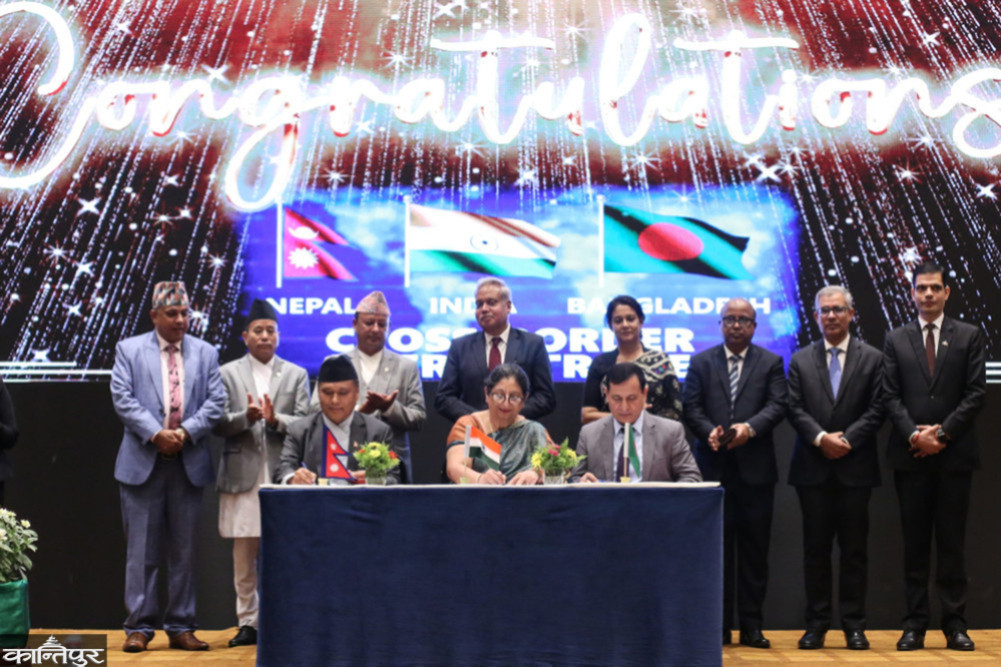
Only 40 megawatts of electricity will be sent to Bangladesh this time.
We use Google Cloud Translation Services. Google requires we provide the following disclaimer relating to use of this service:
This service may contain translations powered by Google. Google disclaims all warranties related to the translations, expressed or implied, including any warranties of accuracy, reliability, and any implied warranties of merchantability, fitness for a particular purpose, and noninfringement.
Nepal will sell only 40 megawatts of electricity to Bangladesh from June 15. If India does not give its approval, an additional 20 megawatts of electricity will not be exported to Bangladesh. Energy officials say that approval from India's Central Electricity Authority (CEA), a decision by the Nepal-India Energy Secretary-level Joint Steering Committee (JSC), and a revised or new tripartite agreement are required. The CEA has not given approval saying that the transmission line does not have capacity, and other processes have not been completed.
Nepal has been exporting electricity remaining after domestic consumption to India and Bangladesh during the rainy season. In the winter, electricity has to be imported from India to meet domestic demand. The Nepal-Bangladesh Energy Secretary-level Joint Steering Committee (JSC) meeting held in Dhaka on November 11, 2005 had agreed to export an additional 20 megawatts of electricity as per the current 40 megawatt agreement. There was also an understanding to proceed with the necessary procedures accordingly.
Nepal Electricity Authority has already sent a formal request to NTPC Vidyut Vyapar Nigam Limited India (NVVN) for an additional 20 megawatts of electricity. The director of the NEA's electricity trade department, Tharka Bahadur Thapa, said that a letter was sent stating that an additional 20 MW could not be exported as the capacity of the India-Bangladesh transmission line is 1,000 MW.
'This time, only 40 MW of electricity will be exported to Bangladesh. Unlike the previous 40 MW export, a tripartite agreement has not been made for an additional 20 MW, despite this, we had initiated the process through NVVN in India's CEA for an additional 20 MW export,' he said, 'but it was decided that the additional 20 MW would not be possible due to the capacity of the transmission line.'
The upcoming Energy Secretary-level Joint Steering Committee (JSC) and Joint Secretary-level Joint Working Group (JWG) meeting to be held in Nepal will also have to take the necessary decision on selling an additional 20 MW of electricity to Bangladesh. But the meeting has not been scheduled yet. Earlier, the Nepal-India JSC meeting had also decided to make a tripartite agreement for the export of 40 MW of electricity to Bangladesh.
The JSC meeting held on 20 Poush 2080 had given an in-principle agreement to enter into a tripartite agreement soon between the Authority, NVVN and Bangladesh Power Development Board (BPDB) to export 40 MW of electricity from Nepal to Bangladesh using India's transmission system as per India's Electricity Import-Export Directive.
On 16 Asoj 2081, a JSC meeting was held between Nepal and Bangladesh and an agreement was reached to enter into a tripartite agreement. The next day, on 17 Asoj 2081, a tripartite agreement was signed between Nepal Electricity Authority, BPDB of Bangladesh and NVVN of India. As per the same agreement, 40 MW of electricity is being exported every year from 15 June to 15 November 15. Now, the Nepal-India JSC will discuss and make necessary decisions for an additional 20 MW. A new tripartite agreement will be signed after the approval of India's CEA. The Authority has stated that the current 40 MW will be increased to 60 MW, while other arrangements will remain the same.
Nepal first exported electricity to Bangladesh for 12 hours on 30 Kartik 2081. Nepal's electricity reaches India through the Dhalkebar-Muzaffarpur 400 kV transmission line. From there, it is transported to Bangladesh through the Behrampur-Bhedamara 400 kV line. Currently, 40 MW of electricity approved for export is being generated by the Trishuli and Chilime hydropower projects. These projects have also received approval for export to India. Therefore, even after receiving approval, the projects will have to take separate permission from India for the 20 MW used for export to Bangladesh. Only then will the actual export begin.
Nepal has been selling electricity to Bangladesh at a rate of 6.40 US cents per unit. The NEA has said that an additional 20 MW will be sold at the same rate. So far, Nepal has received approval to export 1,165 MW of electricity to India and Bangladesh. Electricity is being sold at competitive rates in the 'day ahead' and 'real time market' of the Indian Energy Exchange (IX). Nepal is also selling electricity as per the mid-term agreement with NVVN.
Electricity trade with India is done in Indian rupees. With Bangladesh, transactions are being carried out in dollars. The Indian government had first allowed the import of 39 megawatts of electricity from Nepal in October 2021. So far, India has received permission to export about 1,200 megawatts of electricity.
In the 10 months of the current fiscal year, electricity worth 20 billion 995.2 million rupees has been exported to India and Bangladesh. In the 10 months of the last fiscal year, electricity worth 13 billion 103.3 million rupees was exported.