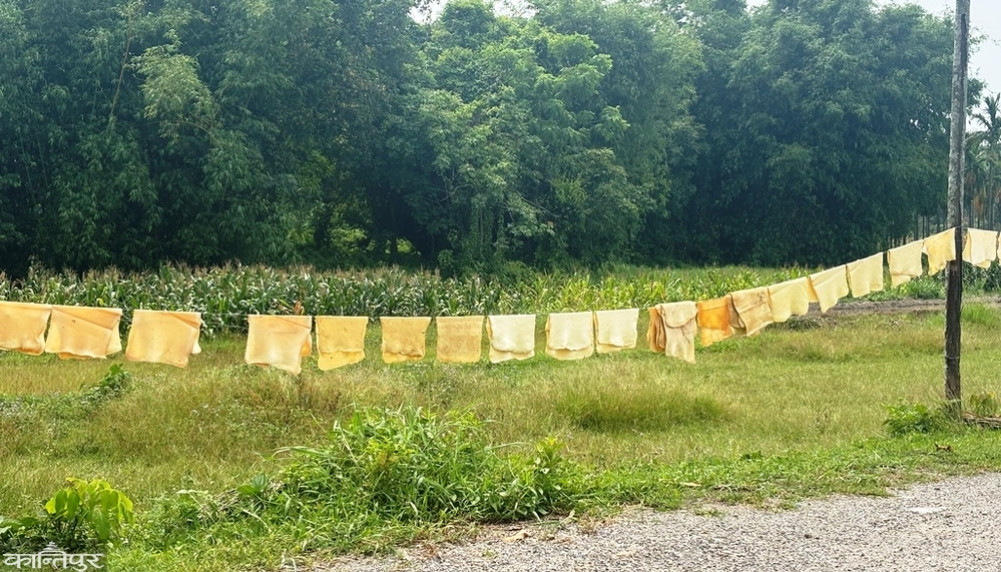
Farmers in Jhapa, who have been suffering from continuous losses in rice and corn, have started choosing rubber farming as an alternative.
We use Google Cloud Translation Services. Google requires we provide the following disclaimer relating to use of this service:
This service may contain translations powered by Google. Google disclaims all warranties related to the translations, expressed or implied, including any warranties of accuracy, reliability, and any implied warranties of merchantability, fitness for a particular purpose, and noninfringement.
Farmers in Jhapa are suffering from the terror of wild animals including elephants and monkeys. Farmers who have been continuously suffering from damage to traditional crops like rice and corn have recently started to be attracted towards rubber farming.
Farmers around the Adarsh Model Community Forest in Buddhashanti-3 have started choosing rubber farming as an alternative to avoid crop damage caused by wild animals. Local farmer Sitaram Bastola has been cultivating rubber for about 12 years after switching from rice and corn. He has been cultivating rubber on 10 kathas of land. ‘When I used to plant rice and corn, elephants and monkeys would not let me harvest my crops, so I started cultivating rubber,’ said Bastola. ‘Now I am earning between 35,000 and 40,000 rupees per month.’
According to him, the damage caused by wild animals in rubber farming is very low. Even if the animals come, they do not damage the rubber plants, which is a relief to the farmers.
Punya Prasad Khatiwada of the same village has also started rubber farming after abandoning paddy and maize. He said that he started rubber farming in 2069 BS. ‘Production started after seven years of planting rubber,’ Khatiwada said, ‘Now I am earning a good income by sitting at home.’
He has planted 150 rubber plants on about nine acres of land. Rubber produces for eight months a year. He said that about 15 liters of latex (latex) is produced from one plant in eight months. According to him, one kilogram of rubber is produced from two and a half liters of latex. ‘After winter sets in, the latex becomes thin,’ he said, ‘at that time, one kilogram of rubber is produced from only four kilograms of latex.’ The farmers have been selling the produced rubber for Rs 300 per kilogram.
According to Chandra Adhikari, president of the Small Farmers Natural Rubber Producers Association, traditional grain farming is facing crisis in some areas of Jhapa due to the increasing threat of wild animals. In such a situation, he said that rubber farming is becoming an effective alternative for farmers. ‘Especially in elephant-affected areas, rubber farming is reducing the risk of crop damage and also creating a regular income base,’ Adhikari said.
According to him, rubber farming is being done in an area of more than five hundred hectares in Jhapa, Morang, Sunsari, Udayapur and Ilam. In Jhapa alone, rubber farming has expanded to an area of about 130 hectares, including community forests. It has been cultivated in municipalities including Mechinagar, Buddhashanti, Arjundhara, Kankai, Kachankawal and Barhadashi, Damak.
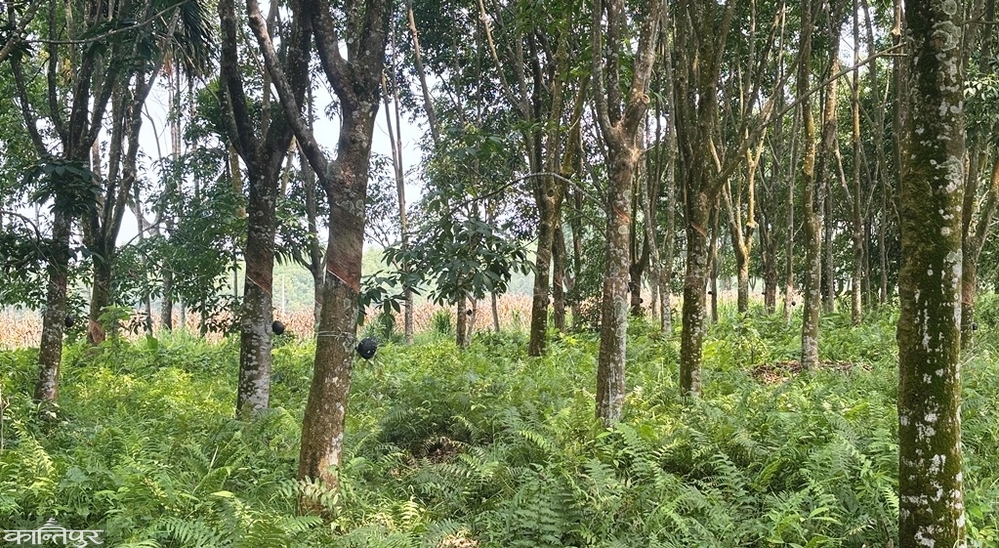
Rubber has been cultivated in more than 15 hectares of area in Adarsh Namuna Community Forest (Buddhashanti), Kalika Community Forest (Dhaijan) and Jamunkhadi Community Forest (Kanakai) alone.
According to the official, rubber cultivation has flourished especially in areas affected by wild animals. ‘Since wild animals cannot cause damage, its cultivation is expanding rapidly in the affected areas,’ he said.
Dilip Goswami, a businessman from Birtamod, has been purchasing the rubber produced by the farmers. The farmers say that there is no problem in the market as he goes to the farmers’ houses to collect the rubber. ‘At least the farmers do not have a problem in selling the produce,’ said Goswami, ‘We take it from home.’
According to Goswami, more than 1,050 liters of chop are produced in a season from Jhapa alone, from which more than 500 kg of rubber is prepared. He sells the rubber purchased from the farmers to various tire industries. ‘Arjundhara’s rubber is being purchased by Goldstar Shoe Industry,’ he said, ‘We send the rubber we collect to the tire industry in Chitwan and Rangeli, Morang.’
According to him, farmers in Jhapa have been earning more than Rs 50 million from rubber farming in a single season. He claims that if the farming area is expanded, the income can increase further. ‘Rubber farming has a lot of potential,’ he said, ‘If you do it with hard work, you can earn a good income sitting at home.’
According to the farmer, sandy soil is suitable for rubber farming. However, adequate irrigation and regular care are required. They have experience that if the land is kept moist, the production will be good. ‘Rubber gives good income, but it also requires hard work,’ said Chairman Adhikari, ‘It cannot be done lazily, continuous care is required to increase production.’
An organization called ‘Rubber Zone’, which is affiliated with farmers involved in rubber farming, is also active in Jhapa. The organization has been working to promote rubber farming. According to the organization’s chairman, Ishwori Pokharel, farmers’ attraction towards rubber farming is increasing, but there is not much government support. ‘Our goal is to re-operate industries like the closed Gorakhkali Tire Industry by producing sufficient rubber,’ said Pokharel, ‘but for that, state support is indispensable. The state can only provide encouragement.’