Implementation of the NRB directive requiring banks and financial institutions to make at least one branch in each municipality disabled-friendly and to provide ATMs with ramps, Braille signs, control buttons, and audio support.
We use Google Cloud Translation Services. Google requires we provide the following disclaimer relating to use of this service:
This service may contain translations powered by Google. Google disclaims all warranties related to the translations, expressed or implied, including any warranties of accuracy, reliability, and any implied warranties of merchantability, fitness for a particular purpose, and noninfringement.
Sita Gyawali, a teacher at Laboratory Secondary School in Kirtipur, was born completely blind. But she can read and write. She does not need any support in her work. She teaches confidently at school, uses a mobile phone, and uses digital materials. Self-reliant in everything, when she needs work at the bank, she starts looking for neighbors, friends, and relatives.
Because she is forced to wear a lapel pin and fill out forms to withdraw money from the bank. Stating that the obligation to take money to others while doing financial transactions does not ensure financial privacy, she said, "There is privacy in your account balance! You have to tell everyone how much money you have, how much you will withdraw, everything. This means that others will also know about my transactions."
Three months ago, she went to open an account at a bank and shared another bitter experience. She requested the bank staff to provide SMS facility to know how much money comes in and goes out of the account. The staff turned her away, saying that the account could be misused and the money could be lost. She said that even though she would be responsible if the bank account or money was misused, the employee refused.
After the verbal request was rejected, she went back to the bank last Baisakh with a written application. She got the SMS facility only a month after submitting the application. Complaining that she did not even get the SMS facility on time at the bank, she said, “Every account holder has the right to know about their transactions. The bank gave that too after three months.”
Although it is natural for the bank to impose a lock saying that they cannot sign from opening an account to making transactions, she says that today's blind people should be able to do mobile banking, SMS facilities and transactions themselves since they are educated and accustomed to technology. She says that she is capable of doing banking transactions. She says, “Today's blind people can do their own work. They should also be able to do the work of the bank themselves. They should not have to look for or tell others to withdraw and spend their earned money.”
Prajwal Subedi, who has a hearing disability, also has a similar experience. He said that when he reached the bank, there was a problem in communication because mobile banking was ‘locked’. He complained that there was no visual indication, signboard or screen to indicate which branch to go to. He tried to explain the problem to the employee, but the employee did not understand. The employee understood his problem only after showing the photo on his phone. He shared his experience through a WhatsApp message, saying, “It took a long time to explain to the employee that my mobile app was broken, there is no one who understands our language.” He said that he faced the same problem when he went to make a check. He works in the Finance Department of the National Federation of the Deaf and uses e-services, wallets and PhonePe. A graduate, he emails the bank when he has a problem, but does not get a response in time. The bank calls, but he cannot speak. Therefore, he has to take help from family and friends. He believes that it would be easier if banks provided services for the hearing impaired through SMS and email.
‘I wish the bank had made it easier for us through email and SMS,’ he said, ‘so that we can talk to the bank directly about loans, interest, fixed deposits and other banking services without the help of others. If there were options like sign language interpreters, we would not have to depend on others.’
Nepal Rastra Bank has recently amended the ‘Unified Directive, 2082’ and issued a directive to licensed banks and financial institutions to expand senior citizen and disability-friendly services in the simple banking system. According to the directive, banks will have to make special arrangements to provide banking services to the visually impaired, disabled and senior citizen service recipients easily. According to the directive, banks and financial institutions should make at least one branch at each local level disability-friendly and arrange ATM booths with ramps, Braille signs, control buttons and audio support in such branches.
Although the Rastra Bank has been issuing directives in the past to operate senior citizen and disability-friendly financial services, the recently revised directive has made a new provision to have Braille signs, control buttons and audio support to provide banking access to the visually impaired.
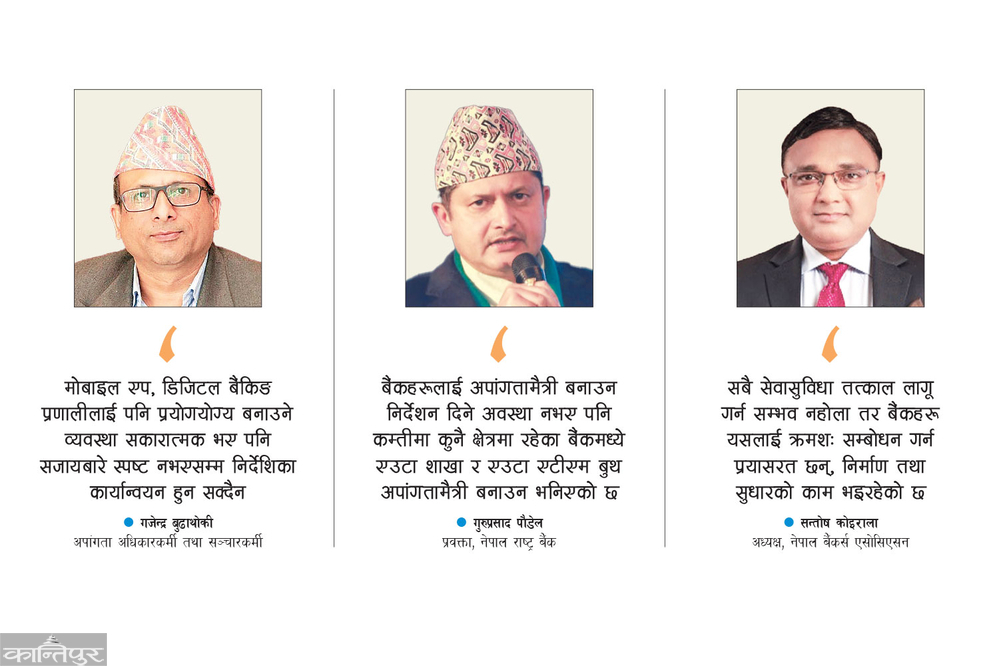
According to the National Census 2078, the population with disabilities is 2.2 percent. Despite the expansion of banking services, most bank buildings, ATM booths, digital services and service delivery systems have not yet become disability-friendly. The visually impaired, hearing impaired and wheelchair users have been complaining of facing various obstacles in accessing banking services. Rights activists have been saying that despite issuing directives repeatedly, they have not been implemented. Disability rights activist and media personality Gajendra Budhathoki said that the latest directive of the Nepal Rastra Bank is more a continuation of the old system than a new issue. He said that in the past, the visually impaired did not have access to banking and the current revised system targets the visually impaired as well. He said that since Kartik 2070, instructions have been given to set up disability-friendly counters to provide banking facilities by giving special priority to senior citizens and physically disabled (differently able) people.
According to the directive, the first disability-friendly counter was operated at the main office of Sunrise Bank in Naxal in 2074, but it is currently unused. He said that he has been sending KYC forms for all transactions through mobile banking through mail lately. ‘Even if I have to go to work, I can’t go to the bank, it’s on three floors, wheelchairs don’t go, how can I go and work?’ Budhathoki said, ‘Although the provision to make the mobile app and digital banking system usable is positive, the directive cannot be implemented unless there is a clear provision on what kind of punishment will be imposed if it is not implemented.’
Budhathoki said that even though the law and directive say ‘to do’, the implementation is not effective because there is no clear provision on what kind of punishment will be imposed if it is not done. ‘Just as banks are punished for not investing in the Poor Area Loan Directive, there should be a provision for action even if they do not implement disability-friendly services. Only then will such a directive be implemented,’ he said, ‘Banks have not shown interest in building disability-friendly structures by making the excuse that the building is rented. Accessible counters should be built in banks in coordination with the local level. There should be a separate counter for collecting taxes in the Land Revenue and Transport Offices, and a disability-friendly counter should also be mandatory.'
Nepal Rastra Bank spokesperson Guru Prasad Poudel claims that the policy is being worked on to expand simple and accessible banking services for people with disabilities. In the past, financial access was limited, so it was not possible to force banks to build disability-friendly infrastructure. Poudel said that there is no immediate direction to make banks disability-friendly and that at least one branch and one ATM in each of the banks in some areas have been instructed to make it disability-friendly. He said that since it is difficult to demolish old buildings and change their structures, disability-friendly structures have been included in newly constructed buildings and efforts are being made to expand access to banking technology.
Poudel says that a study is needed to determine how necessary the use of technology is, how much the target group can use it, and how practical the cost is. 'We also need to see how much demand there is, how capable the target group is of it, and what the cost will be. "We are preparing to move forward on this issue based on studies, consultations with banks and related bodies, and necessary opinions," he said.
Nepal Bankers Association President Santosh Koirala says that banks are gradually expanding disability-friendly services. Such services have already been launched in some banks, while construction and improvement work is underway in others. He said that special attention has been paid to creating a structure that allows wheelchair users to easily reach ATMs while constructing new buildings. "Banks have been providing disability-friendly services. Arrangements have been made to keep teller counters on the ground floor in new buildings so that they can receive services from wheelchairs," Koirala said. He said that discussions are also underway on new technologies and services targeted at the visually impaired. However, he said that it would be challenging to implement all these arrangements immediately. "It may not be possible to implement all the services immediately, but banks are trying to address it gradually," he said.

