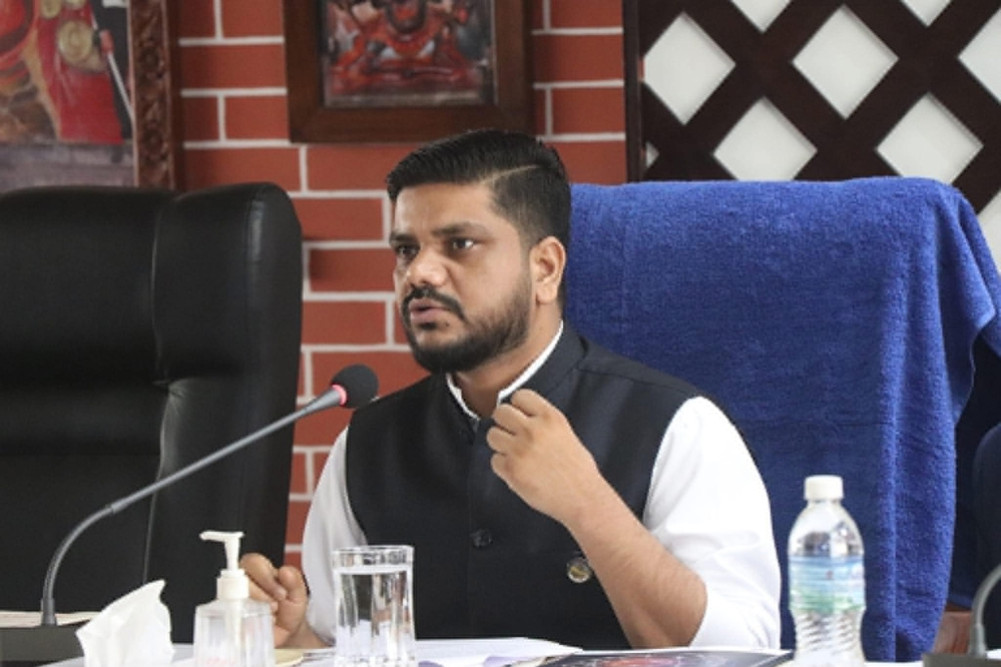
Labor Minister Ramji Yadav made a ministerial decision on Jestha 22 and formed a 7-member committee under the coordination of Pitambar Ghimire, Chief of the Foreign Employment Management Division.
We use Google Cloud Translation Services. Google requires we provide the following disclaimer relating to use of this service:
This service may contain translations powered by Google. Google disclaims all warranties related to the translations, expressed or implied, including any warranties of accuracy, reliability, and any implied warranties of merchantability, fitness for a particular purpose, and noninfringement.
The Ministry of Youth, Labor and Employment has formed a high-level task force to determine the service fees that can be charged from workers going for foreign employment. The task force has been given the responsibility to determine the service fees and make recommendations within five weeks.
Minister for Labor Ramji Yadav took a ministerial decision on Jestha 22 and formed a 7-member committee under the coordination of Pitambar Ghimire, Chief of the Foreign Employment Management Division. The committee members include representatives from the Office of the Prime Minister and Council of Ministers, Nepal Rastra Bank, Central Statistics Office, chartered accountants and immigration experts. The member secretary is the deputy secretary of the Foreign Employment Management Division.
The task force has been given the responsibility to determine the service fees based on the destination country and the nature of the workers, as well as the monthly income received. Minister for Youth, Labor and Employment Yadav said that he is ready to determine the fees after reviewing the policy of free visa and free ticket implemented for workers going for foreign employment.
‘The very word ‘free visa and free ticket’ is wrong. Instead, there should be decent recruitment. It should be zero. We must encourage zero cost. Even if only one rupee is spent when a person travels from a village to a foreign country, it is not decent recruitment,” he had said at a program organized at the Ministry of Labor on 19 Jestha, “We are ready to review the policy of free visa, free ticket. How much should we fix it? We should discuss how to fix it. We will fix it. It has to be reviewed scientifically. We will discuss it with all parties.” In his budget speech, Finance Minister Swarnim Wagle had announced that “by encouraging zero cost for going abroad, we will make the service fee worker-friendly.” He said that foreign employment would be made decent, transparent and automated by arranging unsecured loans and payment in installments from employers. The Ministry of Labor had adopted a policy on 26th Jyeshta, 2072, to charge a service fee of 10,000 rupees for sending workers to the Gulf and Malaysia. Saying this policy is impractical, foreign employment entrepreneurs have been demanding a review and determination of the actual cost fee. Before that, the service fee for Nepalis going to Malaysia and the Gulf was fixed at 70 thousand rupees.
‘On the day the state was announcing 10 thousand. On the same day, we were in protest in Tahachal (district). For 11 years, we have been saying that we cannot send for 10 thousand rupees. We have not sent for 10 thousand,’ said Chairman Hari Bahadur Pandey at a press conference organized by the Nepal Foreign Employment Entrepreneurs Unity Committee on Wednesday, 13 Jestha, ‘We are forced to collect more money. We have already collected it. There is no point in asking for a bribe or hiding a stone in this. The state should be told the truth. Seven overseas workers cannot be sent for 10,000 rupees.'
Businessmen have been demanding that the cost of workers going to Korea and Israel be determined through the government mechanism, just as the actual cost of workers going to Korea and Israel be determined. They are urging foreign employment businessmen not to be arrested without determining the service fee. 'Fix the service fee. We will not allow them to charge more than that. If they do, we will take responsibility for it,' he said.
Rohan Gurung, former president of the Nepal Foreign Employment Businessmen's Association, said that the 31-point agreement reached by the businessmen with the Ministry of Labor in 2072 should be implemented. 'The government's policy has not been able to make the foreign employment sector transparent. Currently, sending one worker alone costs 35,000. It was wrong to say that sending one worker for 10,000 was wrong,' said former president Gurung. 'It has only served to punish the business.' The government has a policy of cutting tickets when sending them. They are telling us to send them for 10,000. This has become a discriminatory policy.’